Imaginary interview with Michel Foucault
by Charactorium · Michel Foucault (1926 — 1984) · Philosophy · 5 min read
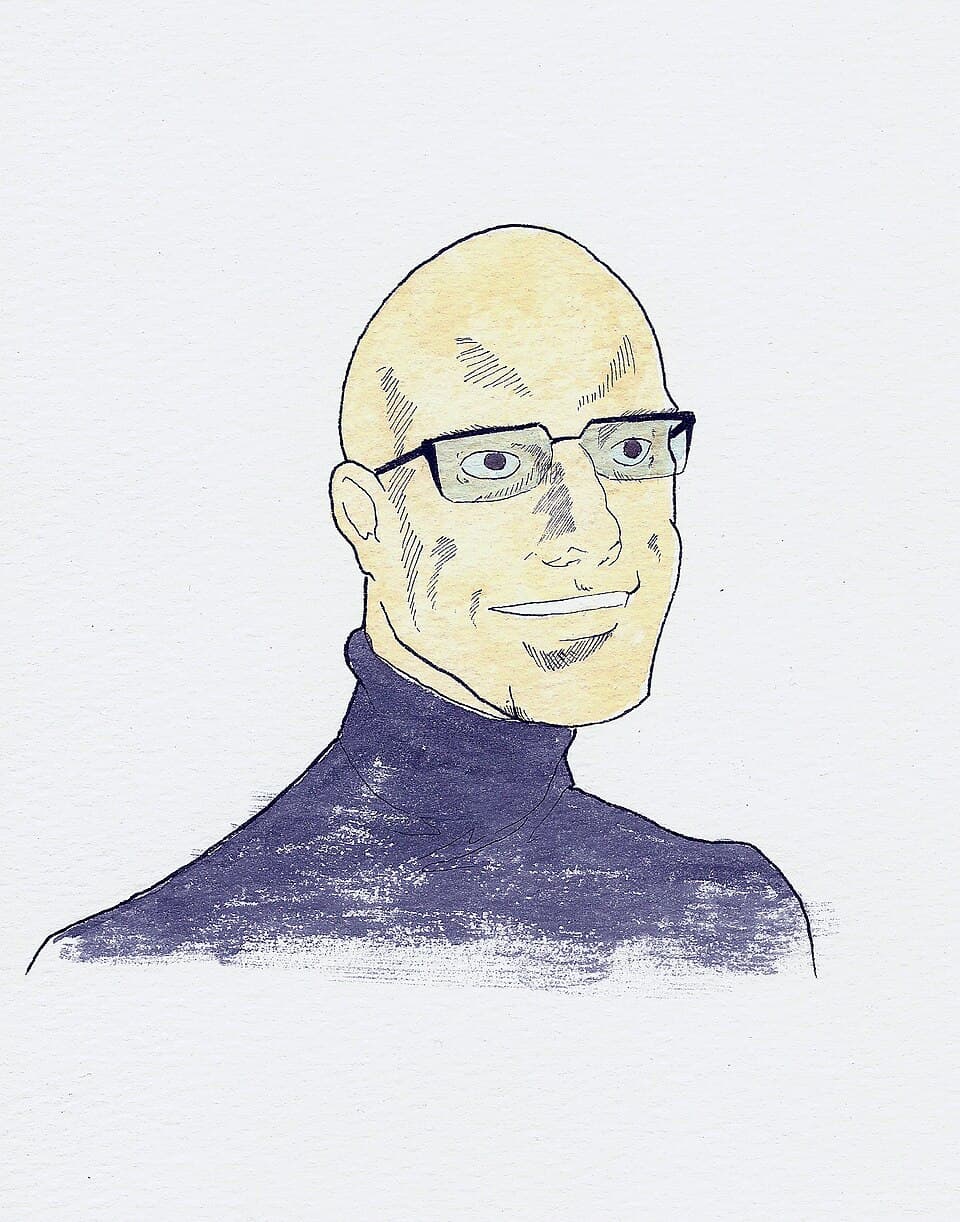
March 1979, late afternoon on Rue de Vaugirard. Bald head, round glasses resting on a pile of archival index cards, Michel Foucault tidies up the newspaper clippings scattered across his desk. He agrees to talk, on condition that no recording be made — thought, he says, is not something to be canned.
—How did you go from a classical education at the École Normale Supérieure to a thesis as unexpected as the one on madness?
When I entered the École Normale Supérieure in the late 1940s, I was destined for pure philosophy, the philosophy of smooth concepts. But Georges Canguilhem taught me one thing: you have to look at what a science excludes in order to understand what it affirms. So I went down into the archives, at the Bibliothèque nationale, and I pored over internment registers, court orders, hospital plans. It was there, in that dust of documents that no one read anymore, that Madness and Civilization took shape in 1961. I wanted to show how a society defines itself by designating those it locks up.
You have to look at what a society excludes in order to understand what it affirms.
—You describe madness as a figure that might one day disappear. What did you mean?
I wrote, on the last page of that thesis: “A day will come, perhaps, when we will no longer know well what madness could have been.” It is not a comforting prophecy; it is a warning. Madness is not an eternal, fixed thing, identical to itself through the centuries; it is a historical construction, a dividing line that each era redraws in its own way. In the classical age it is locked up with vagabonds and the poor; later it is entrusted to the doctor. My entire afternoons spent poring over internment registers served only that purpose: to make this shift visible, to show that the boundary between reason and unreason never stops moving.
—They say that in 1969, at Vincennes, you were seen on a roof. What happened that day?
I had just been appointed to the University of Vincennes, Paris VIII, that experimental institution straight out of May '68. Everything there was to be invented, and everything was contested. During an occupation, the police came to evict us, and I went up onto the roof of the building with the students. Yes, I threw paving stones. People are surprised that a philosopher in a turtleneck throws stones; I, on the other hand, would be surprised by a philosopher who never left his armchair. Thinking about power and feeling it on your body, under the blows, are not quite the same thing — and yet it is the same question.
People are surprised that a philosopher in a turtleneck throws stones; I would be surprised by a philosopher who never left his armchair.
—Did that physical engagement change the way you do philosophy?
Let's say it cured me of an illusion: that of a thought that overlooks things from a lectern. At Vincennes, in the uproar of 1969, I understood that power is not a mass held from above in one's hands. It circulates, it passes through bodies, through buildings, through the most minute regulations. When you are yourself in the thick of the fray, you stop believing that power resides only in a palace or in a law. You see it functioning everywhere, right down to the layout of a classroom or the timetable of a school.
—In 1971, you founded the Prisons Information Group with Gilles Deleuze. Why this field investigation?
Because people talked a lot about prisoners, but never let them speak. With Gilles Deleuze and a few others, we created the GIP not to demand nice reforms, but to give voice to those inside: to collect their letters, their questionnaires, their accounts of the cell. We did not want to plead on their behalf. An intellectual who speaks for the silent silences them a second time. The role of the GIP was to hold out a microphone, not to deliver a speech. And what those voices told was quite different from the official reports.
An intellectual who speaks for the silent silences them a second time.
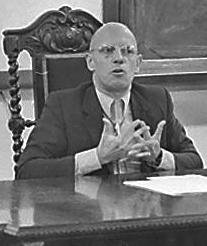
—You visited Attica prison in the United States. What did that visit teach you?
Attica, 1975. I went there after the uprising that had bloodied that prison four years earlier. They made me walk through those immense corridors, those metal blocks, that machinery designed to crush men with almost industrial efficiency. I came back with a certainty that Discipline and Punish, which I was finishing writing, only confirmed: prison corrects nothing, it rehabilitates no one. It produces delinquents that society uses, it manages illegalism rather than eliminating it. That visit did not inspire my book — it verified it, on the spot, in the concrete.
—Discipline and Punish opens with that strange architecture, the Panopticon. Why did this image strike you so much?
Jeremy Bentham's Panopticon is a marvel of simplicity: “at the periphery, a ring-shaped building; at the center, a tower; this tower is pierced with wide windows that open onto the inner face of the ring.” The inmate knows he may be observed at every moment, without ever being able to verify it. And that doubt is enough. He ends up watching over himself, he internalizes the guard. I kept the plan of this circular prison as one keeps the emblem of an era, because it is not just a prison: it is the diagram of the school, the hospital, the workshop. Panopticism is a whole society learning to stand under the gaze.
That doubt is enough: the inmate ends up watching over himself, he internalizes the guard.
—You speak of a disciplinary society. How does this power act on us, concretely?
It no longer acts through the scaffold and spectacular torture, as in the time of kings. It acts through normalization: it measures, classifies, grades, corrects. The student, the patient, the soldier, the worker are caught up in timetables, ranks, examinations that compare them to a norm. What exceeds is corrected; what is lacking is completed. The disciplinary apparatus does not say “obey or die,” it says “become conforming.” It is a much more economical, much more patient power, which does not break bodies but trains them, as one trains a handwriting until it becomes regular.
—Your lectures at the Collège de France overflow into the corridors. Why do you refuse to have them recorded?
Since my election to the chair of History of Systems of Thought in 1970, I give these public lessons every winter, between January and March, where you have to arrive an hour early to find a seat. Hundreds of people pack in, some stand in the corridor, behind the microphone at the Collège de France. But a thought that is still searching is not a commodity to be boxed. When I speak, I advance, I correct myself, I doubt out loud; it is an experience lived in the moment. Fixing that on tape would be turning a living work into a relic. I prefer that it be a little forgotten than to see it embalmed.
A thought that is still searching is not a commodity to be boxed.
—In these lectures, you forge notions like biopolitics. What do you mean by that?
It was in these lessons and in the first volume of The History of Sexuality, in 1976, that I developed the idea of biopower. Modern power is no longer content to discipline bodies one by one: it takes charge of life itself, at the scale of entire populations. It concerns itself with births, mortality, hygiene, public health, sexuality — for “for a long time, it was argued that modernity had transformed sex into discourse.” To govern, henceforth, is no longer only to make obey; it is to manage life, to make it grow, to measure it. This is what I call governmentality.
—Ultimately, what remains of man in all this? You wrote a famous sentence about his disappearance.
In The Order of Things, in 1966 — that book whose success surprised even me — I dared to write that “man is an invention whose recent date the archaeology of our thought easily shows. And perhaps its imminent end.” Outrage was cried, they thought I was killing humanity. But I am not talking about the species: I am talking about a figure of knowledge, “man” as the central object and subject of the sciences, born barely two centuries ago. What one episteme has brought forth, another can undo. Recognizing this is not to despair; it is to reopen the field of what we might become.
What one episteme has brought forth, another can undo.

This imaginary interview was generated by artificial intelligence from sources documented in Michel Foucault's profile. It dramatises what the figure might have said based on what we know about them, but does not constitute attested historical testimony. For primary sources and factual documentation, refer to the full profile.