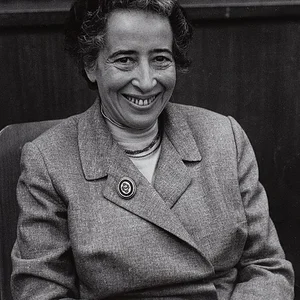

German-born American philosopher (1906–1975), Hannah Arendt is one of the most influential thinkers of the 20th century. A refugee in the United States after fleeing Nazism, she developed a critical analysis of totalitarianism, political violence, and the human condition in the modern world.
Hannah Arendt(1906 — 1975)
Hannah Arendt
États-Unis, Prusse, apatride
7 min read
Frequently asked questions
Famous Quotes
« The banality of evil»
« Action is the only activity that puts men directly in touch with one another without the intermediary of things»
« No one can be free if he is not assured of his security»
Key Facts
- 1933: Flight from Germany following Hitler's rise to power; stateless status
- 1951: Publication of The Origins of Totalitarianism, the first major analysis of modern totalitarianism
- 1961: Coverage of Adolf Eichmann's trial in Jerusalem; development of the theory of the 'banality of evil'
- 1963: Publication of Eichmann in Jerusalem, a foundational work on individual responsibility and mass crimes
- 1958: Publication of The Human Condition, a reflection on action, work, and labor
Works & Achievements
A monumental work analyzing the rise of Nazism and Stalinism as unprecedented forms of total political domination. This book laid the foundations of contemporary political philosophy on totalitarianism.
Arendt distinguishes three forms of human activity: labor, work, and political action. This major essay renews reflection on freedom and public life.
An account of Adolf Eichmann's trial and an analysis of evil as the absence of critical thought. The phrase 'banality of evil' coined here remains one of the most quoted of the 20th century.
A collection of essays on politics, art, truth, and modernity. Arendt defends a demanding conception of culture as a space of shared judgment.
An essay written in response to the revelations of the Pentagon Papers, analyzing the mechanisms of state deception and its corrosive effects on democracy.
An unfinished work published after Arendt's death, devoted to the mental activities of thinking, willing, and judging. It constitutes the philosophical testament of her thought.
Anecdotes
In 1933, Hannah Arendt was arrested by the Gestapo in Berlin for documenting Nazi antisemitic propaganda. Released after eight days of interrogation, she fled clandestinely to Paris, crossing the mountains on foot. This episode convinced her that intellectual resistance was no longer enough: political action was necessary.
During the Eichmann trial in Jerusalem in 1961, Hannah Arendt attended the hearings for The New Yorker. She was struck by the banality of the man: Adolf Eichmann was not a monster, but a zealous bureaucrat incapable of thinking for himself. She then coined the phrase 'the banality of evil', which sparked an immense controversy in the intellectual world and within Jewish communities.
Hannah Arendt maintained a deep and sometimes turbulent friendship with the philosopher Karl Jaspers, with whom she corresponded for decades. Their letters, published after their deaths, reveal a thought in permanent construction and a touching mutual affection, despite their disagreements on the Jewish question and on post-war Germany.
When Hannah Arendt received the Sonning Prize in Denmark in 1975, a few months before her death, she delivered a remarkable speech on culture and politics. She died in December 1975, in New York, in the middle of an evening gathering with friends, her typewriter still open on her desk with the last page of an unfinished essay.
Primary Sources
Totalitarianism seeks not the despotic domination of men, but a system in which men are superfluous. Total power can only be obtained and maintained in a world of conditioned reflexes.
The lesson that this long study of human wickedness had taught us – the lesson of the fearsome, word-and-thought-defying banality of evil – was indeed shattering.
The public space, as it appeared in the Greek city-state, is the space of freedom, the place where men appear to one another as men and not merely as members of the species.
You are quite right, I am not moved by love of the kind of love I feel for the Jewish people. I feel Jewish and nothing else interests me as much as the Jewish question.
Key Places
City where the Arendt family lived during Hannah's childhood. She received her first education there in a liberal Jewish environment steeped in German culture.
University where Arendt studied philosophy under Martin Heidegger. This place was decisive for her intellectual formation and marked the beginning of a complex relationship with her mentor.
Arendt's refuge city between 1933 and 1941, where she worked for Jewish organizations and moved in exile intellectual circles. The Nazi occupation forced her to flee once again.
Internment camp in the Pyrénées-Atlantiques where Arendt was detained in 1940 as an 'enemy alien'. Her escape eventually allowed her to reach the United States.
City where Arendt settled in 1941 and lived until her death. She wrote her major works there and taught, making New York the center of her American intellectual life.
Arendt attended the Eichmann trial here in 1961 on behalf of The New Yorker. This experience formed the basis of her celebrated analysis of the 'banality of evil' and sparked an international controversy.
Typical Objects

Arendt typed all her manuscripts and correspondence herself. Her Olivetti typewriter sat on her desk until her death in 1975, a symbol of her uninterrupted intellectual work.

A heavy smoker, Arendt was rarely photographed without a cigarette. This emblematic attribute accompanied her long sessions of reflection and writing.
📷 Domaine public · Wikimedia Commons ↗
Arendt kept personal notebooks — her Denktagebuch (thought diary) — in which she recorded her reflections throughout the 1950s–1970s.

Like many Jewish exiles fleeing Nazism, Arendt crossed Europe with a suitcase containing her only possessions, a concrete symbol of the stateless condition she would later analyze in her work.

Arendt was an assiduous reader of the ancient Greek philosophers, particularly Aristotle, whose concepts of bios politikos and public space profoundly influenced her thought.

For many years, Arendt held no nationality and had to travel with refugee documents — a founding experience behind her reflection on the rights of stateless people.
School Curriculum
Vocabulary & Tags
Key Vocabulary
Tags
Concept
Daily Life
Morning
Hannah Arendt was a late riser, accustomed to long evenings with friends and late-night discussions. She would begin her day with a strong coffee and the reading of newspapers — often several, in English and German — to stay connected to world political affairs.
Afternoon
The afternoon was devoted to writing and reflection. Seated at her desk in front of her typewriter, cigarette in hand, she could work for several hours without interruption on her essays and lectures. She also taught at the university, where her seminars were renowned for their rigor and liveliness.
Evening
Arendt's evenings were often moments of intense conviviality. She enjoyed hosting intellectual friends — philosophers, writers, journalists — for passionate discussions over a simple meal. These exchanges directly nourished her thinking.
Food
Arendt appreciated European cuisine, particularly the German and French dishes of her years in exile. She was a generous hostess and enjoyed cooking for her friends, perpetuating the culinary traditions of her childhood and her Parisian years.
Clothing
Hannah Arendt had a sober and elegant style, typical of European intellectual women of her generation. She wore dark suits and simple, well-tailored dresses, refusing ostentation without neglecting her appearance. Her attire reflected her intellectual rigor and dignity.
Housing
In New York, Arendt lived in an apartment on the Upper West Side of Manhattan with her husband Heinrich Blücher. The apartment, filled with books and manuscripts, reflected the couple's intense intellectual life. It was a gathering place for European émigrés and New York intellectuals.
Historical Timeline
Period Vocabulary
Visual Style
L'univers visuel d'Arendt convoque l'esthétique noir et blanc de la photographie documentaire des années 1950-60, entre intérieur d'intellectuelle new-yorkaise et atmosphère de l'exil européen.
Sound Ambience
L'univers sonore d'Arendt mêle le crépitement de la machine à écrire dans son appartement new-yorkais, le brouhaha de la ville américaine et les échos de l'Europe intellectuelle de l'exil.
Liens externes & ressources
Références
Œuvres
Les Origines du totalitarisme
1951
La Condition de l'homme moderne (Vita Activa)
1958
Eichmann à Jérusalem – Rapport sur la banalité du mal
1963
La Crise de la culture
1972
Du mensonge en politique
1972
La Vie de l'esprit
1978 (posthume)