Imaginary interview with Natalia Ginzburg
by Charactorium · Natalia Ginzburg (1916 — 1991) · Literature · 6 min read
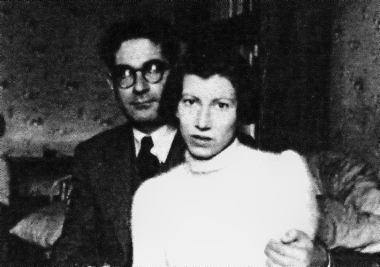
Rome, an autumn afternoon. In an apartment in the historic center where books rise to the ceiling and an old typewriter sleeps under a cover, a woman in dark clothes receives without ceremony, between two annotated galley proofs. She speaks softly, chooses her words as one chooses what to keep from a house one is leaving.
—Do you remember the moment you began writing your first novel?
It was in Pizzoli, a village clinging to the mountains of Abruzzo, where the regime had confined us — what was called the confino. The winter was harsher than any I had known: the cold came in through the walls, my coat never left me even indoors. I had three small children, snow for a horizon, and that strange freedom exile gives when nothing more happens. It was there, almost out of idleness, that I wrote La strada che va in città, the story of a provincial girl who dreams of the city. I believe the spareness of my language was born from that silence, from the cold, from the absence of all ornament around us. One writes short when life has become scarce.
One writes short when life has become scarce.
—Why was that first book published under the name Alessandra Tornimparte?
Because in 1938 Italy had enacted its leggi razziali, those racial laws copied from Nuremberg, which forbade Jews from teaching, publishing, existing publicly. I was a Levi; my name was now an impediment. So I borrowed that of Alessandra Tornimparte, from a nearby village, so that the book could appear in 1942 without the censors seeing a forbidden hand. It was humiliating and necessary. Signing with a false name meant accepting that I was half-erased so that the page itself might survive. I often thought later that my entire work began with that small imposed lie — as if writing, for me, had first meant outwitting prohibition.
—How would you describe the man you married in 1938?
Leone Ginzburg was one of those intellectuals whose life and convictions were one. We married in 1938, the very year of the racial laws, and he was already a co-founder of the publishing house Einaudi in Turin, that hearth of cultural resistance to fascism. He had a rectitude that never compromised: he had refused to swear allegiance to the regime, and that cost him his university chair. We had three children in a country that was closing like a trap. Living with him meant living in a permanent demand, a little austere sometimes, but luminous. I did not yet know that this life would be so brief.
—What happened to Leone in Rome, in 1943 and 1944?
After the armistice of September 1943, he went secretly to Rome to direct Italia Libera, the newspaper of the Resistenza. He lived hidden, changed addresses; we all knew it could not last. The Gestapo arrested him in November and imprisoned him at Regina Coeli. He was tortured there. He died on February 5, 1944; he was thirty-five, and I was twenty-seven, widowed with three children and the war still around us. I never wrote directly about that death — I think I could not have. But it is there, in each of my books, like a watermark, like an underground stream. One does not recover from such a thing; one only learns to write over it.
I never wrote directly about that death; it is there, like a watermark, like an underground stream.
—Where did you get the idea to write a book entirely built on your family's expressions?
From memory, quite simply. My Turin family had its own words, its formulas repeated a thousand times by my father, its jokes, its ritual reproaches — a language that only we understood. In writing Lessico famigliare, I realized that finding those phrases was enough to bring back a whole world: the faces, the angers, the meals, the dead. As I wrote, le parole e le frasi della nostra famiglia... erano come una carta geografica della nostra vita. Those who did not know them understood nothing of us. Those formulas were our secret map, the tangible proof that we had lived together. I had been noting all this in my notebooks for years, without knowing that I was already writing the book.
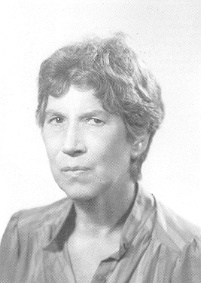
—What does the Strega Prize, which you received in 1963 for that book, represent to you?
The Premio Strega, in 1963, was a recognition I did not expect, because Lessico famigliare was the most intimate of my books — almost a dictation of memory. It wrote itself quickly, almost of its own accord, as if I had only to listen to the past. What touched me was that readers who had never known my Turin family, nor my father, nor our winters, nonetheless recognized themselves in it. Everyone has their own family lexicon, their tribal words. I had always believed that affective memory — that of habits, of loved ones — counted for more than great official History. This prize confirmed that by descending to the most particular, one sometimes touches the most universal.
Everyone has their own family lexicon, their tribal words.
—You worked for a long time as an editor at Einaudi. What did that profession consist of for you?
After the Liberation, I settled in Rome and joined the publishing house Einaudi as an editor — the house that Leone had helped found, and where his absence followed me. My afternoons were spent reading manuscripts, correcting galley proofs, writing to authors. I had in my hands the pages of Cesare Pavese, to whom I was close, and those of the young Italo Calvino. Correcting another's text is an art of self-effacement: you must hear their voice, not superimpose your own. This dual profession suited me well, really — in the morning I wrote my own books, in the afternoon I served those of others. Postwar Italian literature was built that way, around a few tables cluttered with annotated proofs.
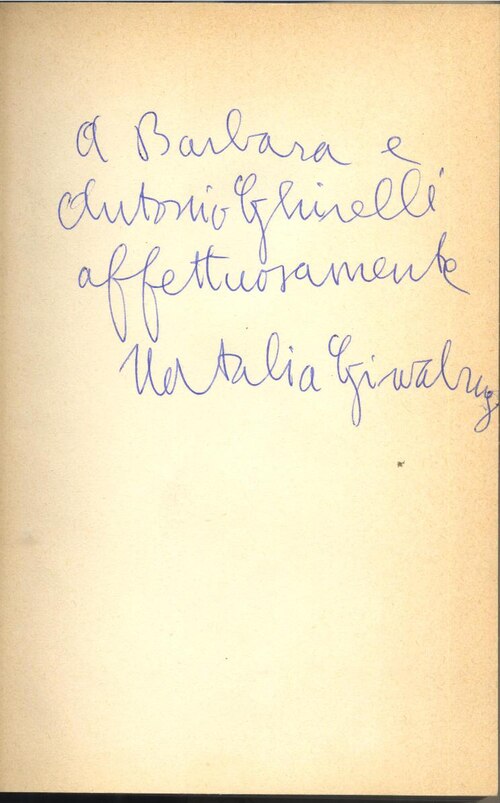
—What did this editorial work bring to your own writing?
Discipline, and humility. Spending my afternoons bent over others' galley proofs taught me every day what a single extra word can ruin. One sees others' flaws more clearly than one's own: by constantly hunting for bombast in Pavese or excessive invention elsewhere, I became merciless toward my own sentences. The Einaudi milieu also extended the prewar antifascist circles of Turin; evenings were filled with writers, political debates, arguments over an adjective. This ongoing conversation was my true school. I believe I never learned anything alone; everything came to me from books that passed from hand to hand, corrected, discussed, loved. The editor and the writer in me never parted.
—You once said you don't know how to invent. What did you mean by that?
Exactly what I confided one day to La Stampa: Non so inventare. So soltanto ricordare. I can't invent, I can only remember. I have always written about what I knew — my family, the houses I lived in, the people I loved. When I try to build a plot from scratch, a story of characters out of nowhere, it rings false to my ear, and I stop. My material is lived experience; my method is listening to the past. Even in a novel like Le voci della sera, everything starts from a real observation, a voice heard, a gesture seen. I am not a novelist of imagination. I am a guardian of memory who happens to write sentences.
I can't invent, I can only remember.
—In your essays, you distinguish between small and great virtues. What do you mean to pass on to your children?
I gathered these reflections in Le piccole virtù, in 1962. There I argue that we should not teach children the small virtues, but the great ones: non il risparmio, ma la generosità, not thrift but generosity; not prudence, but courage and contempt for danger. We postwar parents had seen where the prudence of cowards leads — how far one can remain silent out of caution. After what Leone paid with his life, I could not raise my children in the cult of security and calculation. For me, education means transmitting the ability to spend one's life without counting, as he did. The rest — economy, circumspection — is learned on its own, alas, and all too quickly.
I could not raise my children in the cult of security and calculation.
This imaginary interview was generated by artificial intelligence from sources documented in Natalia Ginzburg's profile. It dramatises what the figure might have said based on what we know about them, but does not constitute attested historical testimony. For primary sources and factual documentation, refer to the full profile.