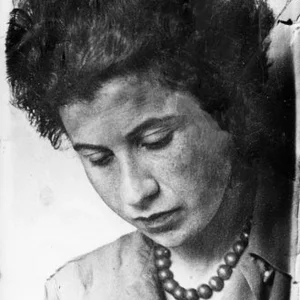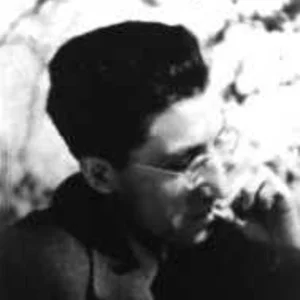

Cesare Pavese was an Italian writer, poet, and translator, a major figure in 20th-century literature. Author of novels and poems marked by solitude and fate, he was also a great translator of American literature. He took his own life in 1950, shortly after receiving the Strega Prize.
Cesare Pavese(1908 — 1950)
Cesare Pavese
Italie, royaume d'Italie
6 min read
Frequently asked questions
Famous Quotes
« We do not remember days, we remember moments.»
Key Facts
- Born in 1908 in Santo Stefano Belbo, Piedmont
- Published his poetry collection *Lavorare stanca* (Work Wearies) in 1936
- Confined (confino) to Calabria in 1935 for his antifascist ties
- Contributor and translator for the Einaudi publishing house, introducing Melville, Whitman, and American literature to Italy
- Received the Strega Prize in 1950 for *The Moon and the Bonfires* (La luna e i falò), then committed suicide in Turin later that year
Works & Achievements
His pioneering translation introduced great American literature to the Italian public.
First collection of poems, blending the peasant world and urban solitude in a new style.
His first novel, rooted in the Piedmontese countryside.
Collection of dialogues inspired by Greek myths, one of his most personal works.
Novel about a man facing war and the Resistance, marked by doubt and guilt.
Three stories that won him the Strega Prize in 1950.
His last novel, considered his masterpiece, about returning to his native village in the Langhe.
Diary published after his death, now a classic of literature.
Anecdotes
In 1932, Cesare Pavese translated Herman Melville's gigantic novel *Moby-Dick* into Italian. At just 24 years old, he introduced Italian readers to then-unknown American literature, and his work as a translator influenced an entire generation of writers.
In 1935, Pavese was arrested by the fascist police and sent to "confino" (internal exile) in Brancaleone Calabro, a poor village in southern Italy. He had been caught with compromising letters belonging to a communist activist friend; thus he was punished for a commitment that was not entirely his own.
Pavese spent almost his entire life in Turin and the hills of the Langhe, his native region in Piedmont. These hills, their vineyards, and their villages recur constantly in his novels, like a landscape both beloved and laden with painful memories.
In 1950, Pavese received the Strega Prize, Italy's most prestigious literary award, for *The Beautiful Summer*. Just a few weeks later, at the height of his fame, he took his own life in a hotel room in Turin, leaving behind a diary that became famous.
For years, Pavese kept a secret diary, which he titled *The Business of Living*. Published after his death, this notebook where he recorded his ideas, doubts, and sorrows became one of the most widely read writer's diaries of the 20th century.
Primary Sources
All of this is horrifying. Not words. A gesture. I will write no more.
Death will come and will have your eyes — this death that accompanies us from morning to evening, unsleeping, deaf, like an old remorse or an absurd vice.
There is a reason why I came back to this village, here rather than to Canelli, to Barbaresco or to Alba. It is almost certain that I was not born here.
Working is tiring. The poet mixes the daily life of peasants and workers with the solitude of city men.
Key Places
Pavese's birthplace, nestled in the wine-growing hills of Piedmont, a central setting in several of his novels.
The city where Pavese studied, worked at Einaudi, and spent most of his life; he died there in 1950.
Where he defended his 1930 thesis on American poet Walt Whitman.
Village in Calabria where Pavese was sent into internal exile ("confino") by the fascist regime in 1935–1936.
Typical Objects

The daily work tool of the writer and editor, on which Pavese typed novels, translations, and articles.

The notebook where he jotted down thoughts, doubts, and reflections on life and writing, published posthumously under the title "Il mestiere di vivere".

Pavese, a heavy smoker, is often depicted with a pipe in his mouth, in cafés or hunched over his manuscripts.

The American books he translated with passion, bringing Melville, Faulkner, or Dos Passos into Italian literature.

The texts he read and corrected as literary director at the Turin publisher Einaudi.

Indispensable for his work as a translator from English and American.
School Curriculum
Vocabulary & Tags
Key Vocabulary
Tags
Daily Life
Morning
Pavese rose early and often walked through the streets of Turin before heading to the offices of the Einaudi publishing house. He enjoyed the morning calm for reflection and reading.
Afternoon
The afternoon was divided between his work as an editor — reading manuscripts, advising, correcting — and his own writings: poems, novels, and translations from English.
Evening
In the evening, he met writer friends in Turin's cafés, discussing literature and politics, or went home to write alone, jotting down his thoughts in his private diary.
Food
His cuisine was that of Piedmont: pasta, polenta, vegetables, local cheeses, and wine from the Langhe. In the city, he would gladly have a strong espresso in Turin's bars.
Clothing
Pavese wore the sober clothes of an urban intellectual of his time: suit, shirt and tie, coat and scarf in winter, often with a pipe in hand.
Housing
He lived in apartments in Turin, surrounded by books and manuscripts, while remaining attached to the family home and the hills of his native village of Santo Stefano Belbo.
Historical Timeline
Period Vocabulary
Visual Style
Une ambiance mélancolique et automnale entre les collines viticoles des Langhe et le Turin brumeux des années 1930-40, dans l'esprit du néoréalisme italien.
Sound Ambience
Le cliquetis d'une machine à écrire dans un bureau turinois, mêlé aux cloches et aux cafés de la ville, et au vent dans les vignes des collines des Langhe.
Liens externes & ressources
Références
Œuvres
Traduction de Moby Dick (Herman Melville)
1932
Lavorare stanca (Travailler fatigue)
1936
Paesi tuoi
1941
Dialoghi con Leucò (Dialogues avec Leucò)
1947
La casa in collina (La maison sur la colline)
1948
La bella estate
1949
La luna e i falò (La lune et les feux)
1950