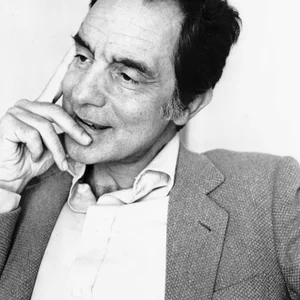

Italo Calvino (1923-1985) is one of the major Italian writers of the 20th century. Author of fantastical and combinatorial tales such as “The Baron in the Trees” and “Invisible Cities”, he blended fable, science, and literary play with boundless imagination.
Italo Calvino(1923 — 1985)
Italo Calvino
Italie, royaume d'Italie
6 min read
Frequently asked questions
Famous Quotes
« A classic is a book that has never finished saying what it has to say.»
Key Facts
- Born in 1923 in Santiago de Las Vegas (Cuba) to Italian parents, he grew up in Sanremo, Italy
- Took part in the Italian Resistance against fascism during World War II (1943–1945)
- Published “The Path to the Spiders’ Nests” in 1947, a novel inspired by his experience as a partisan
- Wrote the trilogy “Our Ancestors” (1952–1959), which includes “The Baron in the Trees”
- Published “Invisible Cities” (1972) and “If on a winter’s night a traveler” (1979); died in 1985 in Siena
Works & Achievements
First novel, inspired by his experience as a partisan; it tells the Resistance through the eyes of a child.
Vast collection of two hundred folktales gathered throughout Italy and rewritten by Calvino, now a classic.
Philosophical tale from the trilogy *Our Ancestors*: a young nobleman decides to live his entire life in the trees.
Collection of stories that transform scientific theories about the universe into fantastic and poetic tales.
Marco Polo describes fifty-five imaginary cities to Kublai Khan; masterpiece on the city, memory, and desire.
Novel that makes the reader itself the hero and intertwines the beginnings of ten interrupted novels.
Posthumous lectures where Calvino defines the literary values to pass on: lightness, quickness, exactitude, visibility, multiplicity.
Anecdotes
Italo Calvino was born in 1923 in Santiago de las Vegas, near Havana, where his parents, both agronomists, ran an agricultural experiment station. The family returned to Italy when he was two, and Calvino grew up in San Remo, Liguria, which he always considered his true hometown. His parents gave him the name "Italo" so they would not forget their native country.
At age twenty, in 1944, Calvino joined the Garibaldi partisan brigades in the Ligurian mountains to fight fascism and the German occupation. His parents were held hostage by the Germans for a time. This experience gave rise to his first novel, *The Path to the Nest of Spiders*, published in 1947.
In the mid-1950s, the publisher Einaudi entrusted Calvino with an immense mission: to do for Italy what the Brothers Grimm had done for Germany. For two years, he collected and rewrote two hundred folktales from all regions and dialects of Italy. The collection *Italian Folktales* was published in 1956 and became a classic.
Settled in Paris, Calvino joined the Oulipo, the group of writers like Raymond Queneau and Georges Perec who created texts based on rules and mathematical games. For *The Castle of Crossed Destinies*, he imagined mute characters who tell their stories by arranging tarot cards on a table.
In 1985, Calvino was preparing a series of lectures for Harvard University. He had written five—on lightness, quickness, exactitude, visibility, and multiplicity—when he died of a cerebral hemorrhage in Siena, leaving the sixth unfinished. These texts were published under the title *Six Memos for the Next Millennium*.
Primary Sources
It was on the 15th of June 1767 that Cosimo Piovasco di Rondò, my brother, sat down among us for the last time.
The inferno of the living is not something that will be; if there is one, it is what is already here, the inferno that we inhabit every day, that we form by being together. […] seek and learn to recognize who and what, in the midst of the inferno, are not inferno, then make them endure, give them space.
You are about to begin reading Italo Calvino's new novel, *If on a winter's night a traveler*. Relax. Concentrate. Dispel every other thought.
I have tried to remove weight, sometimes from human figures, sometimes from celestial bodies, sometimes from cities; above all, I have tried to remove weight from the structure of the story and from language.
Key Places
Town near Havana where Calvino was born in 1923; his parents ran an agronomic station there.
Coastal town where Calvino grew up, surrounded by his father's botanical garden; he always considered it his true homeland.
City where Calvino worked for many years as a literary advisor for Einaudi publishing house.
Calvino lived there from 1967 to 1980 and frequented the Oulipo group of Raymond Queneau and Georges Perec.
City where Calvino died in 1985 of a cerebral hemorrhage while preparing his Six Memos for the Next Millennium.
Seaside village where Calvino spent his summers and where he is buried.
Typical Objects

Calvino tirelessly composed and revised his texts on the typewriter, in search of the "lightness" and precision he sought in every sentence.

For *The Castle of Crossed Destinies*, he uses a tarot deck as a storytelling machine: the order of the cards laid on the table generates the characters' narratives.

For his *Italian Folktales*, he gathered hundreds of stories transcribed in regional dialects, which he translated and rewrote in Italian.

For decades, Calvino was a literary advisor at the Turin publisher Einaudi, reading manuscripts and shaping the catalog.

*Invisible Cities* describes fantastic cities that Marco Polo recounts to Emperor Kublai Khan; each resembles the plan of an impossible place.

In *Palomar*, the hero scrutinizes the world—a wave, a star, a lawn—with meticulous attention, like the astronomer at the Mount Palomar telescope whose name he bears.
School Curriculum
Vocabulary & Tags
Key Vocabulary
Daily Life
Morning
Calvino, a methodical and reserved writer, often devoted his mornings to writing, reworking each sentence with careful slowness. Silence and concentration were essential for him to make progress.
Afternoon
Afternoons could be occupied by his work as an editor at Einaudi: reading manuscripts, corresponding with authors, choosing books to publish. In Paris, he also attended Oulipo meetings and libraries.
Evening
In the evening, Calvino read a lot — science, classics, tales — and discussed literature with other writers and intellectuals. A discreet man, he preferred select conversations to social events.
Food
His cuisine was that of Italy and his native Liguria: pasta with Genoese pesto, focaccia, garden vegetables, Mediterranean fish, olive oil, all accompanied by wine. A simple table fragrant with herbs.
Clothing
Like a 20th-century intellectual, he wore sober clothes: jacket, shirt, and sometimes a tie, in discreet tones, without seeking ostentation.
Housing
Calvino lived in city apartments — in Turin, Paris, then Rome — and returned to the family home in San Remo, surrounded by the exotic botanical garden created by his agronomist father.
Historical Timeline
Period Vocabulary
Visual Style
Un univers graphique léger et précis, entre sobriété d'après-guerre et fantaisie combinatoire : papier vieilli, encre, bleus méditerranéens et villes imaginaires.
Sound Ambience
Le cliquetis de la machine à écrire et le froissement des pages, mêlés aux rumeurs feutrées de Turin, de Paris et du jardin méditerranéen de Ligurie.
Liens externes & ressources
Références
Œuvres
Le Sentier des nids d'araignées
1947
Contes italiens (Fiabe italiane)
1956
Le Baron perché
1957
Cosmicomics
1965
Les Villes invisibles
1972
Si par une nuit d'hiver un voyageur
1979
Leçons américaines
1988