Imaginary interview with Nathalie Sarraute
by Charactorium · Nathalie Sarraute (1900 — 1999) · Literature · 5 min read
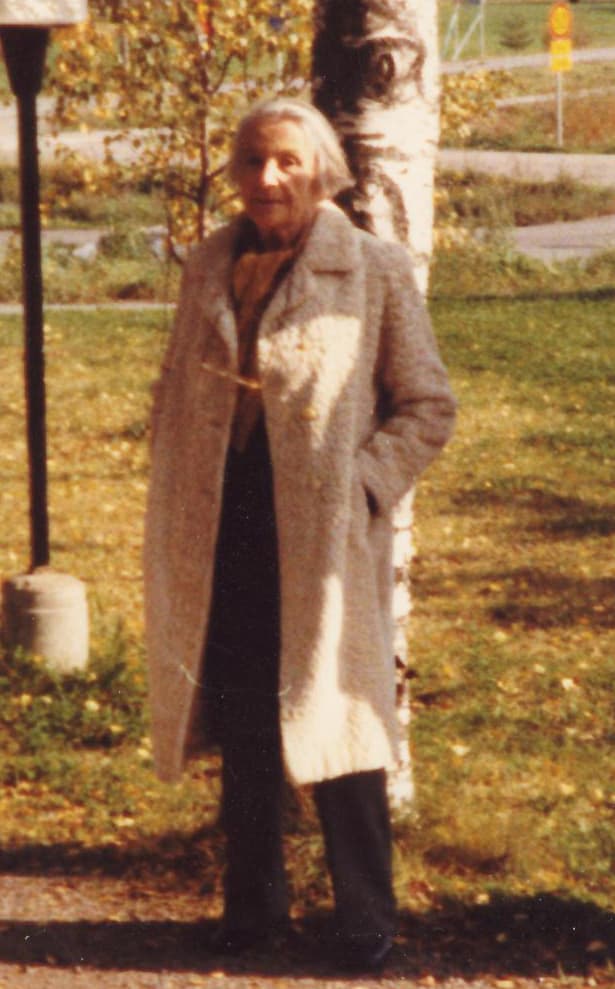
Paris, a late autumn afternoon, in an apartment in the 16th arrondissement where books reach the ceiling and a typewriter sleeps under its cover. Nathalie Sarraute, petite, with a sharp gaze, serves tea in fine cups. She speaks softly, often pauses to hunt for the right word, as if each sentence must first pass the test of suspicion.
—Before being Nathalie Sarraute, you were Natacha Tcherniak. What remains of that little girl born in Russia?
I was born in Ivanovo-Voznesensk, a factory town a few hundred kilometers from Moscow, in 1900, the brand-new century. My parents divorced, and for years I made those trips back and forth between Paris and Saint Petersburg, a child passed from one country to another like a fragile package. From this tossing about, I kept a particular ear: you don't listen to a language the same way when you have two. You hear the silence that separates two words, you guess what trembles beneath a pleasant sentence. I believe that everything I later tried to write was born there, in that forced attention to things that are not said.
You don't listen to a language the same way when you have two.
—How was the idea born for those tiny texts you called tropisms?
I had studied law, I was admitted to the Paris Bar in 1925, and I felt that argumentation, pleading, all of that turned me away from the essential. Around 1932, I began to jot down, in notebooks, very short scenes: not what people said to each other, but what stirred within them without their knowledge. I borrowed from biology this word, tropism, which designates an organism's reaction to a stimulus. These movements are infinitesimal, almost unavowable, they glide at the edge of consciousness. Tropisms appeared in 1939, printed in a few hundred copies, in total indifference. I didn't suffer from it: I knew I had touched something, and that it would take me a whole lifetime to explore it.
Not what people said to each other, but what stirred within them without their knowledge.
—Why choose a laboratory word to speak about inner life?
Because the words of traditional psychology seemed worn out to me, covered with a crust of conventions. Saying "he felt jealousy" was already lying, locking into a name something fluid and murky. The tropism, on the other hand, does not judge, does not name a feeling: it describes a displacement, a contraction, a flight. In Tropisms, I write that between two beings there was "something, indefinable, fragile and tense, like an invisible thread that the slightest gesture might break." That is what I was after: not the great machinery of passions, but that thread that tightens and breaks in a drawing-room, around a cup of tea, without anyone daring to speak of it.
Not the great machinery of passions, but that thread that tightens and breaks in a drawing-room.
—You wrote part of your work under dramatic conditions, during the Occupation. How did you get through those years?
Between 1940 and 1944, I had to live in hiding, under a false identity, because of my Jewish origins. In such moments, you learn to make yourself transparent, to watch every intonation, to read on faces the threat or pity. It was in this forced isolation, in this war of glances, that I continued to write Portrait of a Man Unknown. Strange paradox: this book where a narrator relentlessly spies on a father and his daughter, I was composing it while spying on the world myself to survive. Fear sharpens the ear. I was never so attentive to the underground movements of beings as in those years when my life hung on a misinterpreted frown.
Fear sharpens the ear.
—Sartre prefaced this novel by coining the term "anti-novel" for you. What did this word bring you?
When Portrait of a Man Unknown appeared in 1948, Jean-Paul Sartre wrote that preface where he spoke of an "anti-novel." The word made a stir, and I must admit it protected me: it signaled to the reader that he would not find there what he expected, neither a reassuring plot nor a well-defined character. An anti-novel is not the negation of the novel, it is a novel that turns against its own conventions while remaining inside them. Sartre understood that I wanted to undermine from within that old architecture of the hero, the setting, the neatly tied-up story. His endorsement opened doors for me; but the struggle, I was waging it alone for years.
An anti-novel is a novel that turns against its own conventions while remaining inside them.
—With The Age of Suspicion, in 1956, you almost give a manifesto. What suspicion were you aiming at?
The suspicion of the reader. In 1956, I gathered essays under that title, The Age of Suspicion, to say a simple thing: the reader of today "has become wary, he knows he must be careful not to believe too quickly in the characters, the settings, the situations that the novelist offers him." After so many wars, so many official lies, how can you expect him still to swallow the novelistic character whole, with his civil status and his mustache? This book became, despite myself, a kind of flag for what was called the Nouveau Roman. But I never wanted to found a school. I was describing a crisis already there, in the air of the times, and I was simply proposing to take it seriously.
How can you expect him still to swallow the novelistic character whole, with his civil status and his mustache?
—You also wrote for the theater. What did the stage allow that the novel did not?
The theater offered me the naked voice. In For No Good Reason, two old friends tear each other apart because one said to the other, long ago, "that's nice, that" in a certain tone. Everything is there, in that tone, in that infinitesimal shift of intonation that poisons a lifelong friendship. In the theater, I no longer need to describe the sub-conversations, that flow running beneath banal words: I make them heard directly, in the pauses, hesitations, repetitions. The telephone, a polite sentence, a silence — nothing more is needed for an inner catastrophe to be triggered. Everyday speech is a minefield, and the stage, better than any page, makes the spectator feel it.
Everyday speech is a minefield.
—This idea of "sub-conversation" recurs constantly in your work. How would you define it to someone discovering it?
Imagine two people having tea and exchanging pleasantries. On the surface, everything is smooth, courteous, almost empty. But underneath, a storm is brewing: a word has wounded, a look has judged, a silence has humiliated. That eddy, that mute and frenzied dialogue taking place beneath conventional phrases, I call it the sub-conversation. It is my true subject. In The Golden Fruits, an entire novel consists of those drawing-room conversations where people rave or mock a book — "have you read The Golden Fruits?... it's remarkable, truly remarkable" — and where everyone is actually watching for others' approval. Literary judgment is only a pretext: what I paint is each person's fear of not being in tune.
On the surface, everything is smooth; but underneath, a storm is brewing.
—In 1983, with Childhood, you return to your own memories, but in a very particular way. Why this dialogue with an inner voice?
Because I distrust the smooth autobiography, those accounts where one tells one's life like a calm river, sure of every detail. In Childhood, I split my voice: one part of me begins to evoke, and another interrupts it, suspects it, asks if it is not cheating. "So, are you really going to do that?" that voice says to me. For words, when you look at them closely, "sometimes they give way," they betray the memory instead of rendering it. I wanted to show that: memory is not a chest you draw from, it is shifting ground. Reconstructing my childhood split between Paris and Russia was still hunting tropisms, but this time within myself.
Memory is not a chest you draw from, it is shifting ground.
—After a whole lifetime spent hunting the unspeakable, what would you say to a young reader opening your books for the first time?
I would tell him not to look for the story — there is none, or very little. Let him read rather as one strains one's ear in the next room, attentive to tremors, to things that pass and that one dares not name. All my life, from those notebooks begun before the war to my last books written in the calm of my house in Chérisy, I pursued only one quarry: what stirs in us beneath words, and which words, precisely, never quite manage to grasp. If, reading me, he one day finds himself perceiving, in a banal conversation, that secret eddy, then I will not have written in vain.
Read as one strains one's ear in the next room.


This imaginary interview was generated by artificial intelligence from sources documented in Nathalie Sarraute's profile. It dramatises what the figure might have said based on what we know about them, but does not constitute attested historical testimony. For primary sources and factual documentation, refer to the full profile.