Kids interview Nathalie Sarraute
by Charactorium · Nathalie Sarraute (1900 — 1999) · Literature · 5 min read
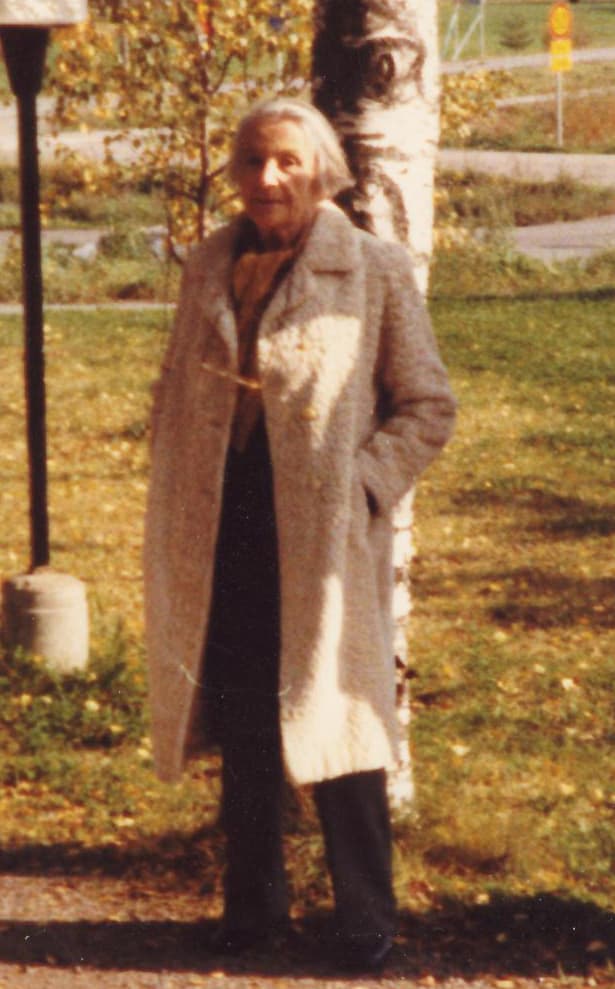
That morning, two middle school students on a field trip push open the door of an apartment in the 16th arrondissement of Paris, filled with books up to the ceiling. An elegant old lady welcomes them with a cup of tea. Her name is Nathalie Sarraute, and she has almost a hundred years of stories to tell.
—Where were you born? They say you weren't really French originally.
You're right, my child. I was born in 1900 in a Russian town, Ivanovo-Voznessensk, 300 kilometers from Moscow. My real name was Natacha Tcherniak. Imagine a child constantly traveling between Paris and Saint-Petersburg, because her parents had divorced. Two homes, two languages, two countries. I settled permanently in Paris at age eight. You know what that taught me? To listen. When you change languages all the time, you become very attentive to words, and especially to the silences between people. I kept that ear my whole life.
When you change languages, you learn to listen to silences.
—What did your home smell like? Did you eat Russian stuff?
What a lovely question! In my apartment, there was always tea. Not as a detail, no: tea is a little ritual I keep from my Russian childhood. We would sit around the table, talk for hours. And I, during those conversations, did a funny thing: I observed. I watched what passed over faces when someone said one word too many. In my day, we lived a lot around those salons, those long discussions. Later, in my books, you'll often find a cup of tea and people talking. That's no coincidence.
—Is it true you were a lawyer before writing? Why did you stop?
That's absolutely true. I studied law at the University of Paris, and in 1925, I was called to the bar. I was a lawyer! I had learned to plead, to argue, to choose each word with precision. But you know, my heart wasn't in it. As early as 1932, in the evenings, I wrote strange little texts. I couldn't help it. So I gave up the lawyer's robe for the typewriter. Keep one thing in mind: nothing is wasted. My lawyer's rigor, that taste for exact argument, I poured it all into my writing. You can change careers without throwing anything away.
You can change careers without throwing away anything you've learned.
—Did your first book succeed right away?
Oh no, not at all! And it's important you know that. My first book, Tropisms, came out in 1939, just at the start of the war. Only a few hundred copies were printed. Almost nobody noticed it. Imagine working on something for years, and the world shrugs. That was it. But I didn't change course. I knew I had something new, even if it was tiny. Recognition came much later, when I already had gray hair. A book, sometimes, is like a seed: it takes years before you see the tree.
A book is a seed: it takes years before you see the tree.
—During the war, were you scared? They say you had to hide.
Yes, my child, I was scared. During the Occupation, between 1940 and 1944, I had to hide because I was of Jewish origin. Imagine you can no longer use your real name. You live under a false identity in the Paris region, pretending to be someone else. Every knock at the door chills you. That was my life during those years. And yet, in that isolation, I kept writing. A novel, Portrait of a Man Unknown. It was my way of staying myself when everything pushed me to disappear. Writing was saying: I am still here.
Writing while hiding was saying: I am still here.
—What is an 'anti-novel'? Is it a book against books?
Ha! Not quite, but I understand why that intrigues. When my novel Portrait of a Man Unknown came out in 1948, a great philosopher, Jean-Paul Sartre, wrote the preface. And he invented that word for me: 'anti-novel.' It doesn't mean a book that hates novels. It means a novel that shakes up the usual rules. Imagine a story without a clear hero, where we follow a man observing a father and daughter without ever piercing their secret. No grand adventure, no clear ending. Just the underside of things. I wanted to show what happens beneath the surface, where no one usually looks.
—You invented a weird word, 'tropism.' What does it mean?
Well spotted! I borrowed it from biology. A tropism, originally, is when a plant leans toward the light without deciding to: a tiny automatic movement. Well, I thought we humans have the same thing inside. Imagine someone pays you a compliment, and deep inside you, without wanting it, something tightens or lights up in a split second. That's a tropism. A minuscule, almost invisible movement that passes beneath our words. All my life, I tried to catch those little jolts with words. It's very hard, because they move fast.
A tropism is that little movement that passes beneath our words.
—How did you write? Did you write quickly or slowly?
Very, very slowly, I assure you! First, I jotted down my observations in notebooks. Tiny notes: a scene seen in a salon, a sentence overheard, a face changing. That was my raw material. Then I moved to my typewriter, and there I started over endlessly. A sentence, I would rework it ten times, twenty times, so it captured exactly the right quiver. I worked mostly in the morning, early, before the house woke up, because my mind was clearest. You see, writing for me wasn't inspiration falling from the sky. It was patient work, like polishing a stone.
Writing isn't inspiration: it's polishing the same stone a hundred times.
—You wrote a play where two friends argue over nothing. Is it true you can get angry over a word?
Oh yes, that's exactly the subject! My play is called For a Yes or for a No, I wrote it in 1982. Two longtime friends tear each other apart over a tiny thing: a certain tone, an intonation. One said 'That's nice...' with a little too much music, and the other felt hurt. You see? Beneath polite words, there is often a second dialogue, hidden. I call it 'sub-conversation': everything we think without saying. Sometimes it's there, in that unspoken, that the real storms between people play out. The biggest quarrels come from the smallest things.
The biggest quarrels come from the smallest things.
—You said you shouldn't believe what you read. Why?
Because today's reader has become clever, suspicious! I wrote that in a book of ideas, The Age of Suspicion, in 1956. It was called the manifesto of the Nouveau Roman — a group of writers who, like me, wanted to shake up the old habits of the novel. Imagine: for centuries, you were presented with a character with his name, his job, his nice story, and you believed it meekly. I say: watch out! People's real lives don't fit into that beautiful facade. It's underneath, in the turmoil and uncertainty. So I invite my readers to distrust appearances that are too smooth. Doubt is a form of intelligence.
Distrusting appearances that are too smooth is already a form of intelligence.
—If you are remembered today, what would you like to be remembered for?
What a beautiful question to end with. You know, I wrote until I was very old, my last novel at 96. My books eventually got read everywhere; The Golden Fruits even received a major international prize in 1964. But that's not what matters most to me. What I'd like you to remember is this: learn to look beneath people's surface. Behind a smile, a politeness, a silence, something is always happening. All my life, I tried to make that invisible visible. If one day you truly listen to someone, beyond their words, then a little bit of my work continues in you.
Learn to look beneath the surface: behind every silence, something is happening.
This imaginary interview was generated by artificial intelligence from sources documented in Nathalie Sarraute's profile. It dramatises what the figure might have said based on what we know about them, but does not constitute attested historical testimony. For primary sources and factual documentation, refer to the full profile.