Imaginary interview with Octavia Butler
by Charactorium · Octavia Butler (1947 — 2006) · Literature · Society · Culture · 6 min read
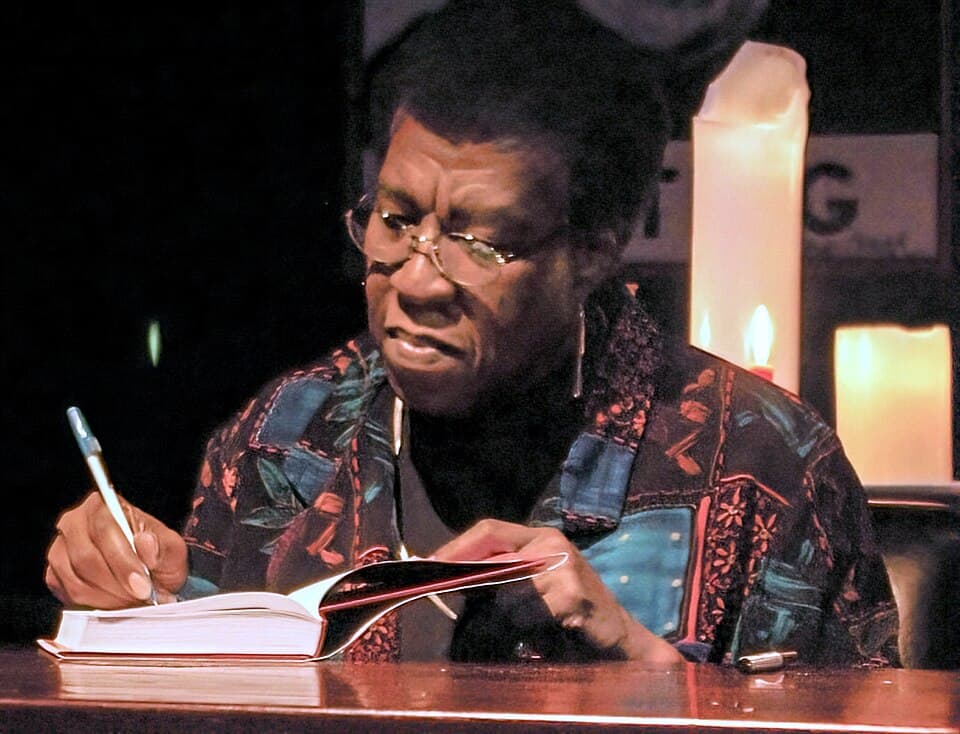
Seattle, a winter morning in 2005. In an apartment with shelves sagging under notebooks and atlases, a tall woman pours us tea and sits by the gray window. She has just finished Fledgling and speaks slowly, weighing each word, like someone who learned very early that nothing would be given to her for free.
—How does a little girl from Pasadena decide, so early, that she will be a writer?
I was ten years old and watching a bad science-fiction movie on television when I told myself, very calmly, that I could do better. My mother was a maid, a widow, and we had no money — but I babysat for months to buy myself a portable typewriter at thirteen. It was the first object that was mine, truly mine. At school, they laughed at my dyslexia, my slowness to read, my silence; I was so tall and so shy that I preferred to disappear. The public library in Pasadena became my real home: I took refuge there in the afternoons, I read everything, biology, African history, those pulp magazines full of a future that was entirely white and male. I told myself that one day I would go live in that future and I would change it.
It was the first object that was mine, truly mine.
—What did that public library represent for the child you were?
Unable to buy books, I borrowed them by the armful. That's where I educated myself — no one around me had gone to college, no one told me what to read. I moved from natural science shelves to slave narratives, without hierarchy, with that slightly disordered hunger of autodidacts. Dyslexia, which earned me so much mockery, had at least taught me one thing: reading slowly is reading twice. Nothing slipped through my fingers. I think my entire body of work was born in that building, between the catalog cards and the smell of paper — long before I had any idea what a publisher was. Poverty stole many things from me, but it gave me a library as one gives a kingdom.
Dyslexia had taught me one thing: reading slowly is reading twice.
—They say you woke before dawn to write. Where does that discipline come from?
I woke at four in the morning, sometimes earlier, to write before the day claimed me. For years I was a worker, an inspector in a chip factory, a switchboard operator, a night employee — I had to eat. So I wrote in the dark, before the first bus, my page quotas noted in a notebook like a contract I made with myself. People wait for inspiration; I learned to distrust it. As I wrote in Furor Scribendi: "First forget inspiration. Habit is more dependable. Habit will sustain you whether you're inspired or not." Habit does not abandon you on a morning of discouragement. Talent does.
People wait for inspiration; I learned to distrust it.
—You often speak of documentary rigor. Why so much research for speculative fiction?
Because I didn't want to write fantasies, but worlds that hold up. My evenings at the library, I spent in genetics, anthropology, botany, the history of slavery. I kept thick research notebooks, where I noted everything that could make a universe credible: how a plant grows, how a power is transmitted, how a people survives. A reader forgives a novel many things, except being taken for a fool. Science fiction has this immense freedom — as I once said, "I was attracted to science fiction because it was so wide open" — but a wide-open door does not excuse you from knowing how to build the house behind it. The discipline of the morning and the discipline of documentation are the same virtue: refusing ease.
A reader forgives a novel many things, except being taken for a fool.
—Kindred projects a black woman of today into slave-era America. Where did that idea come from?
Kindred, published in 1979, was born from anger and a misunderstanding. At university, a young black man of my generation kept saying he was ashamed of his ancestors, that they had let themselves be enslaved without fighting. I wanted to answer that he had no idea what "surviving" required. So I took Dana, a woman of my time, and threw her without warning onto a 19th-century plantation, forced to save the white ancestor from whom she descended. I had read and reread slave narratives, the Narrative of Frederick Douglass especially; those texts taught me that the memory of slavery is not understood from afar, it is endured in the body. It was later called the neo-slave narrative — I only wanted people to stop judging the dead without having walked in their chains.
The memory of slavery is not understood from afar, it is endured in the body.
—Why choose time travel rather than a classic historical novel to deal with slavery?
Because history, when it is neatly arranged in textbooks, ceases to hurt. I wanted Dana to lose an arm in the process — literally — so that the reader understands that one never returns unscathed from the past. The fantastic was not an escape, it was a magnifying glass. By wrenching an educated, modern woman from her California kitchen and hurling her onto a Maryland plantation, I removed the comfortable distance of period costume. She knows how to read, she knows what freedom is, and that protects her from nothing. The slave narratives I always kept near me already spoke this bare truth; I only added a time door so that my contemporaries, finally, would step through it.
History, when it is neatly arranged in textbooks, ceases to hurt.
—Power runs through all your work. What led you to that theme?
Lack. I put it this way in an interview: "I began writing about power because I had so little." The power of the strong over the weak, of the employer over the employee, of the parent over the child — I felt it in my flesh as a young black woman, poor, taking the bus every day through a segregated Los Angeles where neighborhoods told you your place without any law having to write it. Writing was turning the tables: in fiction, I decided who dominated whom, and at what cost. All my life I wanted to understand what it means to survive such relationships without becoming a tormentor yourself. It is a question I have never finished asking.
Writing was turning the tables: I decided who dominated whom, and at what cost.
—Bloodchild features humans carrying the larvae of extraterrestrial beings. What were you trying to explore?
People wanted to see in Bloodchild, in 1984, an allegory of slavery. It is not. It is a story of love and debt — that of a human people welcomed on a planet not their own, who must, to stay, carry in their bodies the offspring of their hosts. I wanted to explore consent when it is wrested from constraint, the tenderness that coexists with domination, what profoundly different beings can do to each other when they depend absolutely on one another. It was also, more modestly, my story of a pregnant man — I had challenged myself to write that seriously. The novella earned me the Hugo and Nebula awards, but above all it allowed me to face the part of trouble in any negotiated survival.
The tenderness that coexists with domination: that is what interested me.
—In Parable of the Sower, a hyperempathic teenager founds a community in a collapsed California. What does this hyperempathy say about your perspective?
Lauren Olamina physically feels the pain and pleasure of others — it is a disease, in the novel, almost a disability. But hyperempathy is also everything I would have wanted to impose on the world: the impossibility of remaining indifferent to the suffering of one's neighbor. I wrote Parable of the Sower in 1993 simply by looking around me — a Los Angeles cracked by inequality, fires, a nature we are exhausting. I prophesied nothing; I extrapolated the trends I had before my eyes from the bus. Lauren responds to collapse by building, not fleeing: she founds Earthseed. It was my way of saying that you do not survive alone, and that clarity without community is only an elegant way to despair.
Clarity without community is only an elegant way to despair.
—If you imagined being read still in half a century, what would you wish those readers to find in your work?
I distrust that kind of dream — but if I allow myself to imagine it, then I hope I am not read as a fortune-teller. I have no crystal ball; I have research notebooks and a long habit of observing people in queues. If my Parables were ever to serve women and men facing their own collapses, I would like them to take from them not fear, but a method: name the danger, organize, plant something despite everything. The MacArthur grant in 1995 finally gave me the time to write without counting my hours; it would be only fair that that time benefits others. A book no longer belongs to the one who wrote it — it belongs to those who need it.
I hope I am not read as a fortune-teller.
Read further
This imaginary interview was generated by artificial intelligence from sources documented in Octavia Butler's profile. It dramatises what the figure might have said based on what we know about them, but does not constitute attested historical testimony. For primary sources and factual documentation, refer to the full profile.