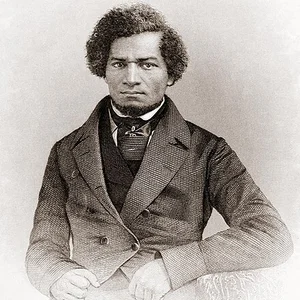

abolitionist orator and writer, leader of the African-American community in the 19th century
Frederick Douglass(1818 — 1895)
Frederick Douglass
États-Unis
8 min read
Frequently asked questions
Key Facts
- Né esclave vers 1818 dans le Maryland, il apprend à lire en secret et s'évade vers le Nord en 1838
- Publie en 1845 son autobiographie 'Narrative of the Life of Frederick Douglass', qui devient un manifeste abolitionniste
- Fonde en 1847 le journal abolitionniste 'The North Star' à Rochester, New York
- Conseiller de Lincoln pendant la guerre de Sécession (1861-1865), il milite pour l'enrôlement des soldats noirs dans l'armée de l'Union
- Après l'abolition de l'esclavage en 1865, il poursuit son combat pour les droits civiques des Afro-Américains jusqu'à sa mort en 1895
Works & Achievements
Douglass's first autobiography, a direct and striking account of his life under slavery. An immediate bestseller, translated into several languages, it profoundly shook Western public opinion on the reality of American slavery.
Abolitionist newspaper founded and edited by Douglass in Rochester. It became one of the leading platforms for the Black cause in the United States, with the motto: 'Right is of no Sex — Truth is of no Color'.
His second autobiography, more in-depth than the first, in which Douglass analyzes the political and social mechanisms of slavery. In it, he asserts his intellectual independence from the white leaders of the abolitionist movement.
Considered one of the greatest speeches in American history. Douglass denounces the hypocrisy of a nation that celebrates freedom while keeping millions of people enslaved.
His third and final autobiography, covering his entire life up to his role as a diplomat. It recounts his part during the Civil War and his fight for civil rights after abolition.
A call published by Douglass to recruit African American soldiers into the Union Army. It contributed to the creation of the famous 54th Massachusetts Infantry Regiment, a symbol of the courage of Black soldiers.
Anecdotes
Frederick Douglass secretly learned to read thanks to his master's wife, who taught him the alphabet before her husband forbade it. He continued on his own, trading bread for lessons with white children in the neighborhood. This thirst for learning convinced him that education was the key to freedom.
In 1838, Douglass escaped from slavery disguised as a sailor, carrying borrowed papers from a free seaman. He traveled by train and boat more than 400 kilometers in less than 24 hours to reach New York and freedom. He would later recount that every moment of the journey was absolute terror, fearing he would be recognized.
During a speech in 1845, Douglass publicly challenged those who doubted he had truly been enslaved by revealing his real name and the name of his former master in his autobiography, risking capture and being sent back to the South. Abolitionist friends had to purchase his freedom from his owner for 711 dollars.
On July 4, 1852, Douglass delivered one of the most celebrated speeches in American history, titled 'What to the Slave is the Fourth of July?'. He declared that this independence holiday was a cruel hypocrisy for the four million enslaved Americans. This text is still studied today in high schools around the world.
Douglass met Abraham Lincoln at the White House in 1863 and was received as an equal, an exceptionally rare occurrence for a Black man at the time. He advised Lincoln on the recruitment of Black soldiers into the Union Army and insisted that they receive the same pay as white soldiers.
Primary Sources
I have no accurate knowledge of my age, never having seen any authentic record containing it. By far the larger part of the slaves know as little of their ages as horses know of theirs.
This Fourth July is *yours*, not *mine*. You may rejoice, I must mourn. To drag a man in fetters into the grand illuminated temple of liberty, and call upon him to join you in joyous anthems, were inhuman mockery and sacrilegious irony.
Knowledge had penetrated the dark shell of ignorance in which I had been enveloped... I saw nothing without seeing it, I heard nothing without hearing it, and felt nothing without feeling it.
I had two masters. My first master's name was Anthony... He was not considered a rich slaveholder... but owned two or three farms and about thirty slaves.
I am your fellow-man, but not your slave. I therefore see no need of elaborate argument to show that slavery is wrong; I have felt it. I can tell you that day dawns to the slave, however long the night.
Key Places
Douglass's birthplace and childhood home, where he was enslaved on several plantations. It was here that he secretly learned to read and began dreaming of freedom.
Douglass lived here as a domestic slave and received his first literacy lessons. The port city allowed him to observe free men and to plan his escape.
Douglass's first city of freedom after his escape in 1838. He worked as a caulker in the shipyards and joined the local abolitionist community.
Douglass settled here in 1847 and founded 'The North Star'. His home was an important station on the Underground Railroad, helping fugitive slaves reach freedom.
Douglass met Abraham Lincoln here and held several high federal positions. He died here in 1895 after delivering a speech in support of women's rights.
Douglass undertook a lecture tour here between 1845 and 1847, fleeing the risk of capture following the publication of his autobiography. His European success enhanced his international standing.
Typical Objects

Douglass learned to read through literacy primers he obtained clandestinely. The book represented for him the very symbol of intellectual emancipation, and throughout his life he linked freedom to access to knowledge.

As a journalist, autobiographer, and editor-in-chief of several abolitionist newspapers, Douglass used the pen as a political weapon. His writings helped change American public opinion on slavery.

Douglass founded this newspaper in 1847 in Rochester, its title evoking the North Star that fugitive slaves followed to reach the North. He served as its editor-in-chief and turned it into a national platform for the abolitionist cause.

Douglass had himself worn chains and iron collars in his youth. He would sometimes display these objects during his lectures to bear witness to the physical reality of slavery before audiences who had never experienced it.

It was through the papers of a free sailor that Douglass was able to escape in 1838, passing himself off as a free man. This forged document symbolizes the fragility of freedom for African Americans in 19th-century America.

An exceptional orator, Douglass spent decades traveling the United States and Europe to deliver speeches against slavery and later for civil rights. The podium was his primary instrument of political struggle.
School Curriculum
Vocabulary & Tags
Key Vocabulary
Daily Life
Morning
In the 1850s, Douglass rose early in his Rochester home to read the national press and reader mail for his newspaper. He devoted the first hours to writing articles and editorials, often standing at his desk, before his team arrived at the printing office.
Afternoon
His afternoons were often taken up by political meetings, interviews with visiting abolitionists, or overseeing the printing of the 'North Star'. During his lecture tours, he might travel several dozen miles by train or stagecoach to reach the next town.
Evening
In the evenings, Douglass sometimes received fugitive refugees whom the Underground Railroad network entrusted to him before their passage to Canada. He read, prepared his speeches, and corresponded with prominent abolitionists such as William Lloyd Garrison and Harriet Beecher Stowe.
Food
Like many middle-class Victorian men, Douglass ate modestly: porridge or bread at breakfast, cold meat and vegetables at noon, soup and bread in the evening. Born into the deprivation of slavery, he always regarded simple, plentiful food as a privilege of freedom.
Clothing
Douglass paid particular attention to his appearance, convinced that a well-dressed Black man contradicted racist stereotypes. He wore a fine black frock coat, a white shirt with a high collar, a carefully knotted cravat or necktie, and polished boots — the respectable attire of a Victorian gentleman.
Housing
In Rochester, Douglass lived in a comfortable two-story house on South Avenue, which his wife Anna Murray had helped purchase with her savings. The home also served as a refuge for escaped slaves; a hidden room could shelter several people in transit to Canada.
Historical Timeline
Period Vocabulary
Visual Style
Esthétique photographique victorienne américaine, portraits en daguerréotype ou tirage albumine, sobriété formelle, lumières dramatiques, tons sépia et brun profond évoquant la gravité morale de l'ère abolitionniste.
Sound Ambience
Ambiance sonore mêlant les grandes salles de conférence abolitionnistes, les rédactions de journaux militants et les routes clandestines du chemin de fer souterrain dans l'Amérique du XIXe siècle.
Liens externes & ressources
Références
Œuvres
Narrative of the Life of Frederick Douglass, an American Slave
1845
The North Star (journal)
1847–1863
My Bondage and My Freedom
1855
What to the Slave is the Fourth of July ? (discours)
5 juillet 1852
Life and Times of Frederick Douglass
1881 (réédité en 1892)
Men of Color, To Arms ! (appel)
1863