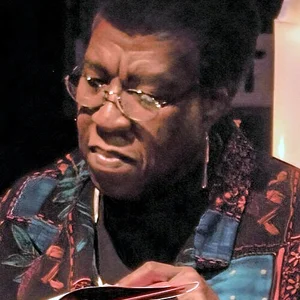

Octavia E. Butler (1947-2006) was a pioneering American novelist of Afro-feminist science fiction. The first Black woman to establish herself in this genre, she explored race, gender, power, and identity through committed speculative narratives.
Octavia Butler(1947 — 2006)
Octavia E. Butler
États-Unis
9 min read
Frequently asked questions
Famous Quotes
« Every story I write adds to me a little, changes me a little, forces me to reexamine an attitude or belief.»
« You don't start out writing good stuff. You start out writing crap and thinking it's good stuff.»
Key Facts
- Born June 22, 1947, in Pasadena, California, into a modest African American family
- Published her first novel Patternmaster in 1976, launching the Patternist series
- First science fiction woman to receive a MacArthur Fellowship (“Genius Grant”) in 1995
- Winner of the Hugo and Nebula Awards for the novella Bloodchild (1984)
- Died February 24, 2006, in Seattle, leaving a foundational body of work in Afrofuturism
Works & Achievements
A contemporary Black woman is hurled back to nineteenth-century slaveholding America to save the white ancestor from whom she is descended. A founding text of neo-slave narrative fiction, widely taught in American universities for its visceral staging of the traumatic memory of slavery.
A novella in which humans living on an alien planet must carry the larvae of their host aliens in order to coexist with them. Winner of both the Hugo and Nebula awards, it uses metaphor to explore consent, bodily domination, and relationships of dependency between species and peoples.
A Black woman who survives a nuclear holocaust is taken in by aliens who demand genetic hybridization in exchange for humanity's salvation. Butler probes the boundaries of identity, gender, and cultural resistance in the face of benevolent domination.
Lauren Olamina, a hyperempathic Black teenager, builds a survival community in a near-future California devastated by inequality and climate change. A prophetic dystopian novel that has become a touchstone for activist movements and scholars studying collective resilience.
The sequel to *Parable of the Sower*, winner of the 1999 Nebula Award. Butler deepens her examination of religious fanaticism, political authoritarianism, and the construction of communal alternatives in the face of institutional collapse.
Butler's final published novel, in which a young amnesiac vampire discovers she is the product of genetic experiments aimed at creating a mixed-race variant. The work deconstructs vampire mythology to explore race, desire, memory, and constructed identity.
Anecdotes
Octavia Butler began writing at age ten after watching a science-fiction film on television and deciding she could do better. Raised in poverty in Pasadena by her widowed mother, who worked as a housekeeper, she saved money earned from babysitting to buy herself a typewriter at thirteen — the founding act of an absolute vocation.
Butler had dyslexia, which earned her ridicule at school and made her deeply shy. Far from crushing her, this difficulty led her to lean even more heavily on her imagination and on writing, which she described as the only space where she felt capable and free.
In 1970, Butler attended the Clarion Writers' Workshop in Pennsylvania, the most prestigious science-fiction writing program in the United States. She was recognized there as an exceptional talent, but for years she had to juggle a string of odd jobs — factory worker, potato chip inspector, telephone operator — to make ends meet while writing before dawn every morning.
In 1995, Butler received the MacArthur Fellowship, nicknamed the 'genius grant,' allowing her for the first time to devote herself entirely to writing. She was one of the first science-fiction authors to receive this honor, confirming that speculative literature could be recognized as a seriously intellectual art form.
Her novel *Parable of the Sower* (1993), in which a young Black teenager founds a survival community in a collapsed California, has become a touchstone text for many American activist movements after 2016 and again after 2020. Community groups use it as a guide for thinking about collective resilience in the face of climate and political crises — proof of a remarkable foresight.
Primary Sources
I was attracted to science fiction because it was so wide open. I was able to ask what if? and explore possibilities. The only limits were the laws of physics — and even those could be stretched.
First forget inspiration. Habit is more dependable. Habit will sustain you whether you're inspired or not. Habit will help you finish and polish your stories.
I began writing about power because I had so little. The power of the strong over the weak — the employer over the employee, the parent over the child. I wanted to explore what it means to survive those relationships.
Bloodchild is the story of an impossible choice between survival and dignity, between love and bodily constraint — a meditation on what very different beings can do to one another when they mutually depend on their coexistence.
Key Places
Butler's birthplace and childhood home, where she grew up in poverty with her mother. It was here that she frequented the public library and wrote her first stories, in a context of the informal yet pervasive segregation that characterized Southern California.
In 1970, Butler attended this science fiction writing workshop — the most selective in the United States. There she was recognized as an exceptional talent and forged the professional connections that would prove decisive for her career.
The city where Butler lived and worked for most of her adult life, taking on odd jobs to survive while continuing to write. Los Angeles, with its racial tensions — the Watts riots (1965) and the 1992 riots — directly inspired the atmosphere of the Parable series.
The city where Butler settled in the final years of her life, made possible by her MacArthur Fellowship, and where she died on February 24, 2006 after a fall. She had just completed *Fledgling* and was working on a third installment of the Parable series.
A formative intellectual space for the young Butler, who spent her afternoons there reading, having no means to buy books of her own. It was here that she discovered science fiction and natural science — the two pillars that would shape her entire body of work.
Typical Objects

Butler bought her first typewriter at thirteen with money she had saved from babysitting. This object symbolizes her early determination to become a writer despite poverty, and remained her primary writing tool long before the age of computers.

Unable to afford books, Butler was a devoted regular at the Pasadena Public Library. It was there that she educated herself — in science fiction, African and African American history, and biology — building the documentary foundation for her novels.

The popular SF magazines of the 1950s and 1960s — *Amazing Stories*, *Galaxy* — were the first readings that sparked Butler's vocation as a writer. In their pages, she discovered a world almost entirely white and male, one she decided to enter and transform.

Butler kept highly detailed research notebooks to fuel her novels: genetics, anthropology, the history of slavery, botany. This scientific and historical rigor gave her speculative fiction an unusual credibility and depth that set it apart within the genre.

Not driving, Butler traveled exclusively by bus throughout Los Angeles for decades. These journeys through a deeply residentially segregated city directly shaped her perspective on social and racial inequality, a lens visible throughout her dystopian novels.

Nineteenth-century American slave narratives — most notably Frederick Douglass's *Narrative* — were among Butler's foundational readings. These historical sources directly inspired *Kindred*, her novel about time travel and slavery.
School Curriculum
Vocabulary & Tags
Key Vocabulary
Tags
Daily Life
Morning
Butler regularly rose before dawn — sometimes as early as four in the morning — to write before any obligations intruded. This near-military morning discipline was her absolute rule: she noted her goals in notebooks and set herself page quotas, convinced that talent without habit produced nothing.
Afternoon
During the long years of struggle before recognition, Butler spent her afternoons at precarious jobs: factory worker, food inspector, telephone operator, night-shift clerk. She rode the bus across Los Angeles, observed fellow passengers, scribbled notes on scraps of paper, and returned to writing when evening came.
Evening
Her evenings were often devoted to documentary research at the library: African and African-American history, genetics, anthropology, botany. Butler considered this scholarly rigor indispensable — she wanted her fictional worlds to be scientifically and historically grounded, not mere fantasy.
Food
Living for many years on very limited resources, Butler kept a frugal, low-cost diet typical of urban African-American working-class households. She rarely mentioned food in her essays, insisting instead on the need to accept material discomfort as a condition of creative freedom.
Clothing
Butler dressed soberly and functionally, with no interest in fashion. Standing around 1.85 m tall, often the only Black woman in very masculine and very white spaces such as SF workshops, she favored a low-key style that let her focus on what truly mattered: her work.
Housing
For many years, Butler lived in modest housing in Los Angeles, a direct reflection of her precarious financial situation. The 1995 MacArthur Fellowship finally allowed her to settle more comfortably in Seattle, in an apartment where she had, for the first time, a dedicated and stable workspace.
Historical Timeline
Period Vocabulary
Liens externes & ressources
Références
Œuvres
Bloodchild
1984
Dawn — trilogie Xenogenesis
1987
Parabole du semeur (Parable of the Sower)
1993
Parabole des talents (Parable of the Talents)
1998
Fledgling
2005