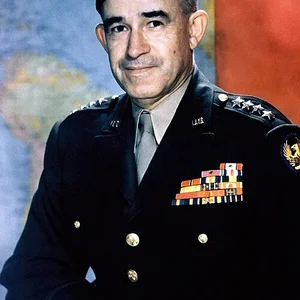

American general, one of the great military figures of the United States in the 20th century. Allied commander-in-chief in the Pacific during the Second World War, he then led the occupation of Japan and afterward the UN forces at the start of the Korean War.
MacArthur
MacArthur
5 min read
Frequently asked questions
Famous Quotes
« I shall return.»
« Old soldiers never die; they just fade away.»
Key Facts
- 1880: born in Little Rock (Arkansas); graduated top of his class from West Point in 1903.
- 1942: forced to evacuate the Philippines invaded by Japan, he vows “I shall return.”
- 1944-1945: reconquest of the Philippines, then, in September 1945, he receives the Japanese surrender aboard the battleship Missouri.
- 1945-1951: administers the Allied occupation of Japan and oversees its new democratic Constitution.
- 1950-1951: commands the UN forces in Korea (Inchon landing); relieved by President Truman in April 1951. Died in 1964.
Works & Achievements
A decorated officer of the First World War, he distinguished himself during the Allied offensives of 1918.
He thoroughly modernized the training of cadets at the American military academy.
An “island-hopping” strategy that led to the defeat of Japan and the return to the Philippines.
Demilitarization, land reform, and democratization of Japan under his authority.
A pacifist text drafted under his supervision, incorporating the renunciation of war (Article 9).
A decisive amphibious operation of the Korean War, regarded as a tactical masterpiece.
An autobiography published the year of his death, recounting his long military career.
Anecdotes
When MacArthur is forced to evacuate the Philippines in 1942 under Japanese pressure, he makes a promise that has become famous: “I shall return.” He keeps his word in October 1944, landing on the island of Leyte, photographed wading through knee-deep water — a carefully staged image.
On September 2, 1945, MacArthur presides over Japan's surrender ceremony aboard the battleship USS Missouri in Tokyo Bay. He has the 31-star American flag that Commodore Perry had brought to Japan in 1853 displayed behind him, as a nod to history.
During the occupation, MacArthur governs Japan almost like a viceroy and plays a key role in drafting the new 1947 constitution, including the famous Article 9 by which Japan renounces war. Many Japanese respectfully nicknamed him the “Gaijin Shōgun.”
In 1950, MacArthur pulls off a daring move: the amphibious landing at Incheon, behind North Korean lines. The operation, considered very risky by the high command, turns the Korean War around within a few weeks.
His public disagreement with President Truman, particularly over the idea of extending the war into China, leads to his removal from command in April 1951. Back in the United States, he delivers a farewell address before Congress that remains famous for its line: “Old soldiers never die; they just fade away.”
Primary Sources
I am closing my fifty-two years of military service. […] Old soldiers never die; they just fade away.
I came through and I shall return.
It is my earnest hope, and indeed the hope of all mankind, that from this solemn occasion a better world shall emerge out of the blood and carnage of the past.
Duty, Honor, Country — those three hallowed words reverently dictate what you ought to be, what you can be, what you will be.
Key Places
City where Douglas MacArthur was born in 1880, into a family of military officers.
Military academy where he trained and graduated at the top of his class in 1903; he would later become its superintendent.
Defensive stronghold of Manila Bay where he held out in 1942 before being evacuated on presidential orders.
Capital where he set up his headquarters as Supreme Commander of the Allied Powers during the occupation (1945-1951).
Port where in September 1950 he led a daring amphibious landing that turned the tide of the Korean War.
Place where he was buried in 1964; the memorial dedicated to him houses his archives.
Typical Objects

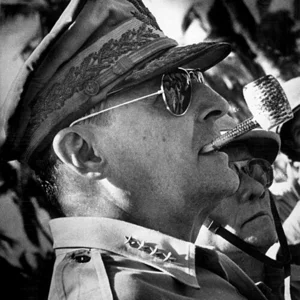
His ceremonial general's cap, lavishly adorned with gilded oak leaves, which he wore almost constantly and which had become his visual trademark.

His large custom-made corncob pipe became an attribute inseparable from his public persona.

His tinted glasses, worn even in uniform, contributed to his recognizable look in photographs from the Pacific.

The circular five-star insignia of the rank of General of the Army, which he received in December 1944.

The pens used to sign the instrument of Japan's surrender aboard the USS Missouri, which he then handed out as historical relics.

The personal weaponry of a staff general, more a symbol of rank than of direct combat.
School Curriculum
Vocabulary & Tags
Key Vocabulary
Daily Life
Morning
As a staff officer, MacArthur often started his day late because he worked through much of the night. The morning was devoted to reading military reports and dispatches, in the quiet of his office.
Afternoon
The afternoon was spent in meetings with his officers, studying maps and planning operations. During the occupation of Japan, he received dignitaries, diplomats, and journalists in Tokyo.
Evening
He liked to work and reflect late into the evening, pacing back and forth in his office while dictating his ideas. He relaxed willingly by watching films, of which he was a great enthusiast.
Food
Like many senior American officers, he ate simple meals prepared by his staff. In Japan, he kept to a Western cuisine rather than adapting to local dishes.
Clothing
He cultivated his image with a recognizable uniform: an ornately decorated cap, tinted sunglasses, sometimes a leather jacket or a plain khaki shirt without superfluous decorations in the field.
Housing
During the occupation, he resided at the United States Embassy in Tokyo and worked from the Dai-Ichi building, his headquarters, from which he governed Japan.
Historical Timeline
Period Vocabulary
Liens externes & ressources
Références
Œuvres
Campagne de la division « Rainbow » en France
1918
Surintendance de West Point
1919-1922
Campagne de reconquête du Pacifique Sud-Ouest
1942-1945
Direction de l'occupation du Japon
1945-1951
Constitution japonaise de 1947
1947
Reminiscences (mémoires)
1964