Imaginary interview with Perceval
by Charactorium · Perceval · Mythology · 6 min read
Deep in a forest of Brittany, where paths vanish under ferns, a knight with a tarnished helm stopped near a spring. His shield bears arms no herald could name. He agrees to speak, in a low voice, as one confides at the close of a long wandering.
—How did you experience, as a child, being apart from the world of arms?
I grew up in the Waste Forest alone, with a mother who had hidden from me even the very name of knighthood. She feared weapons as one fears the wolf, for they had taken her loved ones. I threw javelins at beasts; I knew nothing of courts or helms. One morning, in a clearing, I saw men clad in steel shining in the sun; I took them for angels descending from heaven, so dazzled was I by their radiance. I fell to my knees. My mother had told me of God and His messengers, never of those iron vavasseurs riding great horses. From that day, I had no rest: I wanted to become that light I had mistaken for the divine.
I took them for angels descending from heaven, so dazzled was I by their radiance.
—What did that departure for the king's court cost you?
It cost me my mother. I left for Carduel, for Arthur, without looking back enough; and later I was told she had collapsed, fainted, at the end of the bridge, the moment my horse crossed the river. I still wore coarse clothes, I carried my Welsh javelins like a rustic holds his pitchfork. At court, they laughed at me, at my questions, at my hunger to know everything. But my mother, before I left, had given me three teachings: honor ladies, pray in churches, and do not talk too much. These counsels made me a knight. The last, alas, was one day to damn me.
It cost me my mother, fainting at the end of the bridge the moment I crossed the river.
—Tell us about the night at the Fisher King's castle.
I was received in a great hall, near a crippled lord, wounded between the hips, carried on a bed. And then there passed before me a procession such as no night had ever shown: a servant holding a lance that bled drop by drop, then golden candlesticks, then a maiden bearing the Grail which shed a brightness that dimmed the candles. I saw everything. And I was silent. My mother's words tightened my throat: do not talk too much, do not seem base by asking questions. I did not ask whom they served with that vessel. In the morning, the castle was empty, the drawbridges raised over nothingness, and I alone on the heath.
I saw everything. And I was silent.
—Why does that silence weigh so heavily on your conscience?
Because a single question would have healed everything. If I had asked: whom does one serve with the Grail? and why that lance bleeds, the Fisher King would have risen from his wound, and his wasted land would have greened again. Whole fields remain barren, widows weep, orphans wander, and all of that weighs on my muteness. I thought I was doing right by keeping courtesy; I had done wrong by silencing what my heart cried out to say. A maiden met under an oak threw it in my face like a curse. That day I understood that there are silences more guilty than any words, and that politeness, misplaced, becomes a sin before God.
There are silences more guilty than any words.
—They say one day you stood frozen before the snow. What happened?
It was a winter morning, after a falcon had wounded a wild goose above me. Three drops of blood had fallen on the fresh snow, and the red on the white seized me entirely. For it was the very complexion of Blancheflor, my beloved: the whiteness of her brow, the rosiness of her cheeks. I remained leaning on my lance, motionless, lost in that likeness as in a prayer. Arthur's squires came, spoke to me, almost jostled me; I did not hear them, I was elsewhere, wholly in my love. The sun had to melt the drops for me to return to the world. They thought I had lost my mind. I had only loved too deeply.
The red on the white seized me entirely: it was the very complexion of Blancheflor.
—What does that lady, Blancheflor, represent for you?
She was the first to teach me that one can fight for something other than glory. I had found her in her besieged castle, starving, her people reduced to nothing, her towers threatening ruin. I broke the siege for her, I threw down those who pressed her. Courtesy, that word they drummed into my ears, I first thought it meant keeping silent and bowing; with her, I understood it means serving, protecting, keeping faith. Her face follows me in all my wanderings, through forests and fords, even onto the snow where three drops of blood sufficed to recall her. A knight without a lady is but an empty walking armor.
A knight without a lady is but an empty walking armor.
—How does one, in your view, go from the naïve youth you were to a seeker of the sacred?
Through falling, first. After the failed castle, I wandered five years, forgetful of churches, no longer praying, my heart dry. It was a hermit, met on a Good Friday in the forest, who restored me to myself: he told me that the sin against my mother weighed on my tongue the evening of the Grail. I wept, I fasted, I confessed. Since then, my quest is no longer that of a child who wants to shine like an angel glimpsed long ago; it is the true dubbing, that of the soul. Wearing the hauberk is not enough; one must deserve what one seeks. The Grail is not taken by force like a castle: it is received, when one has made oneself worthy to see it a second time.
The Grail is not taken by force like a castle: it is received.
—How do you feel about being named among the chosen of the quest?
They say that at the end of the road, we will be three to see the mystery fully: Galahad the pure, Bors the loyal, and me. This confounds me more than it makes me proud. Galahad is spotless, born for this; I am the man of the missed silence, the one who had to fall to rise again. Perhaps that is precisely why a place is kept for me: to show that a heart that has failed can still reach the castle of Carbonek and the light it holds. I am no longer the boy from the Waste Forest who mistook steel for angels. I have learned that the highest prowess is not to strike down an enemy, but to conquer oneself and remain faithful to the end of the quest.
I am the man of the missed silence, the one who had to fall to rise again.
—Your story, they say, remained unfinished. How do you experience that suspension?
He who sang my childhood and my night at the Grail died, his pen stopped mid-course, leaving me halfway across my destiny. In his tale, we do not know if I returned to the castle, if I finally asked the question. This troubles me like a door left ajar onto the dark. But others have wanted to finish what he left hanging: after him, continuations were written, my steps were prolonged in the forest, I was made to return to the bleeding lance. I have become a hero passed from hand to hand, each adding his branch to the tree. Perhaps that is the fate of quests: never truly to end, and always to call for a new storyteller.
I am a hero passed from hand to hand, each adding his branch to the tree.
—Do you know that your name travels beyond this land of Brittany?
It has been whispered to me, and I can hardly believe it. Far away, in Germanic lands, a poet is said to have taken up my story and named me Parzival, son of a Gahmuret I had never heard of; he gave me a father, brothers, distant lands, and made my quest a long apprenticeship through suffering and love. That my name should thus cross rivers and languages seems to me a marvel greater than many enchantments met under the oaks. If I could only imagine that I would still be read in a hundred years, in two hundred, I would say that the Grail I could not name continues, itself, to speak for me. A knight dies; a quest, perhaps, never dies.
The Grail I could not name continues, itself, to speak for me.
Read further
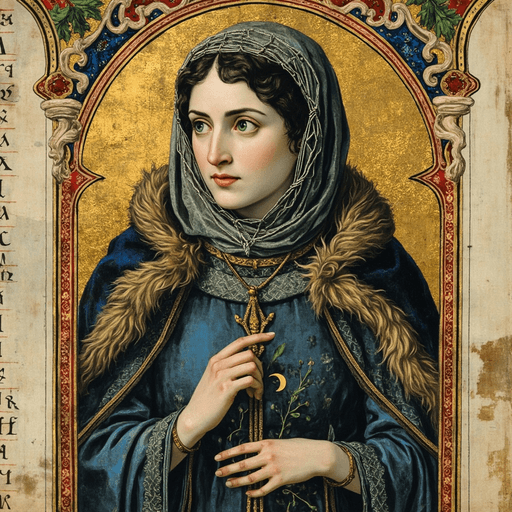
This imaginary interview was generated by artificial intelligence from sources documented in Perceval's profile. It dramatises what the figure might have said based on what we know about them, but does not constitute attested historical testimony. For primary sources and factual documentation, refer to the full profile.