Kids interview Perceval
by Charactorium · Perceval · Mythology · 5 min read
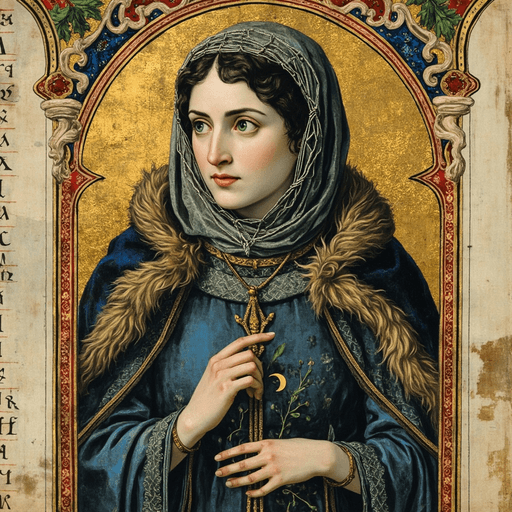
Two twelve-year-old visitors, on a school trip, have crossed the gates of an old castle. By the fireside awaits a gentle-eyed knight: Perceval. He smiles at them, as if happy that someone still takes an interest in his story.
—Is it true you grew up all alone in a forest?
Yes, my child. My mother took me far from everything, into a forest in Wales, in the land of green hills. She had lost my father and brothers in war. So she decided one thing: I would never be a knight. Imagine a wooden house, with no castle or sword, just trees and silence. I didn't even know what a knight was! I lived like a little peasant, hunting with javelins. My mother thought she could protect me. But you'll see: you can't hide a child from the world that calls him for long.
You can't hide a child from the world that calls him for long.
—And one day you saw real knights? What was that like?
Ah! That morning, I heard a terrible noise in the trees. Shining metal, echoing armor. You know what I thought, the little wild boy of the forest? I thought they were angels come down from heaven! Or maybe gods. I fell to my knees, they dazzled me so. They laughed. They were just knights of Arthur. But at that moment, something lit up inside me. I wanted to become like them. I left my mother that day. And that is a pain I have carried for a long time.
I took knights for angels — and I knew I wanted to be like them.
—What did you eat when you lived with your mom?
Oh, simple things, my child! Not the grand feasts of castles. In the forest, it was bread, cheese, clear water from streams. Sometimes the game I caught myself. Later, at court, I discovered long tables covered with meat, venison, white bread, sweet wine. What a difference! But you know what? On my quest, I often had to go back to dry bread and water. And sometimes I fasted on purpose, to purify my heart. A knight who seeks the sacred learns to do without the superfluous.
—What's that story about the Grail where you didn't ask a question?
Ah... you touch my greatest wound. I was a guest of the Fisher King, a wounded king, in a strange castle. During the meal, I saw something incredible pass by: a lance whose tip bled, drop by drop. Then the Grail, shining with a sacred light. My heart cried out: “Ask! Whom does the Grail serve?” But I had been taught courtesy — the art of behaving well, of not talking too much. So I kept silent. What a mistake. That question would have healed the king. My silence condemned him to suffer.
Sometimes silence is the heaviest of faults.
—But why did you stay quiet if you really wanted to speak?
Because I had been taught too well to be polite, you see. When I was that naive youth fresh from the forest, a wise man had told me: a knight does not ask too many questions, he does not chatter like a child. I wanted so badly to do right! So before the Grail, I obeyed the rule instead of listening to my heart. And the entire kingdom remained barren, the land without harvest. You learn an important thing here: politeness is fine, but it must never stop you from asking the real question. Courage, sometimes, is just daring to ask.
Politeness must never stop you from asking the real question.
—I heard you stood staring at snow? Is that true?
Ha! You know that story? Yes, it's true, and I still smile about it. It was winter. A falcon had wounded a wild goose, and three drops of blood had fallen on the white snow. Red on white... Imagine those two colors, so pure side by side. And suddenly, I saw the face of my beloved, Blancheflor: her rosy cheeks, her fair skin. I stood there, motionless, lost in my dream of love. The knights of Arthur came, they called me, but I heard nothing! It took much cunning to “wake” me. Love, my child, can carry you far away.
Three drops of blood on the snow, and I saw the face of the one I loved.
—Did you often think of Blancheflor when you traveled alone?
All the time, my child. You know, a knight errant's life is a life of solitude. Endless forests, cold nights sleeping near my horse, my only faithful companion. In those moments, the memory of Blancheflor warmed my heart better than any fire. That's why three little drops of blood were enough to stop me dead: my mind was seeking her face everywhere. A knight is not just armor and a sword. He is also a heart that loves, that misses, that hopes to see someone again. Never believe that warriors don't cry.
—At first you knew nothing, and at the end you are a chosen one? How?
That is the whole meaning of my quest, my child — that long journey to attain something sacred. I started as a fool of the woods, who took knights for angels and kept silent when he should have spoken. But with every trial, every mistake, I learned. I grew wiser, purer of heart. And in the end, in the great tales, I became one of the three chosen ones of the Grail, alongside Galahad and Bors. Only three knights, worthy to see the mystery! Remember this: one is not born worthy. One becomes worthy, step by step.
One is not born worthy of the Grail. One becomes worthy, step by step.
—What exactly does it mean to seek the Grail?
Good question, and it's deeper than it seems! The Grail is a sacred cup, said to be linked to Christ himself. But seeking it is not just traveling to find a shiny object. It is making oneself better. At each step, I had to be more courageous, more honest, purer. Imagine a mountain: the Grail is at the summit, and every step upward transforms you. That's why my quest is famous. It tells that an ordinary man, even a little savage from the forest, can rise toward the sacred if he never gives up.
—How does your story end in Chrétien de Troyes' book?
Well... it doesn't end! And that's strange, I know. Master Chrétien de Troyes wrote my story around 1180, The Story of the Grail. But he died before finishing it! Imagine a tale told to you at night, and just at the crucial moment, the storyteller falls asleep forever. No one knew how my quest ended. So other poets, after him, wrote sequels called the continuations, trying to answer the mystery. My story remained open, like a door. And perhaps that's what made it immortal.
My story remained unfinished — and perhaps that's why it never dies.
—Do people still talk about you, long after?
Oh yes, and it deeply touches me that you ask! Long after Master Chrétien, a German poet, Wolfram von Eschenbach, told my life under the name Parzival, around 1210. He added a thousand new details, like a gardener making new flowers grow on an old tree. And centuries, centuries later, a musician named Wagner made my story sing in a grand spectacle, Parsifal. Can you imagine? A little boy from the forest of Wales, still spoken of in lands I never saw. A beautiful story crosses time.
A beautiful story knows neither borders nor centuries.
Read further
This imaginary interview was generated by artificial intelligence from sources documented in Perceval's profile. It dramatises what the figure might have said based on what we know about them, but does not constitute attested historical testimony. For primary sources and factual documentation, refer to the full profile.