Imaginary dialogue between Blanchefleur and Perceval
by Charactorium · Perceval · Mythology · 5 min read
It is in the great hall of Beaurepaire, on a winter evening when snow falls on the battlements, that Blanchefleur finds the man she once rescued and loved. A log fire illuminates the tapestries; outside, one hears the steps of horses being led to the stable. They have not seen each other since Perceval set out again on the Grail quest, and the lady has not forgotten the look on his face when he left. She sits beside him, without ceremony, as one speaks to someone known to the very depths of the heart.
—Before Beaurepaire, before me, you grew up alone with your mother, far from everything. Why did she hide you from the world?
You touch the very beginning of it all, Blanchefleur. My mother had seen her lineage bleed and die by arms; she wanted me safe, ignorant even of the name of knighthood. I grew up in the Gaste Forêt, throwing javelins at beasts, unaware that kings and courts existed. The day I came across knights in armor among the leaves, the steel shone so brightly that I took them for angels descending from heaven — I threw myself to my knees. My mother, seeing me leave, fell fainting on the bridge. I did not look back. That fault, you see, I carry even before that of the Grail.
The steel shone so brightly that I took them for angels descending from heaven — I threw myself to my knees.
—When you arrived at my home, at Beaurepaire, you knew almost nothing of customs. Do you remember the man you were then?
I remember it better than you think. I arrived awkward, full of clumsy words, having learned from my first teachers to speak little and ask no questions — a lesson I applied wrongly all my life. Your city was besieged, your people starving, and I was discovering both war and love. You taught me what no recluse mother could: that a knight serves a lady, that there is a sweetness in the world that the sword does not give. If I became a man and no longer a child of the forest, it was within your walls that it happened.
—They say that one morning, before three drops of blood on the snow, you stood motionless for hours. What did you see?
I saw your face, Blanchefleur. A falcon had wounded a wild goose, and three vermilion drops fell on the fresh snow. The red on the white — it was you: the rosiness of your cheeks on the whiteness of your forehead. I leaned on my lance, lost in that thought as in a dream from which no one could rouse me. Knights of King Arthur came to challenge me; I unhorsed two without even knowing what I did, so far was my mind, near you. They thought me mad. But it was only love that held me, stronger than war, stronger than hunger, stronger than my own quest.
The red on the white — it was you: the rosiness of your cheeks on the whiteness of your forehead.
—And then there was that strange castle, that wounded king. They say you remained silent when you should have spoken. What happened?
That is my own wound, one that never closes. I was received at the castle of the Fisher King, a crippled man, lying on a bed, full of courtesy toward me. At the feast, I saw a lance pass by whose tip bled, then a Grail carried by a maiden, in a light so bright it eclipsed the candles. My heart burned to ask whom one served with that Grail — but I had been told so often not to ask too many questions that I remained silent. In the morning, the castle was empty. I learned too late that my single question would have healed the king and made his land fertile. My silence condemned him.
—You carry that silence like a fault. But were you not merely obeying what you had been taught of courtesy?
That is the whole cruelty of it, Blanchefleur. The courtesy I had been taught to make me a courtly man became my sin. I had been told: hold your tongue, do not be one of those fools who talk too much. I believed it good. But before the sacred mystery, silence was not politeness, it was cowardice of the heart. A hideous maiden later came to throw my fault in my face before all of Arthur's court: the king suffers because of your closed mouth. Since then, I have understood that there are times when silence is a crime, and that true courtesy is knowing when to speak.
Before the sacred mystery, silence was not politeness, it was cowardice of the heart.
—You who did not even know how to hold a sword when I met you, how did you become the knight they now speak of?
Through a thousand falls, my sweet. A wise man, Gornemant, took me in hand: he taught me to grip the shield, to couch the lance, to mount without knocking everything over. He girded me with the sword and made me a knight — the dubbing I dreamed of without knowing its name. But the art of arms is the least part. Wandering through kingdoms, righting wrongs, rescuing maidens, fasting and praying in roadside chapels — that is what forges a man. I unlearned my forest roughness as one undoes a knot, slowly. The accomplished knight is not the one who strikes best, but the one who has learned why he strikes.
—They whisper that you no longer seek only the glory of arms, but something higher. What has become of your quest?
It has changed its nature, Blanchefleur, as water becomes wine. At first, I wanted to be the best knight of the Round Table, win tournaments, have my name spoken. The Grail taught me that counted for nothing. Now I know that cup is not won by force: one needs a pure heart, washed of faults. They say three of us will truly approach it — Galahad the spotless, Bors the faithful, and me who have so often failed. I am not worthy like them, but I am of the quest, and penance has brought me closer to what arms alone would never have given me.
—This Grail, this bleeding lance — are they simple marvels, or do you see something beyond yourself?
They are not marvels like the enchantments of Brocéliande, made to astonish the eyes. The bleeding lance, the Grail veiled in light — they touch the holiest, the very Passion of the Savior, I have been told by hermits. The cup does not feed the belly but the soul; he who serves it lives by its light. That is why my silence was so grave: I had not merely been impolite to a host, I had turned my eyes from the divine offered before me. To seek the Grail is not to seek a king's treasure. It is to seek to be pure enough to bear its radiance without lowering one's gaze.
To seek the Grail is not to seek a treasure. It is to be pure enough to bear its radiance.
—Your story already runs from court to court, sung by mouths you will never know. Does it not frighten you that it escapes you?
It troubles me, I admit. The clerk who put my quest into verse left it unfinished — my hand never touched the Grail in his tale, and he departed without telling the end. So others take it up: jongleurs and storytellers extend my path each in their own way, send me here to deliver the king, there to fail again. I do not always recognize the man they describe. But perhaps that is justice: a quest hero does not belong to himself, he belongs to those who need to hope. If my name serves to say that a naive boy from the woods can, through falls and tears, approach the sacred — then let them tell me as they will.
—And me, in all this? When you ride toward your Grail, is there still a place for the one you left at Beaurepaire?
Never think otherwise, Blanchefleur. If three drops of blood on the snow were enough to stop me in the midst of an army, it is because you have never left me. The Grail calls the soul toward heaven, but it is your face that reminds me that heaven became flesh, that there is sweetness on this earth to defend. I left, yes — a knight must go where his quest leads him. But between the holy cup and you, there is no war: you taught me love, and it is through love that I learn to deserve the rest. I will return. What I owe to Beaurepaire cannot be contained in a song.
Three drops of blood on the snow were enough to stop me in the midst of an army.
Read further
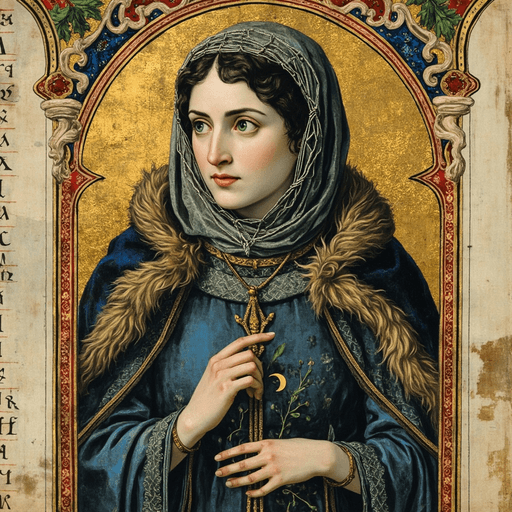
This imaginary interview was generated by artificial intelligence from sources documented in Perceval's profile. It dramatises what the figure might have said based on what we know about them, but does not constitute attested historical testimony. For primary sources and factual documentation, refer to the full profile.