Imaginary interview with Pratibha Patil
by Charactorium · Pratibha Patil (1934 — ?) · Politics · 5 min read
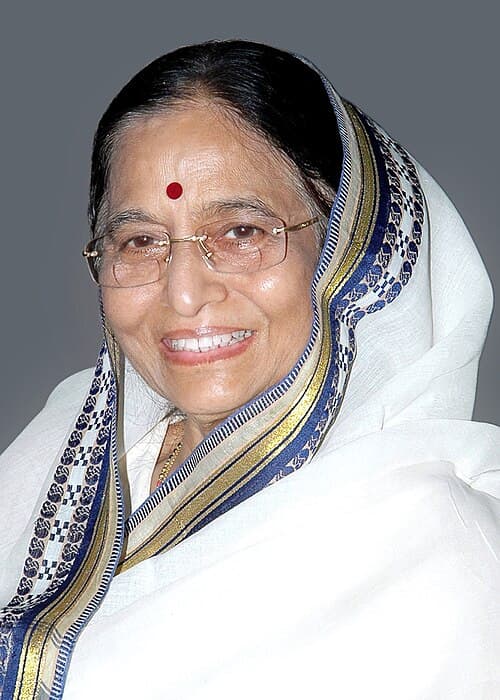
New Delhi, a monsoon morning. In a quiet lounge of the Rashtrapati Bhavan, under the high ceilings designed by Lutyens, a woman in a saffron silk sari receives us, calm and precise. She recently left the highest office of the Indian state; she agrees to look back, without emphasis, on a path that began in a Deccan village.
—How would you describe the place where it all began for you?
I was born in December 1934 in Nadgaon, a town in the Jalgaon district of Maharashtra. It was a world of red earth and fields, where the dust of the Deccan settled on everything, even on books. Few people there imagined that a girl would one day study law. When I think back to that village and look at these three hundred forty rooms around me, I feel not personal pride, but something greater: democracy made this journey possible. A country that lets a child from Nadgaon walk this far keeps its promise.
A country that lets a child from Nadgaon walk this far keeps its promise.
—Studying law in the 1950s as a young woman, what was that like?
In those years, law lecture halls could count women on the fingers of one hand. I was looked at as a curiosity, sometimes kindly, often with surprise. My family was modest, and every rupee spent on studies—which, in many eyes, would be useless for a girl destined for the home—had to be justified. I learned one thing there: knowledge does not wait for permission; you must take it. That conviction, born in a classroom in Maharashtra, never left me.
Knowledge does not wait for permission; you must take it.
—Do you remember the day you founded your first school for girls?
It was in 1962, in Jalgaon, my native region. I had just entered politics, yet my very first decision of public action was not a law or a speech: it was a school for girls. I saw around me so many intelligences sent back to the kitchen before they could even read. I was convinced, and still am, that educating a girl means educating an entire family, and through it a village. That school was my true profession of faith, before the ballot boxes.
Educating a girl means educating an entire family, and through it a village.
—Why did you devote so many years to creating educational institutions in Maharashtra?
Because a single school is not enough. Between the 1970s and 2000, I supported the creation of several colleges and vocational training centers, thinking especially of women from poor backgrounds, those for whom university remained a foreign word. A diploma for them was not an ornament: it was the difference between depending and deciding. I have always believed that India's development would not be played out only in the factories of Bombay, but in those modest classrooms where a peasant woman learns to sign her name instead of pressing an inked thumb.
A diploma for them was not an ornament: it was the difference between depending and deciding.
—What did the power of pardon represent to you, that weighty gesture of the presidency?
The right of pardon is perhaps the most solitary power of a head of state. With that presidential pen, you sign hundreds of laws without trembling; but when it comes to commuting a capital sentence, the hand hesitates, and it must hesitate. I examined many death row cases, and in several instances I chose clemency. I was criticized for granting too many. I answered in conscience: taking a life in the name of the state is an irreversible act, and doubt, in those moments, must always lean toward mercy.
Taking a life in the name of the state is irreversible, and doubt must lean toward mercy.
—On your inauguration day, what oath did you carry within you?
On July 25, 2007, before Parliament, I swore the oath on the Constitution of India. I committed to serve every citizen without distinction of religion, caste, or gender, and to defend our fundamental law. These words are not a formality: they are the very contract of the office. A president belongs to no party, no community; he or she belongs only to the text sworn to protect. Carrying that oath in that circular building built under the British, which became the beating heart of our democracy, was the gravest moment of my public life.
A president belongs to no party, no community; he or she belongs only to the text sworn to protect.
—It is said that at seventy-four, you boarded a military fighter. What happened?
In 2009, I took a flight aboard a Sukhoi-30, a supersonic fighter of our air force. I was seventy-four years old, and under my silk sari I had to put on a pilot's suit, which made some officers smile. But I wanted to show a simple thing: old age and being a woman are not cages. Feeling the Deccan earth disappear beneath the clouds at that speed was to experience in my body what I had always told Indian girls—that no sky is forbidden to them.
Old age and being a woman are not cages; no sky is forbidden.
—How do you reconcile the grandeur of the office with an attachment to a certain simplicity?
At the Rashtrapati Bhavan, evenings quickly fill with state banquets and ceremonies in gilded salons. I learned to go along, because they honor the nation more than my person. But on quieter evenings, I would retreat to my apartments to read or talk with my family, and I remained faithful to a very simple vegetarian diet, that dal and those chapatis of the Marathi cuisine of my childhood. The grandeur of an office must not devour the person who occupies it. One can inhabit a palace of three hundred forty rooms and keep the soul of a village.
One can inhabit a palace of three hundred forty rooms and keep the soul of a village.
—How did you feel becoming the first woman president, in a country that had already known Indira Gandhi?
India had a woman Prime Minister as early as 1966, with Indira Gandhi, whose assassination in 1984 branded us all. But the presidency had never been entrusted to a woman since independence in 1947. On the day of my oath, millions of Indians saw in that event much more than my modest person: a recognition of women's role in the life of the nation. I was not the daughter of a dynasty; I was an activist from the grassroots. Perhaps that is what touched so many mothers and daughters across the country.
I was not the daughter of a dynasty; I was an activist from the grassroots.
—What role did the Congress Party play in your long political career?
I was first elected to the Maharashtra Assembly in 1962, in the Amravati region, and I never left the struggle for nearly five decades. The Congress Party, the Indian National Congress, that of Gandhi and Nehru who led the independence struggle, was my political home always. I climbed each rung patiently, up to the vice-presidency of the Rajya Sabha in the 1980s. One does not improvise a public life: it is built constituency by constituency, file by file, in fidelity to an idea of India.
One does not improvise a public life: it is built constituency by constituency, file by file.
—If you imagined being read in a century, what would you want to be remembered for?
I would like the title to be remembered less than the path. So that a little girl, somewhere in a village as obscure as Nadgaon, might one day learn that another little girl from the Deccan walked all the way to Rashtrapati Bhavan, and say to herself: then, so can I. Power fades, ceremonies vanish, but example remains. If my journey, from the dust of a rural town to the Mughal gardens of this palace, ever serves to convince a single child that the door is not closed, then I will have served far longer than my five-year term.
Power fades, ceremonies vanish, but example remains.
This imaginary interview was generated by artificial intelligence from sources documented in Pratibha Patil's profile. It dramatises what the figure might have said based on what we know about them, but does not constitute attested historical testimony. For primary sources and factual documentation, refer to the full profile.