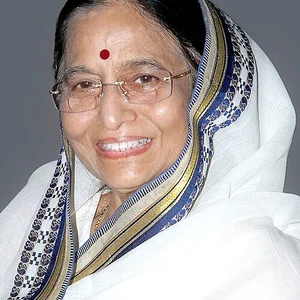

Pratibha Patil is an Indian politician born in 1934 who became the first female President of India from 2007 to 2012. Trained as a lawyer, she was active within the Indian National Congress party and held numerous government positions before reaching the country's highest office.
Pratibha Patil(1934 — ?)
Pratibha Patil
Inde
8 min read
Frequently asked questions
Key Facts
- Born on December 19, 1934, in Nadgaon, in the Bombay Province (present-day Maharashtra)
- Elected Governor of Rajasthan in 2004, becoming the first woman to hold that position in the state
- Elected 12th President of India on July 25, 2007, the first woman to hold the office
- Her presidential term ended on July 25, 2012
- Trained as a lawyer, she served in the Maharashtra Legislative Assembly as early as 1962
Works & Achievements
Pratibha Patil established a school for girls in her home region of Maharashtra, demonstrating from the very start of her career a deep commitment to female education. This pioneering initiative foreshadowed her entire political agenda in support of women's rights.
Pratibha Patil was first elected to the Maharashtra Legislative Assembly, launching a long parliamentary career that would span five decades. She was re-elected multiple times in the same constituency of Amravati.
Pratibha Patil served as Deputy Chairman of the upper house of the Indian Parliament, the Rajya Sabha, from 1986 to 1988. This role placed her at the heart of the national legislative process and strengthened her standing within the Indian National Congress party.
Appointed Governor of Rajasthan by President Abdul Kalam, Pratibha Patil became the first woman to represent the central government in this northwestern Indian state. This appointment was the penultimate step in her rise to the presidency.
By becoming the 12th President of India, Pratibha Patil made history as the first woman to hold the highest office in the Indian state. Her five-year term coincided with a period of strong economic growth and India's growing prominence on the world stage.
Throughout her political career, Pratibha Patil supported the establishment of several educational and vocational training institutions in her home region of Maharashtra, particularly for women from disadvantaged backgrounds.
Anecdotes
On July 25, 2007, Pratibha Patil was sworn in as the first woman to hold the presidency of India since the country's independence in 1947. Her inauguration ceremony at the Parliament in New Delhi was watched by millions of Indians, who saw the event as a historic recognition of women's role in public life.
Before reaching the presidency, Pratibha Patil had founded a school for girls in 1962 in her home region of Maharashtra, convinced that educating women was the key to India's development. This initiative reflected her long-standing commitment to women's empowerment, long before her name became associated with the highest offices of the state.
As president, Pratibha Patil made unusually frequent use of her power of clemency by commuting several death sentences, sparking fierce debate in Indian society. Critics felt she granted pardons too readily, while supporters saw it as an expression of deeply held humanist values.
Pratibha Patil became the first Indian president to fly solo in a Sukhoi-30 military aircraft in 2009, at the age of 74. This display of determination and daring earned the admiration of the Indian Air Force and came to symbolize a presidency that sought to break with convention.
Born into a modest family in Maharashtra, Pratibha Patil had to overcome many obstacles to pursue her law studies in the 1950s, at a time when few women in India had access to higher education. Her journey from Nadgaon to the presidential palace of Rashtrapati Bhavan embodies the social mobility made possible by Indian democracy.
Primary Sources
I am aware of the immense responsibility that this office entails. I pledge to serve every citizen of this great nation without distinction of religion, caste, or gender, and to uphold the Constitution of India.
There shall be a President of India. The executive power of the Union shall be vested in the President and shall be exercised by him either directly or through officers subordinate to him in accordance with this Constitution.
India has made remarkable progress since independence. We must remember the sacrifices of those who fought for our freedom and honor their memory by building a just and prosperous nation.
The government is committed to ensuring inclusive economic growth, eradicating poverty, and guaranteeing every Indian access to education and healthcare. Democracy is only meaningful if it concretely improves the lives of the most vulnerable citizens.
Key Places
Pratibha Patil's birthplace in the Jalgaon district, where she was born on December 19, 1934, and received her early education. This rural village on the Deccan Plateau symbolizes the modest origins of the woman who would become India's first female president.
The presidential palace designed by Edwin Lutyens, and Pratibha Patil's official residence from 2007 to 2012. From this 340-room palace, she served as head of state of the world's largest democracy.
The city in Maharashtra where Pratibha Patil launched her political career in the 1960s, representing the constituency in the State Legislative Assembly. It was here that she built the foundations of her influence within the Indian National Congress party.
The capital of Rajasthan, where Pratibha Patil served as Governor from 2004 to 2007 at the famous Raj Bhavan. This experience as governor was the direct springboard for her presidential candidacy.
The seat of India's legislative power, where Pratibha Patil was sworn in on July 25, 2007, and where she addressed both houses in joint session on several occasions. It is in this circular building, constructed during the British era, that Indian democracy takes shape every day.
Typical Objects

Traditional Indian garment that Pratibha Patil wore at all official ceremonies, often choosing brightly colored silk saris from Maharashtra. This attire symbolized her deep connection to Indian cultural traditions, even while holding the highest office in the land.

The founding document of the Indian Republic on which Pratibha Patil took her oath of office at her inauguration in 2007. As guardian of the Constitution, her role was to uphold it and to sign all legislation passed by Parliament.

The symbolic instrument with which the president affixed her signature to laws, decrees, and presidential pardons. Pratibha Patil's signatures on death sentence commutations sparked heated public debate across India.

A supersonic fighter aircraft of the Indian Air Force in which Pratibha Patil flew in 2009, becoming the first Indian president to pilot such a plane. This landmark event earned her an honorary certificate from the Indian Air Force.
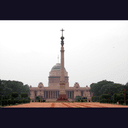
The presidential palace in New Delhi and official residence where Pratibha Patil lived from 2007 to 2012. This grand Indo-British-style building is the symbol of the supreme authority of the Indian state.
📷 Domaine public · Wikimedia Commons ↗
A traditional garland of flowers offered during welcome ceremonies in India, which Pratibha Patil received on her many official visits across the country. This ritual object reflects the culture of Indian hospitality in which the president was deeply rooted.
School Curriculum
Vocabulary & Tags
Key Vocabulary
Tags
Daily Life
Morning
President Pratibha Patil typically began her day with prayers and meditation in keeping with her Hindu spiritual beliefs, around 6 a.m. She would then review the major Indian newspapers — The Hindu, Times of India, Hindustan Times — before receiving daily briefings from her advisors and secretaries at Rashtrapati Bhavan.
Afternoon
Afternoons were devoted to official audiences, meetings with ministers, foreign ambassadors, and delegations from federal states. In her capacity as head of state, she signed bills passed by Parliament and reviewed presidential clemency petitions, often accompanied by her legal advisors.
Evening
Evenings were frequently taken up by state banquets, national honors ceremonies, or cultural events in the halls of the presidential palace. On quieter evenings, Pratibha Patil would retire to her private quarters to read or spend time with her family, maintaining a certain simplicity despite the grandeur of the office.
Food
The president followed a vegetarian diet, in accordance with the religious and cultural traditions of her home region of Maharashtra. Her meals featured dishes typical of Maharashtrian cuisine — dal, chapati, spiced sautéed vegetables — prepared by the palace's kitchen staff.
Clothing
Pratibha Patil invariably wore the traditional sari at all public appearances, choosing vibrant silk fabrics — saffron, emerald green, royal blue — often adorned with gold embroidery. This choice symbolized her commitment to Indian cultural traditions and stood in contrast to the Western attire some Indian women politicians had adopted.
Housing
From 2007 to 2012, Pratibha Patil resided at Rashtrapati Bhavan, the presidential palace in New Delhi built by the British in the early twentieth century. This 340-room palace, surrounded by Mughal gardens, ranks among the largest official residential complexes in the world and also houses the working offices of the presidency.
Historical Timeline
Period Vocabulary
Visual Style
Style portrait officiel mêlant l'esthétique cérémonielle indienne à la dignité républicaine, avec des couleurs chaudes, des textures de soie et l'architecture imposante de la présidence de New Delhi.
Sound Ambience
Un mélange de solennité républicaine et de vibrance urbaine indienne, entre cérémonies d'État à New Delhi et atmosphère populaire du Maharashtra des années 1960-2000.
Liens externes & ressources
Références
Œuvres
Fondation d'une école de filles à Jalgaon
1962
Élection à l'Assemblée législative du Maharashtra
1962
Mandat de Présidente du Rajya Sabha (Sénat)
1986-1988
Gouverneure du Rajasthan
2004-2007
Présidence de la République indienne
2007-2012
Fondation d'établissements d'enseignement supérieur au Maharashtra
1970-2000