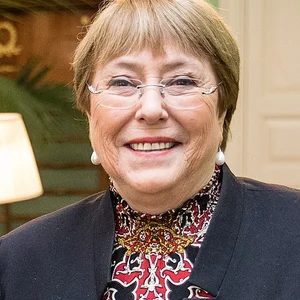

Michelle Bachelet, born in 1951 in Chile, is a physician and politician who became the first female president of Chile (2006–2010, then 2014–2018). A human rights activist, she also led UN Women and the UN High Commissioner for Human Rights.
Michelle Bachelet(1951 — ?)
Michelle Bachelet
Chili
7 min read
Frequently asked questions
Famous Quotes
« I came to power to serve the people, not to be served by them.»
« Being a woman is not a handicap — it is a strength.»
Key Facts
- Born on September 29, 1951, in Santiago, Chile.
- Her father, a general who opposed the 1973 coup, was arrested and died in prison; she herself was arrested and tortured by Pinochet's dictatorship.
- Exiled to East Germany, she continued her medical studies before returning to Chile after the dictatorship ended.
- First female president of Chile (2006–2010), re-elected for a second term (2014–2018).
- First Executive Director of UN Women (2010–2013) and UN High Commissioner for Human Rights (2018–2022).
Works & Achievements
Social protection programme targeting Chile's poorest families, combining financial aid, social support and access to public services. Considered a model for poverty reduction in Latin America.
By appointing a cabinet with exactly as many women as men, Bachelet set a historic global milestone in political equality, inspiring many countries.
During her first term, Bachelet institutionalised environmental policy by creating a dedicated ministry, restructuring the country's ecological governance.
Major reform aimed at eliminating tuition fees at Chilean public universities, responding to the demands of the student movement. It transformed access to higher education in Chile.
Official document from the UN High Commissioner's Office concluding that the treatment inflicted on the Uyghurs could constitute crimes against humanity — a historic and controversial report published at the end of her mandate.
As the first director of UN Women, Bachelet structured this new UN institution and gave it decisive international visibility for women's rights.
Anecdotes
Michelle Bachelet personally experienced Pinochet's dictatorship: in 1975, she and her mother were arrested and detained at Villa Grimaldi, a torture center in Santiago. Her father, General Alberto Bachelet, had refused to support the 1973 coup and died in prison as a result of the mistreatment he suffered. This traumatic experience profoundly shaped her commitment to human rights.
Despite the persecution she endured under Pinochet, Bachelet became a surgeon specializing in pediatrics, then in military medicine — a field reserved for men. She thus broke a double taboo: being a woman in the military and being the daughter of an officer condemned by the regime. In 2002, she was appointed Minister of Defense, which was unprecedented for a woman in Latin America.
During her first presidential term (2006-2010), Bachelet established a gender-equal cabinet: for the first time in the world, a government had exactly as many female ministers as male ministers. This powerful symbolic choice was internationally celebrated as a model of political equality.
In 2010, after the end of her first term, Michelle Bachelet was appointed director of UN Women, the new United Nations entity for gender equality. She thus became the first person to lead this organization created to defend women's rights around the world.
During her second term (2014-2018), Bachelet pushed through an ambitious educational reform aimed at making public university education free in Chile, a country that had one of the most expensive tertiary education systems in the world. This measure responded to years of massive student mobilizations.
Primary Sources
"We have the extraordinary opportunity to build together an exemplary democracy, a more just, more united society, with greater equality between men and women."
Michelle Bachelet testified about her detention at Villa Grimaldi in January–February 1975, describing the conditions of internment and the violence suffered by political prisoners under the dictatorship.
"Gender equality is not only a fundamental right, it is the necessary foundation for a peaceful, prosperous, and sustainable world."
Under Bachelet's leadership, the High Commissioner's Office publicly denounced human rights violations in Venezuela, China (Xinjiang), and Ethiopia, engaging the institution's international credibility.
Key Places
The seat of the Chilean presidency, La Moneda is the place where Bachelet served her two presidential terms. It is also the palace bombed during the 1973 coup against Allende — a historically charged location for her.
A detention and torture center run by the DINA (Pinochet's secret police) where Bachelet and her mother were imprisoned in 1975. Today it has been transformed into a peace park and memory museum.
It was from this office that Bachelet led the United Nations Entity for Gender Equality from 2010 to 2013, promoting women's rights on a global scale.
Headquarters of the United Nations High Commissioner for Human Rights, where Bachelet served from 2018 to 2022, publishing critical reports on states such as China, Russia, and Venezuela.
Bachelet lived in exile in the GDR, where she studied German and sciences — an experience that shaped her international outlook and her ability to navigate between different cultures and political systems.
Typical Objects

Bachelet is first and foremost a pediatric physician. The stethoscope symbolizes her commitment as a caregiver serving the most vulnerable, a vocation that has shaped her entire political career in favor of social rights.
📷 CC BY-SA 4.0 · Wikimedia Commons ↗
Trained at the National School of Military Health, Bachelet wore the uniform within an institution once associated with the oppression of her own family. This paradox symbolizes her capacity to reconcile opposites in post-dictatorship Chile.

During her two terms, Bachelet worked on constitutional reform projects to modernize the Constitution inherited from Pinochet (1980). The annotated copy represents the struggle for a more inclusive democracy.

Present at all her inaugurations, the red, white, and blue starred flag embodies Chile's democratic reconquest after the dictatorship — a powerful symbol for a woman whose father died for refusing to betray the Republic.

As High Commissioner (2018-2022), Bachelet produced reports on situations of serious violations around the world. These official documents have become major diplomatic tools for the protection of human rights.

A symbol of contemporary multilateral diplomacy, the phone is the daily negotiation tool of a leader who has managed complex international crises from the La Moneda palace to the United Nations in Geneva.
School Curriculum
Vocabulary & Tags
Key Vocabulary
Tags
Daily Life
Morning
Bachelet starts her days very early, a habit inherited from her medical and military training. She reviews diplomatic or presidential briefings at dawn, often accompanied by a black coffee. Reading the national and international press is an invariable part of her morning routine.
Afternoon
Her afternoons are structured around cabinet meetings, official audiences, or, at the UN, consultations with national delegations. She is renowned for her attentive listening and her ability to synthesize complex positions during lengthy negotiations.
Evening
In the evenings, Bachelet favors family time when her schedule allows. She is known for her passion for music — she plays guitar and listens to Chilean nueva canción, particularly Victor Jara. Reading remains a constant pleasure, from novels to UN reports.
Food
True to traditional Chilean cuisine, Bachelet enjoys empanadas, cazuela (Chilean stew), and Pacific seafood. A physician by training, she is mindful of a balanced diet. Maté and coffee are her working beverages.
Clothing
In her presidential role, Bachelet favors understated suits in national colors (red, white, blue), conveying authority without ostentation. At the UN, she opts for neutral yet elegant international attire. She deliberately avoids extravagance, preferring an approachable image.
Housing
During her presidential terms, she resides at the Casa de Gobierno in Santiago and at the official La Moneda residence. In Geneva, she occupies a modest diplomatic residence. She is known for turning her living spaces into informal meeting places with her collaborators.
Historical Timeline
Period Vocabulary
Visual Style
Un style visuel ancré dans le réalisme politique latino-américain, mêlant la chaleur des tons andins aux codes institutionnels froids de la diplomatie onusienne.
Sound Ambience
Un mélange de sons andins et de résonances institutionnelles onusiennes, entre mobilisations populaires à Santiago et diplomatie multilatérale à Genève.
Liens externes & ressources
Références
Œuvres
Création du système Chile Solidario
2006-2010
Cabinet paritaire — premier gouvernement à parité hommes-femmes
2006
Création du Ministère de l'Environnement chilien
2010
Réforme éducative — gratuité de l'université
2015-2018
Rapport sur la situation des droits humains au Xinjiang (Chine)
2022
Direction d'ONU Femmes
2010-2013