Character Catalog

Historical Library

CollectionGalaxy
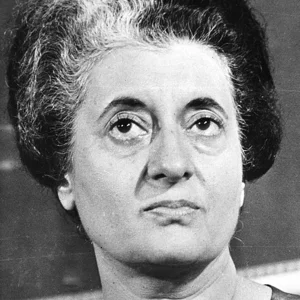
Portrait de Indira Gandhi

Indira Gandhi

Indira Gandhi

1917 — 1984

Inde, Raj britannique, Union indienne

PoliticsPolitique20th Century

Émotions disponibles (6)

N

Neutre

par défaut

I

Inspirée

P

Pensive

S

Surprise

T

Triste

F

Fière

Key Facts

    Works & Achievements

    Nationalisation of Indian banks (1969)

    Indira Gandhi nationalised 14 major private banks, a populist measure that strengthened her grip on Congress and radically transformed the Indian economy by giving poor rural populations access to credit.

    Victory in the Indo-Pakistani War and creation of Bangladesh (1971)

    Under Indira Gandhi's leadership, the Indian army won a decisive victory against Pakistan in two weeks, enabling the creation of Bangladesh. She was hailed as 'Durga' (the warrior goddess) even by the opposition itself.

    Pokhran I Programme — 'Smiling Buddha' (1974)

    India's first nuclear test, conducted secretly under her leadership, making India the sixth nuclear power in the world. This strategic decision aimed to assert India's sovereignty and power.

    Green Revolution in India (1966-1971)

    Indira Gandhi actively supported the introduction of new high-yield wheat varieties and agricultural modernisation, enabling India to achieve food self-sufficiency and break free from dependence on American food aid.

    My Truth (autobiography) (1981)

    A collection of interviews and personal reflections by Indira Gandhi, in which she looks back on her political life, her vision of Indian democracy, and her relations with the world's major powers.

    ISRO Programme — launch of the Aryabhata satellite (1975)

    Under her impetus, India launched its first artificial satellite, Aryabhata, laying the foundations of the Indian Space Research Organisation (ISRO) and the nation's space ambitions.

    Anecdotes

    As a child, Indira Gandhi burned her cotton foreign dolls to support Gandhi's swadeshi movement. Her father Nehru had raised her in the spirit of Indian nationalism, and she understood early on that even toys could become a political act.

    During Operation Bluestar in June 1984, Indira Gandhi ordered the Indian army to enter the Golden Temple in Amritsar to flush out armed Sikh militants. This decision, one of the most controversial of her career, cost her her life a few months later.

    Indira Gandhi was the first woman to lead a democratic government in a Third World country. Upon her election in 1966, many opponents nicknamed her 'goongi gudiya' ('dumb doll'), thinking they could easily manipulate her — they were sorely mistaken.

    During the state of emergency she declared in 1975, Indira Gandhi had thousands of political opponents arrested and suspended civil liberties. Paradoxically, after her electoral defeat in 1977, she accepted the verdict of the ballot box and left power without resistance.

    Indira Gandhi had been passionate about astronomy since childhood. She maintained a lengthy correspondence with her father Nehru, imprisoned by the British, in which he explained the history of the world and sciences from his cell — these letters were published under the title 'Glimpses of World History'.

    Primary Sources

    Indira Gandhi's letter to the nation upon the declaration of the Emergency (26 juin 1975)
    I am personally convinced that the Emergency is in the interest of the nation. Democracy can only survive if order is maintained.
    Speech at the United Nations General Assembly (1974)
    Poverty is the worst form of violence. We cannot afford to ignore the millions of men and women living in misery.
    Speech of October 31, 1984, the day before her assassination (31 octobre 1984)
    I don't mind if I live or die. I have lived a long life and I am proud that I have devoted my entire life to the service of my people.
    Correspondence with Nehru — 'Letters from a Father to his Daughter' (1928-1933)
    You asked me to write to you. And there is no better subject than the history of the world, for it is the history of us all.
    Speech at the Pokhran I nuclear test ('Smiling Buddha') (18 mai 1974)
    India has successfully conducted an underground nuclear test of a nuclear device for peaceful purposes.

    Key Places

    Anand Bhavan, Allahabad

    Family home of the Nehrus, now a national museum. It was here that Indira Gandhi was born in 1917 and grew up in a household at the heart of the Indian independence movement.

    South Block, New Delhi

    Seat of the Indian Prime Minister's office, where Indira Gandhi governed India for more than fifteen years in total. This colonial-style building is the nerve center of Indian executive power.

    Golden Temple, Amritsar

    The holiest site in Sikhism, scene of Operation Bluestar in June 1984, ordered by Indira Gandhi against armed militants. This event, deeply traumatic for the Sikh community, precipitated her assassination.

    1, Safdarjung Road, New Delhi

    Indira Gandhi's official residence as Prime Minister, where she was assassinated on October 31, 1984 by her own bodyguards. The site has since been transformed into a national memorial.

    Pokhran, Rajasthan

    Desert site where India's first nuclear test was conducted in May 1974, codenamed 'Smiling Buddha'. This decision by Indira Gandhi made India a nuclear power and altered the geopolitical balance in Asia.

    Typical Objects

    Khadi cotton sari

    Indira Gandhi consistently wore saris made of khadi (hand-spun cloth), a symbol of the independence movement launched by Gandhi. The white rose pinned to her sari was her personal trademark, instantly recognizable.

    Intelligence Bureau files

    As Prime Minister, Indira Gandhi personally oversaw India's intelligence services and reviewed national security reports daily, particularly regarding separatist threats in Punjab and Kashmir.

    South Block secure telephone

    From her office in South Block, New Delhi, Indira Gandhi managed diplomatic crises. Her secure telephone allowed her to coordinate the military intervention during the 1971 war that led to the creation of Bangladesh.

    Portraits of Mahatma Gandhi and Nehru

    Indira Gandhi's office at the official residence on Safdarjung Road was adorned with portraits of her father Nehru and Mahatma Gandhi, the guiding figures of her political and moral upbringing.

    Indian Air Force presidential aircraft

    Indira Gandhi undertook numerous diplomatic tours around the world, particularly among the non-aligned nations, strengthening India's role on the international stage throughout the 1970s.

    Charkha spinning wheel

    A legacy of the Gandhian movement, the charkha spinning wheel symbolized national self-sufficiency. Indira Gandhi owned one, a constant reminder of her nationalist roots and the struggle for independence.

    School Curriculum

    LycéeHistoire

    Vocabulary & Tags

    Key Vocabulary

    Tags

    Indira GandhipolitiqueHomme/femme politiquedecolonisationDécolonisationguerre-froideGuerre froide

    Daily Life

    Morning

    Indira Gandhi rose at dawn, practicing yoga and meditation before any activity. From 6 a.m., she would go through press reviews and dispatches from the Intelligence Bureau, often in the company of her personal secretary. Working breakfasts with her close advisers began as early as 7:30 a.m.

    Afternoon

    Afternoons were devoted to official audiences, cabinet meetings, and receptions for foreign dignitaries. Indira Gandhi placed great importance on these diplomatic appointments and personally prepared her briefing files. She also oversaw sensitive economic matters, particularly agricultural and industrial policy.

    Evening

    Evenings were often taken up by ceremonial obligations — receptions at Rashtrapati Bhavan, state dinners, cultural events. In private, she enjoyed reading (Indian and international literature), personal correspondence, and gardening in the grounds of her official residence.

    Food

    Indira Gandhi followed a vegetarian diet influenced by Brahmin tradition and Gandhian principles. She favored North Indian cuisine — dal, rice, vegetables sautéed with mild spices — and ate frugally, in keeping with the ideal of austerity instilled by her nationalist upbringing.

    Clothing

    Indira Gandhi wore exclusively khadi saris (hand-spun cotton), a symbol as much political as personal. Her favorite colors were white, beige, and pastel tones. Her personal style signature was a fresh white rose pinned to her sari, which she wore every single day without exception.

    Housing

    Indira Gandhi resided at 1 Safdarjung Road in New Delhi, an official residence modest by the standards of other heads of state. The house was surrounded by a garden she cherished. Her personal quarters reflected a blend of family objects inherited from Nehru, diplomatic gifts, and references to classical Indian culture.

    Historical Timeline

    1917Naissance d'Indira Priyadarshini Nehru Ă  Allahabad, fille de Jawaharlal Nehru, futur Premier ministre.
    1930Gandhi lance la Marche du Sel ; Indira, âgée de 13 ans, fonde le 'Vanar Sena' (armée des singes), groupe d'enfants nationalistes.
    1942Mariage avec Feroze Gandhi (sans lien de parenté avec le Mahatma). Arrestation d'Indira pour participation au mouvement Quit India.
    1947Indépendance de l'Inde le 15 août. Partition sanglante avec le Pakistan. Nehru devient Premier ministre.
    1955Conférence de Bandung : naissance du mouvement des non-alignés, dont l'Inde est un pilier sous Nehru.
    1964Mort de Nehru. Indira Gandhi est élue au Parlement et nommée ministre de l'Information.
    1966Indira Gandhi devient Première ministre de l'Inde, première femme à occuper ce poste dans le pays.
    1971Guerre indo-pakistanaise : l'Inde soutient le Bangladesh qui proclame son indépendance. Victoire militaire décisive d'Indira Gandhi.
    1974L'Inde réalise son premier essai nucléaire souterrain ('Smiling Buddha') au Rajasthan, devenant une puissance nucléaire.
    1975Proclamation de l'état d'urgence (1975-1977) : suspension des libertés civiles, arrestation des opposants, censure de la presse.
    1977Défaite électorale d'Indira Gandhi. Elle quitte le pouvoir — premier transfert pacifique du pouvoir en Inde.
    1980Retour triomphal au pouvoir. Mort de son fils Sanjay Gandhi dans un accident d'avion.
    1984Opération Bluestar : assaut de l'armée indienne contre le Temple d'Or d'Amritsar occupé par des militants sikhs.
    1984Assassinat d'Indira Gandhi le 31 octobre par deux de ses gardes du corps sikhs, en représailles à l'opération Bluestar.

    Period Vocabulary

    Non-Alignment — Foreign policy of not formally allying with either the American or Soviet bloc during the Cold War. Indira Gandhi's India was one of its leading proponents, particularly at the conferences of non-aligned countries.
    Garibi hatao — Hindi slogan meaning 'Eradicate Poverty', used by Indira Gandhi during the 1971 elections. This social promise earned her a landslide victory and became a symbol of her populist policies.
    State of Emergency — Period of suspension of fundamental rights proclaimed by Indira Gandhi from June 1975 to March 1977, justified by threats to national security. It remains one of the most controversial episodes in Indian democracy.
    Operation Bluestar — Code name for the military assault ordered by Indira Gandhi in June 1984 against the Golden Temple in Amritsar, which had been occupied by Sikh separatist militants led by Jarnail Singh Bhindranwale.
    Khalistan — A project to create an independent Sikh state in Punjab. This armed separatist movement was one of the main domestic crises Indira Gandhi had to contend with in the 1980s.
    Green Revolution (Harit Kranti) — Agricultural modernisation programme launched in India in the 1960s–70s, introducing high-yield seeds, irrigation, and chemical fertilisers, enabling India to achieve food self-sufficiency.
    Indian National Congress (I) — Faction of the Indian National Congress founded by Indira Gandhi in 1978 after her expulsion from the historic Congress party. The 'I' officially stood for 'Indian' but was universally understood as referring to 'Indira'.
    Swadeshi — Economic and political principle advocating the use of India-made goods and the rejection of foreign imports. Inherited from the Gandhian movement, it shaped Indira Gandhi's upbringing and her nationalist economic vision.
    Lok Sabha — Lower house of the Indian Parliament (literally 'house of the people'), elected by direct universal suffrage. Indira Gandhi served there and was Prime Minister — her command of this assembly defined her entire political career.
    Indian Nuclear Deterrence — India's policy of developing an autonomous nuclear capability without joining the Nuclear Non-Proliferation Treaty (NPT), which India refused to sign as discriminatory against non-Western powers.

    Gallery

    Woman Montage (1)

    Woman Montage (1)

    Painting of a Leucistic tiger at IGZoo park

    Painting of a Leucistic tiger at IGZoo park

    Statue of The Sun God

    Statue of The Sun God

    Body Painting Puli Kali Artist

    Body Painting Puli Kali Artist

    Dhi - a Painting by Saudamini Mishra

    Dhi - a Painting by Saudamini Mishra

    Delhi Airport Surya Statue 2

    Delhi Airport Surya Statue 2

    Mermaid Sculptures at RK Beach Park 01

    Mermaid Sculptures at RK Beach Park 01

    Indira Gandhi Statue, Bhubaneswar

    Indira Gandhi Statue, Bhubaneswar

    LORD BUDDHA STATUE - ADRIKA

    LORD BUDDHA STATUE - ADRIKA

    Poster of results,Women's History Month,India,2014

    Poster of results,Women's History Month,India,2014

    Visual Style

    Style portrait officiel indien années 1970, mêlant réalisme politique occidental et références à la peinture moghole, dominantes saffran, blanc khadi et grès rouge de New Delhi.

    #C84B1C
    #F5F0E8
    #8B6914
    #2C4A3E
    #D4A843
    AI Prompt
    Portrait of a determined Indian stateswoman in the 1970s. Dignified composition inspired by Indian modernist painting and official state portraiture. Warm earth tones and deep saffron, white cotton khadi sari with hand-spun texture, a single white rose pinned at the shoulder. Grey-streaked hair pulled back severely. Background suggests the red sandstone of New Delhi governmental buildings, Mughal architectural arches. Dramatic lighting emphasizing resolve and authority. References to Indian miniature painting traditions blended with mid-century political realism. Map of the Indian subcontinent subtly present.

    Sound Ambience

    Atmosphère sonore du New Delhi gouvernemental des années 1970 — bureaux officiels animés, radio nationale, foules politiques et mousson indienne.

    AI Prompt
    Sounds of a busy Indian governmental office in 1970s New Delhi: the clatter of typewriters, rustling of official documents, distant crowds chanting political slogans in Hindi. Street sounds drifting through open windows — rickshaw bells, vendors calling, monsoon rain on stone courtyards. Occasional military parade drums, All India Radio news broadcasts in the background, the hum of ceiling fans in a colonial-era building. During parliamentary sessions, the resonant echo of the Lok Sabha chamber, heated debates in Hindi and English, microphone feedback.

    Portrait Source

    Wikimedia Commons — domaine public — Anefo — 1977