Kids interview Ptolemy
by Charactorium · Ptolemy (250 — 350) · Sciences · 5 min read
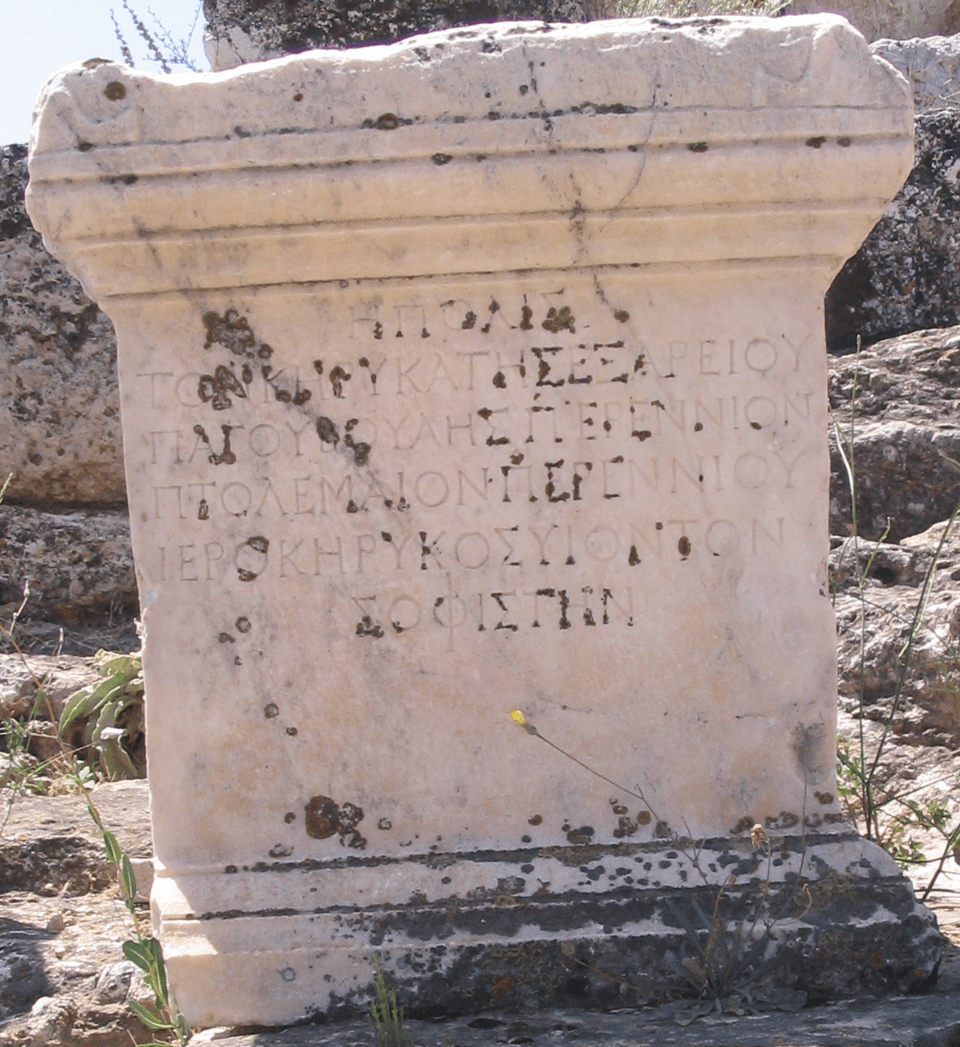
Two twelve-year-old visitors push open the door of a room in the Mouseion, in Alexandria. An old man in a large woolen cloak awaits them, his arms full of papyrus scrolls. He smiles, pleased that children have come to hear him talk about the stars.
—What were your evenings like when you watched the sky?
You know, my child, the evening was my favorite time. After a light meal — bread, olives, some fish from the port — I would bring out my instruments. Imagine a night with no light anywhere, just the stars, huge above Alexandria. I had an armillary sphere, a large graduated bronze ring: it helped me measure the height of the Sun in the sky. And a gnomon, a simple rod stuck in the ground, whose shadow gave me the time and place. I wrote everything on papyrus, by hand, by the light of an oil lamp. The sky was my great open book.
The sky was my great open book.
—Were you afraid, all alone at night observing the stars?
Afraid? No, my child. But I remember one night that tightened my heart. It was in the year 141, here in Alexandria. The Moon slowly darkened, as if swallowed by a shadow. We call that an eclipse. Many people at the time believed it was a bad omen, a sign of misfortune. I knew it was the Earth passing between the Sun and the Moon. So I was not afraid: I had my stylus and my papyrus, and I noted every moment. Understanding something, you see, is the best way to no longer fear it.
Understanding something is the best way to no longer fear it.
—Why did you say the Earth was in the middle of everything?
Because that's what my eyes and my calculations showed me, my child. In my great book, the Almagest, I write that the Earth is 'situated in the middle of the heavens, like a center.' Imagine a large motionless ball, the Earth, and all around it, the Sun, Moon, and stars revolving. In my time, no one felt the Earth moving under their feet — so how could they believe it was hurtling through space? I was wrong, we know that today. But with what I could observe, it was the most solid explanation. Science advances like that: we build, and one day someone corrects.
Science advances like that: we build, and one day someone corrects.
—What's an epicycle? Your stuff seems complicated!
Ha! You're right, it was complicated. Let me explain gently. The problem is that the planets in the sky sometimes go backward, as if hesitating. Strange, right? To explain that without moving the Earth, I imagined the epicycle: a small circle that the planet describes, while that small circle itself revolves around us. Imagine a marble rolling along the edge of a big turning wheel. I even added a special point, the equant, to make my predictions even more accurate. It was a bit like a great game of gears drawn in the sky.
A great game of gears drawn in the sky.
—They say you copied another scholar, is that true?
Ah, that question comes up often, and it's honest. Here's the truth, my child. Before me lived a great astronomer, Hipparchus of Nicaea. At the Library of Alexandria, I could read all his works, hundreds of scrolls. I used his observations, corrected them, supplemented them, and organized them in my Almagest. But I didn't always name him, and scholars still reproach me for that today. In my time, people thought less about 'who found what' than about gathering all knowledge in one place. Today, they'd say I should have cited my sources better. You see, you learn even a thousand years after death.
You learn even a thousand years after death.
—Why was that great library so important?
Because without it, my child, I could have done nothing. Imagine a vast place, the Mouseion, full of scholars, poets, and thousands of papyrus scrolls arranged on shelves. All Greek knowledge was there: Hipparchus's observations, Aristarchus's ideas — who already dared to speak of a Sun at the center. I would come to read, compare, copy. It was like a treasure I could draw from. A scholar never starts from nothing: he stands on the shoulders of those before. The Library was the memory of the world — and I was lucky to work there.
A scholar never starts from nothing: he stands on the shoulders of those before.
—How did you make maps of countries you had never seen?
Good question, my child! I never traveled to the ends of the known world. But merchants, soldiers, sailors returned with stories: 'so many days' march south,' 'such a city on the bank of such a river.' In my Geography, I gathered the coordinates of thousands of places, like a vast list of points. Then I invented a way to draw the round Earth on a flat sheet — we call that a projection. It was like gently flattening the skin of an orange without tearing it. My maps were imperfect, but they were used for over a thousand years.
Gently flattening the skin of an orange without tearing it.
—Is it true that because of you, an explorer took the wrong path?
Yes, and it makes me a bit uneasy! In my Geography, I miscalculated the size of the Earth: I made it too small. Fifteen centuries after my death, a navigator named Christopher Columbus read my numbers. He believed Asia was very close by sailing west, within reach of sails. He set out on the ocean... and stumbled upon lands unknown to anyone in Europe. You see, my child: a small error in a calculation can travel very far, across the centuries, and change the history of the whole world.
A small error can travel across the centuries and change history.
—Did you also work on music? What's the connection with the stars?
You'd be surprised, my child! For me, music and the sky followed the same laws: those of numbers. In my treatise, the Harmonics, I sought why certain sounds go so well together. In my time, two groups were arguing. Some said: 'trust your ear alone.' Others: 'no, only calculations matter.' I sought a path between the two. I write that 'the criterion in matters of harmony is the combination of hearing and reason.' In other words: listen with your ear, but check with your head. Both together are better than each alone.
Listen with your ear, but check with your head.
—How would it feel to know that people still read you today?
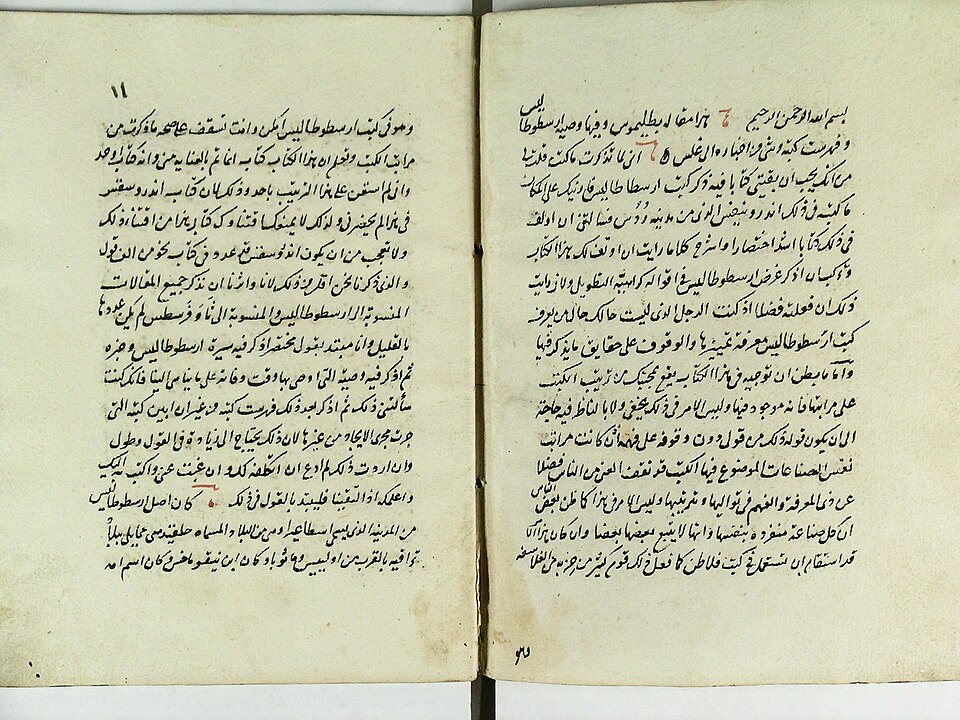
My child, it touches me deeply. When I wrote my Almagest on my papyrus scrolls, I didn't know if it would survive oblivion. Many works of my masters have disappeared. But scholars copied mine, and in the 9th century, in Baghdad, it was translated into Arabic. They called it Al-Majisti, 'the greatest.' Thanks to them, my work has reached you. My ideas were sometimes wrong, I know. But they made people think, doubt, correct — for over a thousand years. If you, today, look up at the stars with curiosity, then I have not worked in vain.
If you look up at the stars with curiosity, I have not worked in vain.
Read further
This imaginary interview was generated by artificial intelligence from sources documented in Ptolemy's profile. It dramatises what the figure might have said based on what we know about them, but does not constitute attested historical testimony. For primary sources and factual documentation, refer to the full profile.