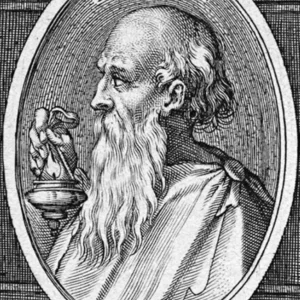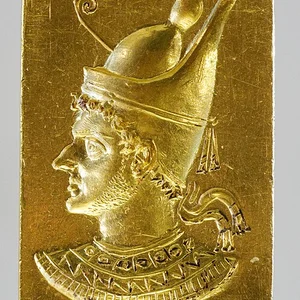

A Greek astronomer and mathematician of the 2nd century CE, Ptolemy developed the geocentric model that dominated Western astronomy for over a thousand years. His major work, the Almagest, is a foundational treatise of ancient astronomy compiling observations and mathematical theories.
Ptolemy(250 — 350)
Ptolemaios
Empire romain, Égypte antique
7 min read
Frequently asked questions
Key Facts
- Wrote the Almagest (c. 150 CE), a comprehensive synthesis of ancient Greek astronomy
- Developed the geocentric model with a system of epicycles to explain planetary motion
- Created astronomical tables enabling the prediction of the positions of celestial bodies
- Made contributions to ancient geography, optics, and cartography
- His theory remained dominant until the Copernican Revolution in the 16th and 17th centuries
Works & Achievements
A 13-book treatise synthesizing the whole of Greek astronomy, presenting the geocentric model with epicycles. The standard reference in astronomy for over 1,400 years, until Copernicus.
In 8 books, this cartographic work lists the geographical coordinates of thousands of locations and proposes methods of map projection. It influenced European cartography through to the Renaissance.
A 4-book treatise laying out the theoretical foundations of astrology within the framework of ancient scientific thought. The standard astrological text in both the medieval Arabic and Latin worlds.
A 3-book treatise on music theory seeking to establish a mathematical basis for musical intervals. Ptolemy offers an original synthesis between the Pythagorean and Aristoxenian schools.
A partially preserved treatise examining vision, reflection, and the refraction of light. Ptolemy provides the first description of atmospheric refraction and its effect on celestial observations.
Simplified astronomical tables derived from the Almagest, designed for practical use by astronomers and astrologers. They allowed the positions of celestial bodies to be calculated quickly.
Anecdotes
Ptolemy reportedly spent years compiling the observations of his predecessors, particularly Hipparchus of Nicaea, without always crediting them. Some modern historians have found that several of his astronomical data points appear to have been borrowed from Hipparchus with minor adjustments, sparking debate about the boundary between synthesis and plagiarism in the ancient world.
His work the Almagest was translated into Arabic in the 9th century under the title 'Al-Majisti' (the greatest), a term that gave the text its Western name. Without the Arab scholars who copied and commented on it, this monumental astronomical work would likely have been lost, like so many other ancient texts.
Ptolemy devised a system of cartographic projection to represent the spherical Earth on a flat surface — a major innovation. His Geography listed the coordinates of thousands of locations, but his miscalculations of the Earth's size influenced Christopher Columbus, who underestimated the distance to Asia fifteen centuries later.
In his treatise on music, the Harmonics, Ptolemy attempted to reconcile mathematics with auditory perception. He criticized musicians who relied on their ear alone just as much as theorists who ignored listening entirely, seeking a middle path between reason and experience.
Ptolemy developed a theory of epicycles to explain the apparent movement of the planets without challenging Earth's place at the center of the universe. Though ultimately incorrect, the system was precise enough to predict eclipses and planetary positions, and remained the dominant model until Copernicus in the 16th century.
Primary Sources
We shall first show that the heavens are spherical in shape and move spherically, that the Earth is spherical in form and situated at the center of the heavens.
Cartography is a representation through drawing of the entire known world, together with the phenomena contained within it. It differs from chorography in that it concerns itself with large regions rather than local details.
The criterion in the study of harmonics is the combination of hearing and reason — not hearing alone, as the empiricists maintain, nor reason alone, as the Pythagoreans assert.
The first method, by which one may predict the celestial configurations of the sun, moon, and stars, has already been set forth in the appropriate work through systematic demonstration.
Key Places
The city where Ptolemy spent most of his life and carried out all of his known astronomical observations. One of antiquity's greatest intellectual centers, it was home to the famous Library and the Mouseion.
The great scholarly institution where Ptolemy had access to the works of his Greek predecessors, including Hipparchus and Aristarchus. This place symbolizes the transmission of ancient knowledge that he synthesized in his writings.
A city in Upper Egypt considered the likely birthplace of Ptolemy, according to the Byzantine geographer Theodore Meliteniotes. It was located in the Thebaid region.
A coastal city near Alexandria where Ptolemy is said to have made some of his celestial observations, mentioned in the Almagest as the site of an observation dated to 146 AD.
Liens externes & ressources
Références
Œuvres
Almageste (Μαθηματικὴ Σύνταξις)
vers 150 ap. J.-C.
Géographie (Γεωγραφικὴ Ὑφήγησις)
vers 150 ap. J.-C.
Tetrabiblos (Ἀποτελεσματικά)
vers 160 ap. J.-C.
Harmoniques (Ἁρμονικά)
vers 160 ap. J.-C.
Optique
vers 160 ap. J.-C.
Tables pratiques (Πρόχειροι Κανόνες)
vers 150 ap. J.-C.