Imaginary interview with Ptolemy
by Charactorium · Ptolemy (250 — 350) · Sciences · 6 min read
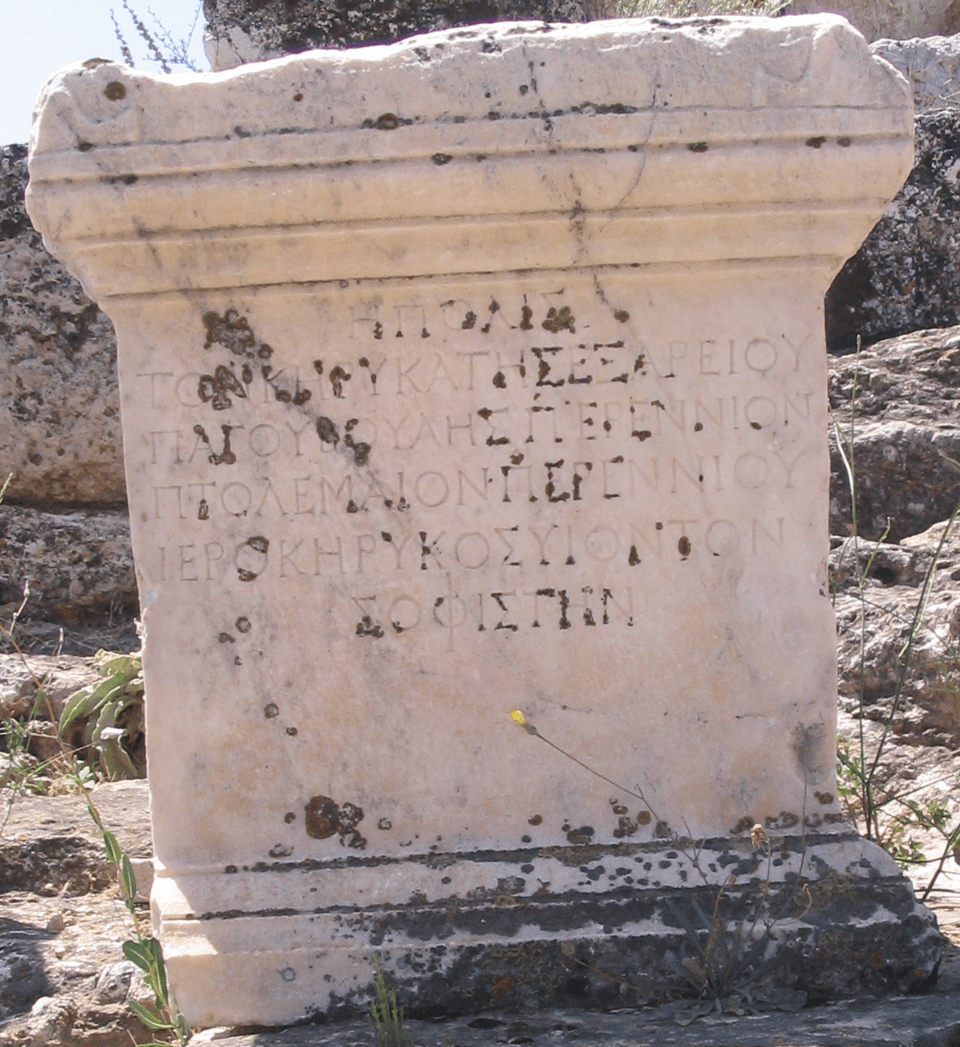
Alexandria, an evening in the summer of 150. On the terrace of a house in the Greek quarter, the air still smells of the salt of the harbor and the wax of lamps. Leaning over his papyrus rolls, a bronze armillary sphere turned toward the sky that is lighting up, Claudius Ptolemy agrees to put down his reed pen for a moment to talk about his world — the one that, he believes, fits in thirteen books.
—Why keep the Earth motionless at the center of everything, when the whole sky seems to turn?
I am often asked why I place the Earth in the middle of everything. Look at the vault turning each night in a single motion, like a perfect sphere: where would you put this center, if not under our feet? In my great treatise, I write that the sky is spherical and moves in the manner of a sphere, that the Earth is spherical in shape and situated in the middle of the heavens, like a center. If our ground were hurtling through the ether, clouds and birds would be left behind, and no stone thrown straight up would fall back at our feet. Aristotle already taught this, and my measurements with the armillary do not contradict it. Geocentrism is not a belief for me: it is what my eyes and my calculations agree on.
—Your nested circles intrigue. How do you explain these planets that seem to move backward in the sky?
The planets are capricious travelers: Mars advances, slows down, then retreats across the vault, as if hesitating. To account for these whims without dislodging the Earth, I have each star revolve on a small circle — the epicycle — itself carried by a larger circle. And when the numbers still resisted, I imagined a point from which the motion appears uniform: what I call the equant. I have been criticized for this mechanism, I know. But it predicts the time of an eclipse and the position of Jupiter in a month, and that is all I ask of a model: to save the appearances. No matter if my circles are the exact framework of the world, as long as they give the calculator the correct position on the appointed evening.
To save the appearances: that is all I ask of a model.
—Where did you find the knowledge of those who came before you?
Everything I know, I first read. In the halls of the Mouseion, under the protection of the Muses, slept the rolls of my predecessors: the eclipses once noted by the Chaldeans, the circles of Aristarchus who dared, he, to make the Earth revolve around the Sun. I unrolled these papyri, I weighed each measurement. Aristarchus was wrong, in my opinion — his moving world offends common sense and the senses too much — but I never despised his audacity. The great library was already declining in my time, its treasures crumbling under dust. That is perhaps why I wanted to gather everything in a single work: so that at least what is valuable would be saved in a chest, the day the shelves empty.
—It is whispered that you owe much to Hipparchus without always naming him. What do you reply?
Hipparchus of Nicaea is my master, though he died before I was born. Without his records, nearly three centuries old, how could I have grasped the slow drift of the stars, that precession he himself had sensed? I took his observations, I compared them to my own made in Alexandria, and the gap of years gave me truths that a single human life could not attain. Some may say that I do not cite him on every page, that I appropriate his labor. But in our schools, building on the ancient is not stealing: it is honoring. I hold his lamp higher, that is all. Would one reproach the mason for raising a wall on foundations he did not dig himself?
—Tell us about one of your nights of observation.
My finest hours are nocturnal. When evening comes, after a frugal meal — bread, olives, a fish from the harbor — I orient my instruments toward the vault. My bronze armillary, fixed in the plane of the meridian, gives me the height of the stars; my gnomon traces on the ground the shadow that tells the time and latitude. Thus one night, above Alexandria, I watched for a lunar eclipse and noted the exact moment when the shadow bit it — for an eclipse is a clock that the sky offers free to those who know how to read it. Sometimes I go to Canopus, on the coast, for a clearer sky. Each reading, recorded on papyrus at the following dawn, becomes a stone in my edifice.
An eclipse is a clock that the sky offers free to those who know how to read it.
—How do you go from an angle measured in the sky to a number written on papyrus?
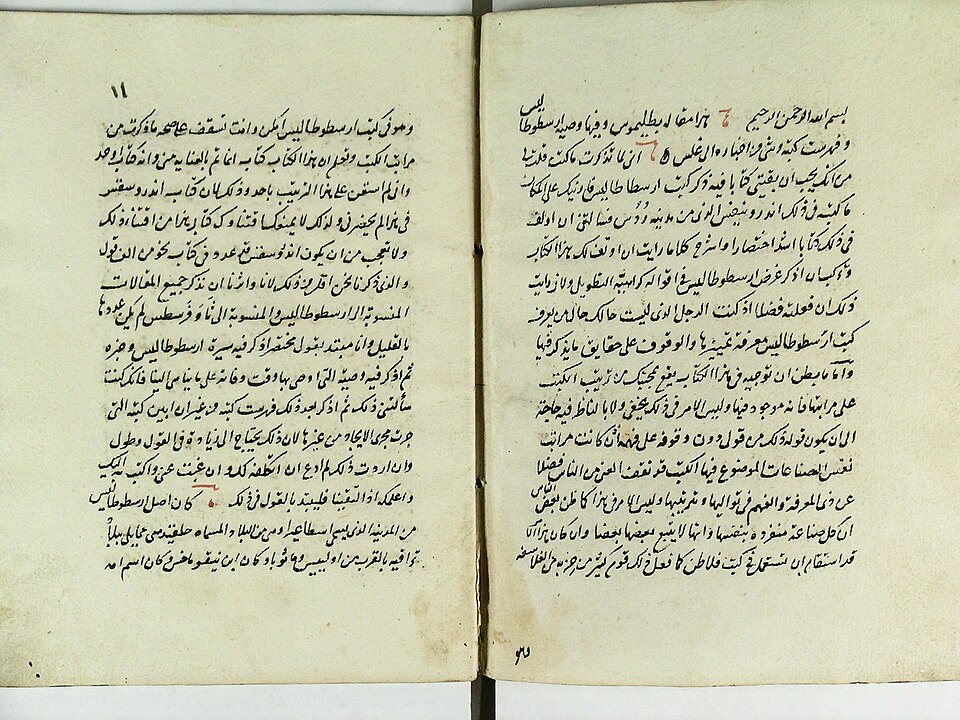
Before predicting a star, you must know how to measure an angle, and for that I had to forge my own calculation tools. In my treatise appears a table of chords: for each arc of a circle, I inscribed the length of the chord that subtends it, half-degree by half-degree. It is the scale that translates angles of the sky into manageable numbers — without it, no calculation of epicycle would hold. I also pointed my armillary at the Sun at the solstices to measure the inclination of the ecliptic to the celestial equator, that slight tilt of the solar path. The geometer has only his rule, his compass, and his patience; the rest is in the numbers. People think the astronomer is a dreamer; he is first a surveyor of the sky, a measuring cord in hand.
—How to represent a round Earth on a flat sheet without betraying it?
Mapping the entire Earth on a sheet is like trying to lay an orange on a table without tearing it. In my Geography, I separated two arts: one embraces the great regions of the known world and their phenomena, while chorography dwells on the detail of a canton — the harbor, the hill, the isolated house. To not betray the roundness of the globe, I curved my lines, meridians and parallels, in a projection that imitates the glance of a god placed above the world. To each city I assigned two numbers, its longitude and latitude, so that anyone, a thousand leagues away, could find its exact place. Thousands of places thus fixed, from the Euxine Sea to the confines of India: such was my ambition as a geometer.
—Measuring the size of the Earth itself, is that the most perilous of your art?
It is the most daunting task, yes. Eratosthenes, long ago, had stretched the shadow of his gnomon between Syene and Alexandria to guess the circumference of the globe. I preferred, myself, tighter estimates of the terrestrial degree — and I fear I made the world smaller than it is. For if you shrink the Earth, you stretch the known lands accordingly: my Asia extends eastward, and the ocean that bounds it appears narrower than in truth. I confess: between two competing measurements, I decided by calculation more than by pacing the ground. That a future traveler, trusting my degrees, might think the Orient closer than it is — that is the kind of error a cartographer dreads without always being able to avoid.
—You are known as an astronomer, but you also wrote about music. Why?
Yes, I listened to music as a geometer. In my Harmonics, I wanted to reconcile two camps that were hurling insults: the disciples of Pythagoras, who reduced every interval to a ratio of numbers without listening, and those of Aristoxenus, who trusted only their sensation. I hold that the criterion, in this matter, is the combination of hearing and reason — not hearing alone as the empiricists would have it, nor reason alone as the Pythagoreans maintain. The stretched string does not lie: divide it according to just proportions, and the ear recognizes the consonance that calculation had announced. It is the same alliance that governs my heavens: number and perception, never one without the other.
—Do you ever think that the sky itself is musical?
The idea is not mine alone: since Pythagoras, it is whispered that the spheres, as they turn, produce a sound. I have never heard with my ears this music of the heavens — no astronomer has recorded it with the armillary! But I see clearly that the same laws of proportion govern the string I pluck and the orbit I calculate. In my Harmonics, I dared to compare the intervals of song with the positions of the stars on the circle: what makes two notes consonant closely resembles what puts two planets in agreement. The world, I believe, is woven from ratios. Geometry in the sky, harmony in the ear: it is one and the same reason that sings, under two faces.
—What would you like to remain of you, if you were still read many generations from now?
If I could imagine being read in ten generations, I would not ask to be believed in everything. A model is not a dogma: it is a scaffolding erected to reach the roof, and replaced as soon as a better one is forged. My epicycles will serve as long as they predict correctly; the day simpler circles better describe the dance of the planets, let mine be discarded without regret. What I would like to be kept is not the Earth placed at the center, but the method: observe with the armillary, record on papyrus, submit the eye to number and number to the eye. May my great treatise transmit less fixed answers than the patient art of seeking them.
A model is not a dogma: it is a scaffolding erected to reach the roof.
Read further
This imaginary interview was generated by artificial intelligence from sources documented in Ptolemy's profile. It dramatises what the figure might have said based on what we know about them, but does not constitute attested historical testimony. For primary sources and factual documentation, refer to the full profile.