Imaginary dialogue between Richard Cœur de Lion and Saladin
by Charactorium · Saladin (1138 — 1193) · Politics · 6 min read
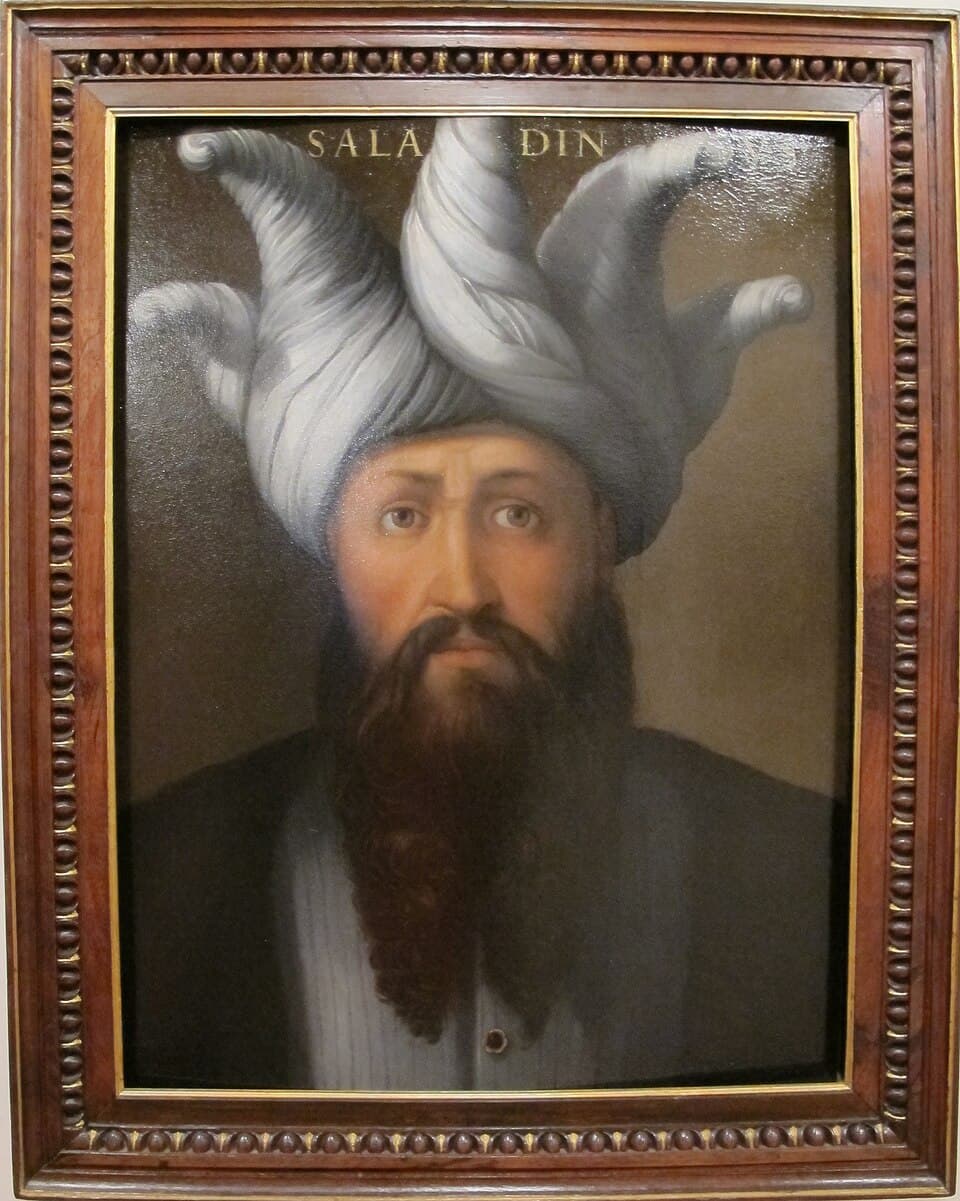
It is under the campaign tent pitched in the plain of Ramla, in this autumn of 1192, that Richard the Lionheart meets Sultan Saladin as the truce negotiations drag on. The King of England, feverish and weary of two years of crusade, has requested this man-to-man meeting — without heralds or notaries. On the carpet, cups of snow from Mount Hermon sweetened with syrup, a gift from the sultan to his ailing adversary. They have never seen each other face to face, but their envoys have carried so many messages that each already believes he knows the other.
—Sultan, they say among the Franks that you were not born a prince. Where do you really come from, you who have held me at bay for two years?
You have heard correctly, King Richard: I was not born in purple. I came into the world in 1138 in Tikrit, on the banks of the Tigris, in a Kurdish household where one learned to ride before learning to read. My father and my uncle served great emirs, sword in hand, and it was in their shadow that I grew up. I was trained in arms, but also in jurisprudence and the Quran, for a warrior without law is nothing but a brigand. You, who are a king's son, may find it hard to conceive: everything I possess, I first served under others before commanding it. That is why I never despise the man who obeys — I obeyed for a long time.
Everything I possess, I first served under others before commanding it.
—Before facing me, you subdued Egypt and Syria. Did your own coreligionists accuse you of ambition as you rose?
They did, and more harshly than your barons criticize me. When I became vizier of Cairo in 1169, then ended the Fatimid caliphate in 1171, it was whispered that the Kurd was seizing Egypt for himself. Upon the death of my master Nur ad-Din in 1174, I took Damascus, and then they cried usurpation against the heir. But understand this, Richard: as long as our princes tore each other apart, your fortresses held firm among them. A divided world could do nothing against your knights. I spent nearly twenty years gathering what discord had shattered. Unification was not my ambition: it was the price to pay even before thinking of Jerusalem.
A divided world could do nothing against your knights.
—Let us speak of Hattin. My barons still tremble at it. How did you break, in a single day, the entire army of the kingdom?
It was not a single day, King Richard, but long patience. In that summer of 1187, I let your knights leave their watering holes to follow me into the arid hills above Tiberias. Thirst did more than my archers: their mounts collapsed, their mail coats became furnaces. I had the brush set on fire so that smoke blinded them. By evening, the kingdom's army no longer existed. I captured King Guy of Lusignan and, in his baggage, that True Cross which your priests carried like a banner. When you question your survivors, they will tell you that it was not valor they lacked — it was water. Three months later, Jerusalem opened its gates to me.
Thirst did more than my archers.
—And that True Cross you took from me at Hattin? My men demand it in every message. What do you intend to do with it?
I know how dear that wood is to you, Richard, and that is precisely why I keep it. For you, it is the relic of your prophet's torture; for us, it is but an object, but an object that makes you march by the thousands from the sea. As long as I hold it, I also hold a pledge in our negotiations. Your envoys have offered me gold, fortresses, prisoners for it — you see that it is no mere beam. I will not burn it, for I do not insult what men venerate; but I will not return it without the entire peace being sealed between us. A sultan does not bargain away what an entire people would redeem at the price of blood.
I do not insult what men venerate; but I will not return it without peace.
—When Jerusalem fell, you did not massacre its inhabitants. My chroniclers marvel at this. Why this clemency toward your enemies?
Your chroniclers marvel because they remember 1099. When your fathers took Jerusalem, they waded in blood up to their ankles, Jews and Muslims slaughtered indiscriminately. I, in October 1187, set a ransom: so much for a man, less for a woman, even less for a child. Those who could not pay, I freed many from my own purse, and my brother al-Adel freed thousands. This is not weakness, Richard: a victor who spares inspires more fear than a butcher. And besides, my law commands it — jihad does not permit cruelty toward the unarmed vanquished. I wanted Christians to say: the sultan was more faithful to their Gospel than they themselves had been.
A victor who spares inspires more fear than a butcher.

—Yet it is said that at Acre, blood flowed on both sides. Does clemency have limits, even for you?
It does, and you know it better than anyone, Richard, for it was you who executed my prisoners under the walls of Acre when the ransom was delayed. I do not reproach you as a coward — war has its furies, and I too have had heads cut off, those of the Templars and Hospitallers captured at Hattin, because those orders lived only to fight us. The clemency I grant the peasant or the pilgrim, I refuse to the soldier who has sworn my destruction. A sultan must know when his mercy protects his people and when it betrays them. But believe me: whenever I could spare without endangering myself, I did so. Gratuitous cruelty only feeds hatred, and hatred is a poor counselor for one who would rule.
The clemency I grant the pilgrim, I refuse to the soldier who has sworn my destruction.
—You and I have been fighting for two years without ever seeing each other. Tell me frankly: what kind of adversary am I in your eyes?
An adversary I have not underestimated for a single day, King Richard. When you landed and retook Acre, I understood that the other Frankish kings were nothing beside you. You charge like a lion — the name they give you does not lie — and you know war better than any prince I have faced. When my spies reported that you lay sick with fever, I sent you fruit and snow from Mount Hermon, not out of cunning, but because a brave man who dies of illness dishonors his victor. We make war, and yet I would rather lose Jaffa than see you fall otherwise than with weapons in hand. It is rare, in this world, to meet an enemy one can esteem.
I would rather lose Jaffa than see you fall otherwise than with weapons in hand.
—My counselors proposed a strange alliance: marrying my sister to your brother al-Adel, to share this land. Did you ever seriously consider it?
I considered it more seriously than your sister would have wished, I think! The idea was bold: my house and yours united, Jerusalem governed jointly, the cross and the crescent under one roof. My brother al-Adel saw an end to the slaughter, and I saw peace without dishonor for either of us. But our priests and your bishops cried scandal, and you knew it as well as I when you proposed it. Perhaps it was only a maneuver on your part to gain time, as it was on mine. Yet, Richard, I want to believe that at heart we were two men weary of war, seeking a door that our peoples closed to us. Kings propose what peoples refuse.
We were two men weary of war, seeking a door that our peoples closed to us.
—If we sign this truce, will Christian pilgrims truly be able to pray in the holy city without fearing your soldiers?
On my word as sultan, yes. Let peace be sealed, and Jerusalem will remain mine, but its gates will open to your unarmed pilgrims. Let them come to the Holy Sepulchre, let them pray, let them depart in safety — my guards will protect them as they protect the merchants of Damascus. I do not fight your faith, Richard, I fight your armies. The pilgrim who lays down his sword is no longer my enemy, but a guest on my land, and hospitality is sacred among us as among you. You will return to your western kingdom where they say your brother stirs in your absence; I will watch over the holy places of all. Let each serve his God in peace: that is what neither you nor I could achieve by the sword in two full years.
I do not fight your faith, I fight your armies.
—One last thing, Sultan. When you are gone, what will remain of all this — of your dynasty, your conquests?
That is a king's question, Richard, and no one knows the answer but God. I founded in 1174 a house, that of the Ayyubids, and I placed my sons and my brother at the head of Egypt, Syria, and Mesopotamia. Will they survive united, or will they tear each other apart as did the princes I had to subdue? I do not know. Empires built by a single man rarely last longer than his memory. But if one thing is to be remembered of me, I wish it not to be Hattin nor the blood spilled — rather that a man born without a kingdom restored to the believers their holy city without defiling it. The rest, stones and borders, time will undo. The manner in which one ruled, that it keeps.
Empires built by a single man rarely last longer than his memory.


This imaginary interview was generated by artificial intelligence from sources documented in Saladin's profile. It dramatises what the figure might have said based on what we know about them, but does not constitute attested historical testimony. For primary sources and factual documentation, refer to the full profile.