Imaginary interview with Salif Keita
by Charactorium · Salif Keita (1949 — ?) · Music · 6 min read
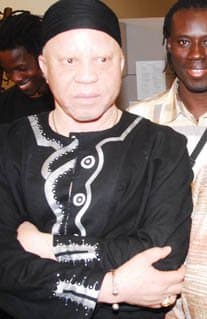
Djoliba, on an island in the Niger River, at the end of a dry season. Salif Keïta receives in the courtyard of his studio, a white boubou draped over his shoulders, the kora of a young musician rustling in the distance. The golden voice of Africa speaks low, almost in confidence, as if each sentence must first pass the test of silence.
—Do you remember how people looked at you as a child in Djoliba?
I was born in 1949, right here, in Djoliba, with skin that was not like the others'. In a Manding village, an albino is not an ordinary child: some see a bad omen, a thing from elsewhere. They looked at me as if I were a ghost; for many, an albino was not really a human being. Still, I helped in the fields like everyone else, except the sun bit my skin, it punished me while the others played. The hardest part was not the burn, it was the look. They attributed powers to me, they feared me, they avoided me. A child does not understand why he frightens others. He only understands that he is alone, and that solitude, believe me, stays with you a long time.
The hardest part was not the burn of the sun, it was the look.
—In 2009, you made albinism the heart of an album. Why take up this cause so late?
Because I first had to have a voice that people would listen to, to dare say what I had kept silent for so long. La Différence, in 2009, is the record where I stop hiding behind music. I sing: I am black, my skin is white, and I like it that way, difference is beautiful. That is not a pretty phrase, it is a declaration of gentle war. In Africa, albinos are still hunted, mutilated for fetishes, children disappear. I had created my foundation in 2005, but a foundation heals bodies; a song changes looks. I wanted the little albino boy in a village to hear, on the radio, that he is neither a ghost nor a bringer of bad luck. That he is, simply, beautiful in his difference.
A foundation heals bodies; a song changes looks.
—How did your family react to your decision to become a singer?
As a betrayal. I am descended from Soundiata Keïta, who founded the Mali Empire in the 13th century: in our world, a Keïta is a noble, and a noble does not sing. Singing, public speech, is the business of griots, the djéli, a separate caste that keeps the memory of kings. Crossing that boundary was dishonoring the name. In my family, a Keïta does not sing. Singing was the business of griots, not nobles. My father never really accepted it. I had to leave home, leave without a blessing, with only this voice that no one wanted in a mouth like mine. An albino, and on top of that a noble who becomes a singer: I piled up every scandal. But I believe you do not choose your voice. It chooses you.
You do not choose your voice. It chooses you.
—Rejected twice, by your skin and by your caste, how did you endure?
By turning rejection into fuel. When an entire system tells you “you don't belong,” you have only one thing left: invent a place for yourself. A noble who violates the taboo of the griots is not just a disobedient son, he is someone who damages an order seven centuries old, that of the Manding area. But that order had already excluded me because of my skin. So why respect rules that never welcomed me? In Bamako, in the 1970s, I sang in the streets, in the stations, wherever I was tolerated. I was hungry, but I was free. The shame my family wanted to burden me with, I turned it around: it was not I who was the dishonor, it was the contempt shown to those who are different.
When an entire system tells you “you don't belong,” you have to invent a place for yourself.
—Tell us about the Rail Band, that orchestra born in a station.
The Rail Band, in 1970, was the orchestra of the Bamako station, attached to the railway hotel. Imagine: music coming out of a station buffet, between two trains, with the smell of coal and the whistle of locomotives. We rehearsed in the afternoon in the orchestra's rooms, we played in the evening for travelers and partygoers. That is where I crossed paths with an extraordinary guitarist, Mory Kanté, before he became a star. We were young, hungry for sound, mixing Manding rhythms with electric guitars from elsewhere. That station was my real school. They say today that the Rail Band was a nursery of modern Malian music; at the time, we weren't thinking about history, we were thinking about making the room dance until dawn.
The music came out of a station buffet, between two trains, in the smell of coal.
—Why did you leave that orchestra in 1973?
Because a musician who stops moving forward begins to die. In 1973, I joined Les Ambassadeurs, another great orchestra, and soon we left for Abidjan, Ivory Coast. There, we aimed wider: a pan-African audience, halls full of people from all over the continent. From that time came Mandjou, in 1978, a song that goes back to Manding history and suddenly made me known wherever our languages were spoken. Leaving the Bamako station was leaving the nest. You never do it without a pang. But I felt that my voice had to travel further than the rails of Mali, cross borders that even trains did not reach. Abidjan was the first of those borders.
A musician who stops moving forward begins to die.
—How did the idea of blending traditional instruments with Western sounds come about?
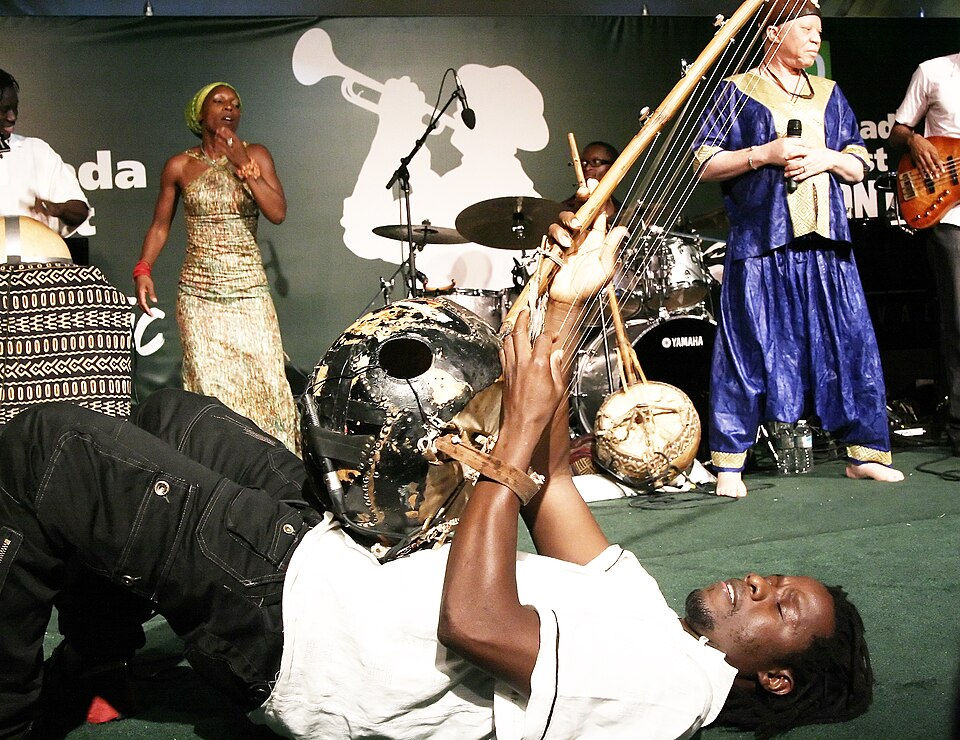
In 1984, I settled in Paris, the hub of African music in Europe. That is where Soro was born, in 1987. The idea was simple and scandalous at the same time: to make the kora, that twenty-one-stringed harp-lute of the griots, and the synthesizer, that cold keyboard from modern studios, converse. Many thought you don't mix the sacred with the plastic. I heard something else: the kora sings the memory of the Mali Empire, the synthesizer opens a door to the world. Why choose? In Soro, the two answer each other, seek each other, end up dancing together. Later they called it world music. I wasn't looking for a label. I was only looking for my African voice to stand on every stage on Earth.
The kora sings the memory of Mali, the synthesizer opens a door to the world. Why choose?
—What did Paris represent for an African artist of your generation?
Paris, in the 1980s, was the great crossroads. All the musicians of the continent passed through, crossed paths, and even envied each other a little. There you found the studios, producers, engineers capable of capturing a new sound. That is where I recorded Soro, then Amen, in 1991, co-produced with jazzman Joe Zawinul: imagine American jazz sitting down next to my Manding melodies, like two old men discovering they share the same grandfather. Paris gave me the means for my dreams. But a city of concrete never replaces a river. Every night spent there, I heard, beneath the car horns, the silence of Djoliba. You can conquer the world's stages and remain, deep down, a child of the Niger who is cold.
You can conquer the world's stages and remain, deep down, a child of the Niger.
—What brought you back to more African sounds in the 1990s?
A man always ends up hearing the call of his land. After the great Parisian experiments, I needed to strip down my music, bring it back to the bone. Folon... The Past, in 1995, that title means “the past”: I was looking behind me, toward what I had been, toward the rhythms of my childhood. Then came Moffou, in 2002, an almost acoustic record, where the voice and strings breathe without artifice. I had spent years adding layers, synthesizers, arrangements; there, I was removing. People think an artist progresses by accumulating. Often he progresses by removing, until he finds the bare note he was seeking from the start. It was my way of coming home even before I set my bags down.
People think an artist progresses by accumulating. Often he progresses by removing.
—You built a studio on the island of Djoliba. What were you seeking by returning to where it all began?
The full circle. In 2002, I returned to Mali and had a studio built on the island of Djoliba, right where I was born a ghost. Today, I share my life between Paris and this river. In the morning, I listen to the water; in the evening, sometimes a young person comes to play the balafon in the courtyard. Building a studio where I was rejected is not revenge, it is reconciliation. I wanted music to return to the village that did not want an albino noble. I wanted the children here to grow up hearing that you can leave far away and come back greater. The little boy who was afraid of the sun ended up building a house of sounds on his island. Perhaps that is my most beautiful song.
Building a studio where I was rejected is not revenge, it is reconciliation.

This imaginary interview was generated by artificial intelligence from sources documented in Salif Keita's profile. It dramatises what the figure might have said based on what we know about them, but does not constitute attested historical testimony. For primary sources and factual documentation, refer to the full profile.