Imaginary interview with Seneca
by Charactorium · Seneca (4 av. J.-C. — 65) · Philosophy · 7 min read
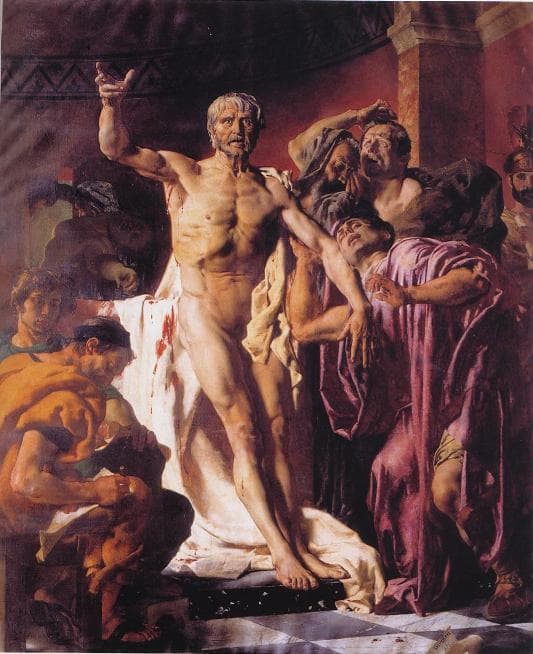
We meet Seneca in the columned study of his Rome townhouse on a still spring afternoon — wax tablets, papyrus scrolls, and a clay oil lamp arranged across a cedar table. He has been retired from Nero's court for three years; he is nearing seventy, and he speaks with the measured deliberateness of a man who has finally stopped measuring time by ambition. He gestures for us to sit, and begins before the question is asked.
—Eight years on the island of Corsica, in forced exile — what did that do to a man who had been one of Rome's most sought-after voices?
Eight years is a long time to be angry. The first year on Corsica I spent in exactly that: anger — at the injustice, at the rock and pine and grey sea, at an island that wanted nothing from me. I had been a senator, a man whose opinion was fetched. Suddenly I was no one in a place without an audience. But bitterness is expensive, and I had read the Stoics long enough to know I had no excuse for paying it indefinitely. Otium — true leisure, leisure turned inward — is not a comfort; it is the only condition in which thought can hear itself clearly. By the third year I was writing again, not for readers but because thought unrecorded is thought half-finished. Corsica gave me what Rome had always denied: the distance between me and my own reputation.
—When you were finally allowed to return to Rome — after those eight years — what was harder to reclaim: your standing, or your sense of self?
Standing repairs itself if you give it time and a willing audience. The self is more stubborn. I had left Rome as a man who believed cleverness was sufficient armor — that a gift for rhetoric and a well-placed friendship could carry a person safely through any court. The island disabused me of that completely. What I brought back from Corsica was something lighter and therefore far more useful: the understanding that I did not need to be essential to anyone. One reads differently in exile — without ambition, without the eye that scans each page for quotable passages to deploy in argument later. I returned as a student rather than a performer. That shift, invisible to most who welcomed me back, changed everything that followed. The praeceptor who arrived at the Palatine palace in 49 was a different man from the one the exile had swallowed.
—In 49 AD, you became tutor and moral guide to the young Nero — a boy who would one day hold the world. How did you understand that appointment at the time?
Clearly and, I think, honestly. His mother Agrippina had a use for me: a philosopher attached to a future emperor lends a kind of moral veneer that power finds convenient. I understood that. But I also held a belief — not naive, or so I told myself — that the Stoics had described correctly when they wrote of the philosopher who shapes a ruler through the slow, patient pressure of reason. When Nero came to the throne in 54, I dedicated De Clementia to him. The argument was simple: the prince who rules by fear earns only fear in return; clemency earns something more durable, something closer to genuine authority. I believed every word of it. What I misjudged was not the principle but the particular boy who now wore the purple. Principles are stronger than arguments; they are not always stronger than a young man's appetites.
—As you watched Nero pull further from those teachings — becoming, year by year, the emperor we now know — at what point did you understand your influence was finished?
By 62, the understanding was complete, though I had suspected it longer. I had spent thirteen years near the Palatine palace — drafting speeches, softening decrees, arguing in private for the restraint I had made my life's work to teach. There is a particular grief in watching someone choose the worse course when you know they understand the better one. But grief was not my only feeling. There was also a clear-eyed recognition: the moment a philosopher's continued presence becomes complicity rather than counsel, the philosopher must leave. I walked away from the court and attempted something I had perhaps never done properly — to be quiet, to stop shaping, to return to my own thoughts. The Epistulae I wrote afterward would not have been possible had I stayed.
The moment a philosopher's continued presence becomes complicity rather than counsel, the philosopher must leave.
—Your critics — and they were not few — pointed to your considerable wealth: estates, loans, vineyards across the provinces. How did a man who preached detachment from material goods reconcile that with his own fortune?
I reconcile it the way I answer it now: with honesty rather than performance. Yes, I am wealthy — property across several provinces, a comfortable domus here in Rome, more resources than a man of plain needs requires. My critics expected a philosopher to wear rags and call that virtue. But apatheia is not poverty; it is the severing of the soul's dependency on what it possesses. A man who clutches his last coin in terror is a slave whether the coin is bronze or gold. I manage wealth the way a seasoned navigator manages a difficult crossing — competently, without love for the sea. If fortune removes it tomorrow, I lose a convenience, not myself. I will acknowledge that this is easier to say from a furnished study than from genuine destitution. That tension I do not pretend to dissolve — I only insist that the principle does not collapse because its advocate is imperfect.
—And yet — doesn't that visible gap between teaching and practice undermine the philosophy's authority in the eyes of those who might otherwise follow it?
The man who waits until he has fully embodied a truth before speaking it will never speak at all. I am a student of wisdom, not its completed product. In De vita beata I argued — and I maintain it — that the happy life belongs to the soul that is strong, unshakeable, aligned with nature and reason, freed from attachment to what fortune can withdraw. That argument stands whether or not the man making it owns a fine dining room. Socrates continued asking questions until his final hour precisely because philosophy is a practice, not a credential one earns and then displays. If my visible contradictions make me easier to dismiss, I accept that cost. The alternative — the philosopher's retreat into a silence that preserves his consistency — seems to me far more dishonest than the admission: I am still mid-journey, and here is what I see from where I stand.
—After you withdrew from Nero's court, you began writing the letters to your friend Lucilius — 124 of them. What were you trying to give him that a formal treatise could not?
Not instruction — I had given enough of that from enough rostra. These letters to Lucilius were something quieter: the kind of conversation a man has with a friend when both understand that time is not unlimited. I told him once that life is a long apprenticeship — that one ought not be surprised if an entire existence is barely sufficient to learn how to live. I said that not to discourage him, but because there is a genuine relief in accepting incompleteness. Each letter began with something small and immediate — the noise from the baths below my window, the fatigue of a short journey, a sentence encountered before dawn — and moved from there toward whatever seemed true. That movement from the near and concrete toward the general: that is how wisdom actually propagates. Not through declaration, but through careful accretion, letter by letter, observation by observation.
Life is a long apprenticeship — one ought not be surprised if an entire existence is barely sufficient to learn how to live.
—Writing 124 letters in your final years — was there an urgency in that work, a knowledge that you were writing against time itself?
The ratio — the faculty of clear reasoning — had, by 62, finally triumphed over ambition. Ambition is the voice that tells you tomorrow will be a better moment for honest work. When I sat by lamplight in the evenings — a simple clay lamp, the kind I had once barely noticed amid more elaborate furnishings — I was aware that I was not writing for a court or a patron or a posterity I could see clearly. I was writing for the reader who needs what I had needed: permission to take mortality seriously, reassurance that the examined life moves slowly and that slowness is not failure, the reminder that the only hour truly ours is the one we currently inhabit. Whether those letters are read in a generation or not at all, I cannot say. I know only that they are honest, and honesty is rarer in what survives than in what disappears.
—In 65 AD, you were accused of involvement in the Pisonian conspiracy against Nero. Were you surprised when the accusation arrived?
A man who practices Stoicism genuinely is surprised by very little — and I had been watching this particular storm gather for some years. After I withdrew from court in 62, I had become the kind of figure that makes a nervous emperor uncomfortable: a former praeceptor who remembers everything, who still commands a certain respect in certain circles, who has written publicly about the virtues a prince ought to embody and the character a tyrant reveals through his actions. In a suspicious mind, such a man is always a potential enemy. Whether I had foreknowledge of the Pisonian plot is a question I will leave for those who survive me to argue. What I can say is that when the accusation arrived, it arrived the way a sentence arrives in a document one has been half-expecting to sign. There was almost a clarity to it. The waiting, at least, was finished.
—When the order came to die, you chose to open your veins — an act later compared to Socrates accepting the hemlock. Was that a deliberate philosophical decision, or simply the only course left open to you?
Everything deliberate is philosophical, whether the man performing it recognizes the fact or not. Socrates drank his cup because he refused to distinguish between his life of thought and his manner of dying — they were one continuous commitment. I made no long speech at the end. I had no desire for theater. I sat with those who were present, spoke as calmly as circumstances allowed, and tried to demonstrate by the only means still available to me that ratio does not abandon a man when the body begins its departure. The Stoics have always held that the one freedom no emperor can revoke is the freedom to choose one's relationship to what happens. A sentence of death from Nero dictates the manner of my dying — it does not dictate whether I fear it. That is the line I have been walking for forty years. At this point, one either walks it steadily or one never walked it at all.
A sentence of death dictates the manner of my dying — it does not dictate whether I fear it.
—Looking back across a life that moved from Corduba to exile, from exile to the throne of Rome and then to a philosopher's study — what did the Stoics understand that others had missed?
That the interior life is the only property with a defensible border. Wealth can be taxed. Exile can be decreed. Reputation can be dismantled in an afternoon in the Forum. The body itself can be condemned — as I have had occasion to discover at each stage of the life you describe. But the judgment one brings to events — the decision about what one names good, what one names evil, what one names bearable — that belongs to no senator and no emperor. The Epicureans grasped part of this, retreating toward tranquility through withdrawal. Zeno and those who followed him added something the Epicureans feared: that the wise man engages fully — with Rome, with politics, with friendship, with grief, with power — precisely because he is not controlled by any of it. I have failed at this daily. That failure does not make the principle less true. It makes it more necessary.
This imaginary interview was generated by artificial intelligence from sources documented in Seneca's profile. It dramatises what the figure might have said based on what we know about them, but does not constitute attested historical testimony. For primary sources and factual documentation, refer to the full profile.