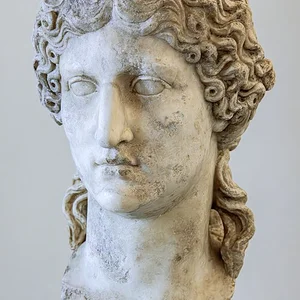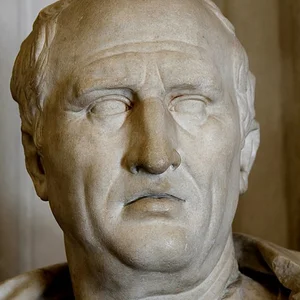

Roman orator, politician, and philosopher (106–43 BC), Cicero is one of the greatest figures of the Roman Republic. He left a lasting mark on Latin literature through his eloquence and philosophical works, becoming a model of rhetoric for centuries to come.
Cicero(106 av. J.-C. — 42 av. J.-C.)
Cicero
Rome antique
8 min read
Frequently asked questions
Famous Quotes
« Nothing is so unbelievable that oratory cannot make it acceptable.»
« Civis Romanus sum»
« O tempora, o mores!»
Key Facts
- Consul of Rome in 63 BC, he foiled the Catilinarian conspiracy
- Delivered the Catilinarian Orations (four speeches against Catiline) between November and December 63 BC
- Wrote numerous philosophical treatises inspired by Greek thought, notably on rhetoric (De Oratore, Brutus, Orator)
- Exiled from Rome in 58 BC for having sentenced the conspirators to death without trial
- Assassinated in 43 BC during the proscriptions of the Second Triumvirate
Works & Achievements
Four speeches delivered before the Senate and the people to denounce the Catilinarian conspiracy. Masterpieces of political eloquence, they have been studied as models of rhetoric since Antiquity.
A political treatise in six books in dialogue form, inspired by Plato, defining the ideal form of government. The Dream of Scipio, which concludes it, had an immense influence on medieval thought.
A treatise in three books on the art of oratory, presented as a dialogue among the great Roman orators. Cicero defines the ideal of the learned orator, master of philosophy, law, and literature.
A treatise on practical ethics addressed to his son Marcus, exploring the conflict between the useful and the honorable. It was one of the first books printed by Gutenberg and a cornerstone of humanist education.
Five books of philosophical dialogues on happiness, pain, death, and the passions. Written at his villa in Tusculum following the death of his daughter Tullia.
Fourteen speeches against Mark Antony, inspired by the Philippics of Demosthenes. Cicero's final oratorical battles to save the Republic, they ultimately cost him his life.
More than 900 preserved letters, addressed to Atticus, family members, and political figures. An exceptional historical source on the end of the Roman Republic.
Anecdotes
During his consulship in 63 BC, Cicero foiled the Catilinarian conspiracy, a plot to overthrow the Republic. He delivered four thunderous speeches before the Senate, the Catilinarians, which forced Catiline to flee Rome. The Senate awarded him the title of 'Father of the Fatherland' for having saved the state without resorting to arms.
Cicero was so formidable an orator that the pirate Heraclea, having heard him plead a case, is said to have declared he would rather face a storm at sea than Cicero in a courtroom. From his very first major trial — the defense of Sextus Roscius in 80 BC — he dared to oppose a protégé of the dictator Sulla, making him famous overnight.
After his assassination in 43 BC, on the orders of Mark Antony, Cicero's head and hands were displayed on the Rostra in the Forum, the very place where he had delivered his most celebrated speeches. According to Plutarch, Fulvia, Mark Antony's wife, allegedly pierced Cicero's tongue with a hairpin to take revenge on his eloquence.
Cicero was exiled in 58 BC after having ordered the execution without trial of the Catilinarian conspirators. His house on the Palatine Hill was razed by his political enemies. When he was triumphantly recalled a year later, the Senate voted to have his home rebuilt at public expense — an exceptional honor.
A passionate devotee of Greek philosophy, Cicero created much of the Latin philosophical vocabulary still in use today. Words such as 'qualitas' (quality), 'moralis' (moral), and 'humanitas' (humanity) are his inventions. Without him, the lexicon of Western philosophy would be radically different.
Primary Sources
Quo usque tandem abutere, Catilina, patientia nostra? — How long, Catilina, will you abuse our patience? When will your unbridled fury cease to run rampant?
Est igitur res publica res populi; populus autem non omnis hominum coetus quoquo modo congregatus, sed coetus multitudinis iuris consensu et utilitatis communione sociatus. — The republic is the affair of the people; and the people is not every gathering of men assembled in any manner, but a society founded on the consent of law and the community of interest.
Non nobis solum nati sumus ortusque nostri partem patria vindicat, partem amici. — We are not born for ourselves alone: our country claims a share of our existence, our friends another.
Cicero confides to his friend Atticus in a letter from 61 BC: "I am so downcast, so overwhelmed, that the leisure hours in which I write to you are the only ones in which I feel alive." These letters offer an intimate, unfiltered account of Roman political life.
Key Places
Heart of Roman political life where Cicero delivered his greatest speeches, including the Catilinarian Orations from the Temple of Jupiter Stator and the Philippics at the Rostra.
Cicero's birthplace in Latium, about 120 km southeast of Rome. He always kept a family estate there and remained proud of his municipal origins.
In this town in the Alban Hills, Cicero owned his favorite villa, the Tusculanum, where he wrote many philosophical works including the Tusculan Disputations.
Coastal town in Latium where Cicero owned a villa. It was near Formiae, on the road to Gaeta, that he was caught and assassinated by Antony's soldiers in December 43 BC.
Cicero stayed here in 79–77 BC to study philosophy under the Academic philosopher Antiochus of Ascalon and to study rhetoric. This journey profoundly shaped his thinking.
Typical Objects

Cicero's primary writing medium for composing his speeches, philosophical treatises, and vast correspondence. His works filled hundreds of scrolls kept in his library.
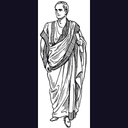
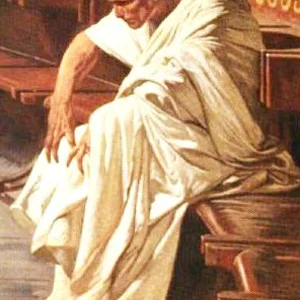
White toga bordered with purple worn by Cicero as a magistrate. A symbol of his consular authority, it was the official garment of high-ranking Roman dignitaries.
📷 Domaine public · Wikimedia Commons ↗
Everyday writing tools used for taking notes, drafting texts, and corresponding. Cicero often dictated to his secretary Tiro, who used a shorthand system.

Folding ivory seat reserved for the highest Roman magistrates. As consul, Cicero had the right to sit in it in the Senate and at the tribunal.

Engraved signet ring that Cicero used to authenticate his official correspondence and legal documents.

Cicero often worked at night to prepare his pleadings. The Latin expression "lucubrare" (to work by lamplight) aptly describes his studious habits.
School Curriculum
Vocabulary & Tags
Key Vocabulary
Daily Life
Morning
Cicero rose before dawn to work on his writings by the light of an oil lamp. After a quick wash and a frugal breakfast (bread, cheese, olives), he received clients and petitioners from the very first hour during the morning salutatio, an unavoidable social ritual for a man of his standing.
Afternoon
In the afternoon, Cicero went to the Forum to plead in court or attend Senate sessions. He could spend hours there debating, listening to arguments, or negotiating political alliances. After public business, he sometimes visited the baths to relax and converse with fellow senators.
Evening
In the evening, Cicero attended banquets (cenae) at friends' homes or entertained in his own residence. These dinners were occasions for lively philosophical and literary discussions. He also devoted his evenings to reading, dictating letters to his secretary Tiro, and preparing his court speeches for the following day.
Food
Cicero's diet was that of a Roman aristocrat: wheat bread, vegetables (beans, lentils, cabbage), olives, cheese, fruit, fish, and meat at main meals. Wine diluted with water accompanied meals. Banquets could be more elaborate with refined dishes, but Cicero was rather restrained in his tastes.
Clothing
Cicero wore the toga, the official garment of the Roman citizen, over a linen or wool tunic. As consul, he wore the toga praetexta edged with purple. His candidacy for the consulship entitled him to wear the toga candida, whitened with chalk. At home, he dressed more simply in a comfortable tunic.
Housing
Cicero owned a luxurious domus on the Palatine Hill, the most prestigious district of Rome, as well as several country villas (Tusculum, Arpinum, Formiae, Astura). His Roman house included an atrium, a tablinum for receiving guests, a library, and gardens. He also had a domestic staff that included educated slaves.
Historical Timeline
Period Vocabulary
Visual Style
L'esthétique de la République romaine finissante : architecture monumentale de marbre et de travertin, lumière méditerranéenne dorée, toges blanches et pourpres, avec le réalisme sans concession des portraits romains.
Sound Ambience
L'atmosphère sonore du Forum romain au Ier siècle av. J.-C. : les débats passionnés du Sénat, la foule bruissante, les marchands, le bruit de la cité la plus peuplée du monde antique.
Liens externes & ressources
Références
Œuvres
Les Catilinaires (In Catilinam)
63 av. J.-C.
De Republica (De la République)
54-51 av. J.-C.
De Oratore (De l'orateur)
55 av. J.-C.
De Officiis (Des Devoirs)
44 av. J.-C.
Les Tusculanes (Tusculanae Disputationes)
45 av. J.-C.
Les Philippiques (Philippicae)
44-43 av. J.-C.
Lettres (Epistulae)
68-43 av. J.-C.