Imaginary dialogue between Valéry Giscard d'Estaing and Simone Veil
by Charactorium · Simone Veil (1927 — 2017) · Politics · 5 min read
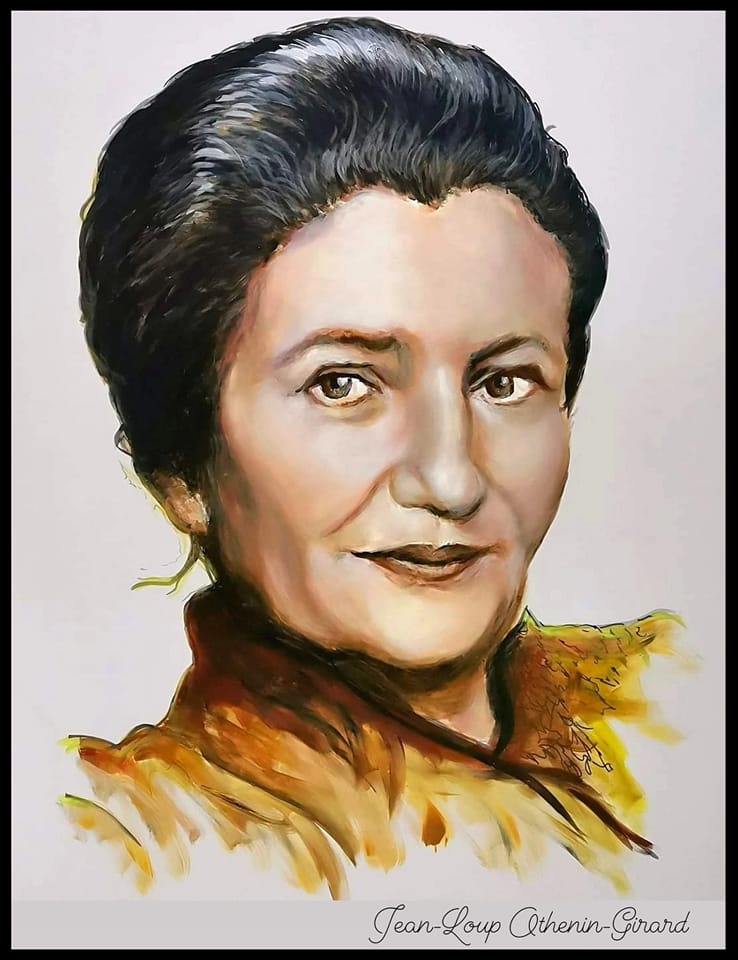
It is in the hushed office of the Élysée Palace, one autumn evening in 1978, that Valéry Giscard d'Estaing meets Simone Veil, his Minister of Health. The desk lamp illuminates a legislative file still open, and in the distance one can hear the footsteps of ushers. They have known each other for four years, ever since he appointed her to the government right after his election. Tonight, the President has come without advisers, like a neighbor, to understand what this woman went through long before she stepped up to her podium.
—Simone, when I entrusted you with Health in 1974, you knew the fight that awaited you. How did you hold your ground at that podium?
You who appointed me, Valéry, you know what I found in the chamber on that November 26, 1974: closed faces, insults I did not expect from this assembly. I had come to ask them to pass a law allowing women to control their own bodies, and some threw comparisons at me that I will never forget. But I could not afford to waver. Every day, women were dying from illegal abortions, and it was to them I was thinking, not to my opponents. I spoke of distress, not ideology. I believe that is what eventually cracked their certainties, during that endless night of debate.
I could not afford to waver: every day, women were dying from illegal abortions.
—You were one of the few women in my government. In our cabinet meetings, did you feel the weight of that male gaze?
You chaired those meetings, Valéry, so you saw what I saw: a table of men, and me. I never asked for special consideration, I only demanded that I be listened to as one listens to a minister. My suit, my calm voice—those were my weapons as much as my files. In the morning, I was at my desk before seven, having read the press and my notes when others were barely arriving. They thought me tough; I was mostly prepared. Antoine, my husband, told me I worked as if I constantly had to prove my place. He was right. A woman, in that world, cannot afford to be sloppy.
They thought me tough; I was mostly prepared.
—I always felt you were driven by something older than politics. Where did that strength come from, Simone?
It comes from a place I rarely speak of, Valéry. In 1944, I was arrested in Nice with my family; I was seventeen years old, and I was deported to Auschwitz-Birkenau. The prisoner number A-25220 stayed on my arm; it never left my skin, nor my memory. I knew horror, and I could not pretend to forget it. When I returned, I understood that my life afterward had to be worth having survived. That is why I cannot tolerate indifference to the suffering of others. Those who insulted me in the Assembly did not know that I am no longer frightened by words. I have seen worse than the hatred of a chamber.
My life after Auschwitz had to be worth having survived.
—That number you bear—many still do not know its story. Why do you insist on never hiding it?
Because forgetting it would be a betrayal, Valéry. Those who did not return left only our memory for them to still exist. I did not survive to remain silent. When I meet young people, I tell them what that camp was—not to burden them, but so they know how low man can sink when he is allowed to despise his fellow man. You appointed me minister of a Republic which, under Vichy, had handed over my people. I never confused that France with the one I serve. But I want us to face that past squarely. The duty of remembrance is not a ceremony: it is a constant vigilance against forgetting and against cowardice.
The duty of remembrance is not a ceremony: it is a constant vigilance.
—There is talk that Europe tempts you, Simone. You who suffered so much from nations set against each other, what do you expect from it?
You know me well, Valéry: yes, Europe is close to my heart, more than you imagine. I have seen what hatred between peoples produces; I have seen French, Poles, Hungarians die side by side without that changing barbarism. To build an assembly where these nations deliberate instead of fighting—for me, who came back from the camps, that is not an abstraction: it is a reparation. If the voters allow me, I would like to take that voice to the European Parliament. Not out of career ambition—I have seen enough of that—but because I believe that a woman who returned from hell has a duty to defend what prevents going back there.
For me, who came back from the camps, Europe is not an abstraction: it is a reparation.
—That 1975 law now bears your name. On the night of the vote, did you doubt it would pass?
I doubted until the very end, Valéry, I admit it. The debate lasted nights, amendments rained down, and so did attacks. It took a left-wing majority to supplement the votes I lacked on the right—an unusual situation for your minister. When the text was adopted, I felt no triumph. I was exhausted, and I thought of all those women who had not waited for this law to suffer. The law of January 17, 1975 does not legalize abortion for pleasure: it regulates it so that it stops killing in the shadows. I always said it was a last resort, never a trivial right. Those who accused me of disrespecting life understood nothing of my approach.
The law does not regulate abortion for pleasure: it prevents it from killing in the shadows.
—Behind the minister, there is a wife, a mother. How do Antoine and your sons experience the storm around you?
They pay the price, Valéry, and it weighs on me. Our walls were covered with vile inscriptions, my children were targeted with insults that had nothing to do with them. Antoine supported me without a complaint; he understands my stubbornness because he knows my story. In the evening, when I come home from official dinners or hearings, it is with him that I lay down the burden. We talk, at length, about everything except politics sometimes. I need that anchor: without my family, I think the harshness of public life would have broken me. People see me strong at the podium; at home, I become simply a woman afraid for her loved ones, like any other.
People see me strong at the podium; at home, I become a woman afraid for her loved ones.
—You carry this fight for women as a universal cause. Do you truly believe it can be transmitted beyond our French borders?
I deeply believe it, Valéry. A woman's right to decide her own life has no nationality. What we achieved in France is not a French privilege: it is a dignity that all women should know. Wherever I can, I will say that women must be able to choose, because no society rises by keeping half of its members under guardianship. You gave me the opportunity to act here; but the fight does not stop at our borders. I am not an ideologue, you know that. I am a woman who has seen death, and who now refuses that others be disposed of without their consent. That conviction, I will carry it as far as I am allowed to speak.
A woman's right to decide her own life has no nationality.
—If tomorrow Europe called you to preside over it—you, a woman—how would you receive such an honor?
With gravity, Valéry, not with vanity. For a woman to preside over an assembly of European nations would be both a signal and a function. I would see it as proof that this continent has learned something from its disasters. You know how wary I am of honors: I have seen too closely what titles are worth when humanity collapses. But a presidency is not a decoration; it is a responsibility to make those who once hated each other dialogue. If I were entrusted with that, I would not forget where I come from, nor in whose name I would sit. The dead of the camps have no grave; to preside over a reconciled Europe would be a little like giving them one.
The dead of the camps have no grave; a reconciled Europe would be a little like giving them one.
—To finish, Simone: of everything you undertook under my presidency, what would you like to be remembered for?
Not a name on a law, Valéry, but an attitude. Let it be remembered that one can go through the worst and still choose to serve life rather than resentment. I could have come out of Auschwitz full of hatred; I chose instead to fight so that others suffer less. The 1975 law, Europe, the memory of the camps: these are different paths to the same idea—that no one should decide for another human being what they are worth. You opened the door of government for me; what I did with it, I did for those who never had a voice. If that is what people remember of me, then my life afterward will truly have been worthwhile.
I could have come out of Auschwitz full of hatred; I chose to fight so that others suffer less.
This imaginary interview was generated by artificial intelligence from sources documented in Simone Veil's profile. It dramatises what the figure might have said based on what we know about them, but does not constitute attested historical testimony. For primary sources and factual documentation, refer to the full profile.