Kids interview Simone Veil
by Charactorium · Simone Veil (1927 — 2017) · Politics · 5 min read
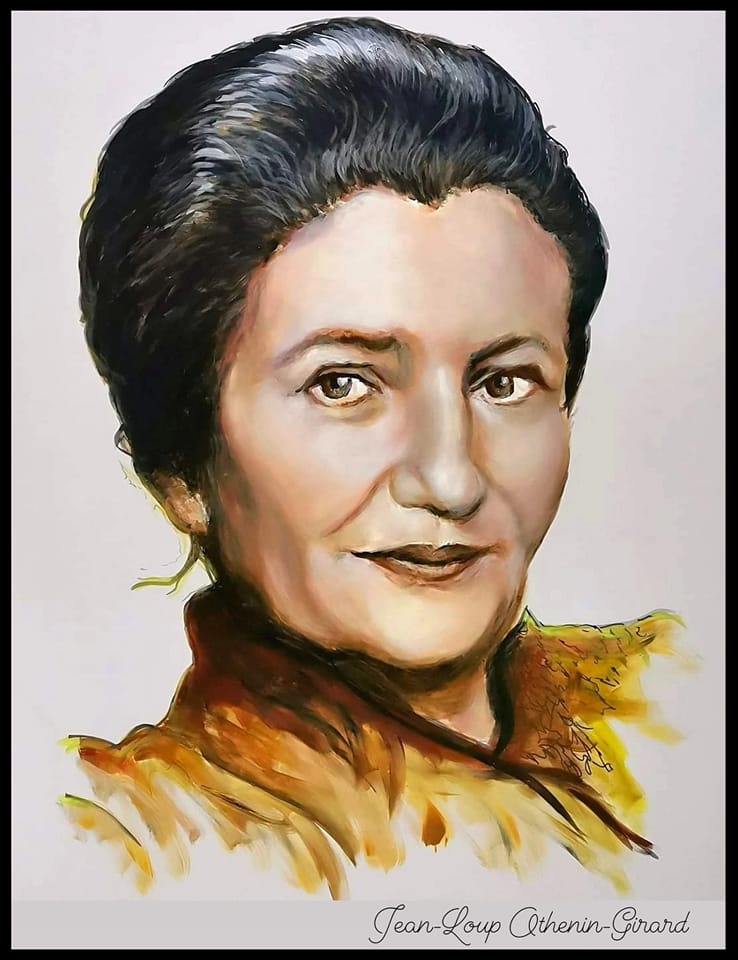
That morning, two twelve-year-old visitors pushed open the door of a Parisian office lined with books. A lady in a sober suit greeted them with a tired but warm smile. Her name was Simone Veil, and she had agreed to tell them everything.
—How old were you when you were arrested? What happened?
I was 17, my child. Almost your older brother or sister. It was in Nice, in 1944, during the war. Imagine: you come home, and men are waiting for your family to take you away. We were deported to Auschwitz-Birkenau, a camp where Jews were imprisoned to be killed. My crime? Being born Jewish, nothing else. There, I was cold, hungry, scared every night. I saw things no child should ever see. You know, in my memoirs I wrote three very heavy words: "I knew horror." And yet, I survived. That's why I am here, before you.
My crime? Being born Jewish, nothing else.
—Is it true you had a number on your arm? Why did you keep it?
Yes. In the camp, they no longer called us by our first names. They tattooed a number on our arm, in ink, forever. Mine was A-25220. Imagine your name replaced by a number, as if you were no longer a person. I carried that number all my life. Never removed. You'll ask me why? Because it was my testimony. As long as I lived with it on my skin, no one could say it didn't happen. When you survive something like that, you can't pretend to forget. You must tell, again and again.
They no longer called us by our first names, but by a number.
—Were you one of the only women in the government? What was that like?
You're right, there were very few of us. In 1974, I became Minister of Health, and around the table, almost all men. Imagine a big meeting room where you are the only girl, and everyone looks at you as if you're going to make a mistake. So I put on my strict suit, stood up straight, and spoke loudly and clearly. That outfit was a bit like my armor. I received women's associations demanding more rights, and I listened to them. That's called feminism: asking that girls have the same rights as boys. I wasn't going to lower my eyes.
My strict suit was a bit like my armor.
—Did a minister's day start early? What did you do in the morning?
Very early, yes! Before seven o'clock, I was already up. I read the newspapers to know what was happening in the country, and I opened my files, those big cardboard boxes full of papers to decide on. A light breakfast, and off I went. You know, I learned that discipline young, studying law after the war. Afternoons were meeting after meeting: doctors, health officials, associations. Evenings, sometimes an official dinner, sometimes time with my husband Antoine. It was dense, tiring. But when you believe in a project, you don't count the hours, my child.
—What's the most important law you passed?
The most difficult, especially. In 1975, I defended a law so that women could decide to end a pregnancy when they weren't ready: the IVG, voluntary interruption of pregnancy. Before my law, it was forbidden, and women died from it in secret. Before all the deputies, at the National Assembly, I began with a simple sentence. I came to ask them to vote on a law allowing women to "dispose of their own bodies". Imagine saying that alone, standing, before a room shouting at you. It was a fight so that girls, later, would be free to choose their lives.
Before my law, women died in secret.
—Were people mean during the debate? Were you scared?
Yes, it was very hard. Some deputies were angry, they almost insulted me, they banged on the benches. I was told cruel things, sometimes reminding me that I was Jewish, like a threat. Imagine defending a just idea, and being shouted at for hours. My heart was pounding, but I did not sit down, I did not cry in front of them. My file on abortion was in front of me, and I knew every number. After what I had been through in Auschwitz, believe me, the shouts of a room could no longer make me back down. The law eventually passed.
After Auschwitz, the shouts of a room could no longer make me back down.
—They say you were the first woman to lead Europe, is that true?
It's true, and I was very proud of it! In 1979, several European countries voted together to elect a large common Parliament. And guess who they chose to preside over it? Me, a woman, the first. Imagine a huge council where people speaking different languages — French, German, Italian — try to work together instead of making war. Because don't forget: a few years earlier, these countries were fighting and sending their children to die. I, who had known the camps, bringing these nations together around a table was almost a miracle. Peace is built, patiently.
Peace is built, patiently.
—Why was this united Europe story so important to you?
Because I had seen where hatred between peoples leads, my child. When countries hate each other, it ends in blood, in camps like the one where I was imprisoned. So building Europe, for me, wasn't complicated politics: it was preventing it from happening again. Later, in 1992, the countries signed a great treaty in Maastricht to come even closer. Imagine neighbors who were at war, and who decide to open their borders and trade together. Yesterday's enemies become friends. That's why I gave so much of myself: so that you, the young, would grow up in peace.
I had seen where hatred between peoples leads.
—Why did you write a book about your life?
Because one day, I won't be here to tell it. In 2007, I wrote my memoirs, a book simply called Une vie. I put everything in it: my childhood, the camp, my struggles. You know why? In that book, I explain that my life after Auschwitz had to be devoted to something worthwhile. Surviving is not enough; you must do something with that gift. Imagine receiving a second chance after a great misfortune. What would you do? I chose to fight for others, and to write it so that you, the children, would remember it after I'm gone.
Surviving is not enough; you must do something with it.
—What would you like us children to remember about you?
What a beautiful question. You know, I devoted part of my life to transmitting the memory of the Shoah, that word for the massacre of Jews during the war. At the Shoah Memorial in Paris, these memories are kept preciously. What I would like you to remember? That the worst things happen when people stay silent and look away. So, my child, do not stay silent in the face of injustice. If a classmate is treated differently because he is Jewish, Arab, girl or boy, defend him. I will soon no longer be here, but you, you can continue. It's up to you now to watch over.
The worst things happen when people stay silent and look away.
This imaginary interview was generated by artificial intelligence from sources documented in Simone Veil's profile. It dramatises what the figure might have said based on what we know about them, but does not constitute attested historical testimony. For primary sources and factual documentation, refer to the full profile.