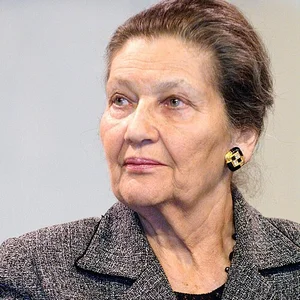

French politician (1927-2017), Holocaust survivor, and Minister of Health under Valéry Giscard d'Estaing. She is celebrated for championing the law decriminalizing abortion in France in 1975, a landmark victory for women's rights.
Simone Veil(1927 — 2017)
Simone Veil
Belgique, France
8 min read
Frequently asked questions
Famous Quotes
« I am not a political woman, I am a woman who does politics.»
« True responsibility means telling the truth.»
Key Facts
- 1944: Arrested with her family and deported to Auschwitz-Birkenau; the only survivor in her family
- 1974: Appointed Minister of Health by Valéry Giscard d'Estaing
- 1975: Championed and secured the passage of the law decriminalizing abortion, debated in Parliament amid fierce criticism
- 1979-1999: Elected to the European Parliament, where she chaired the Liberal and Democratic group
- 2010: Elected to the Académie française; inducted into the Panthéon in 2018 (posthumously)
Works & Achievements
A landmark reform decriminalizing abortion in France, allowing women access to voluntary termination of pregnancy under certain conditions. This law marks a decisive turning point for women's rights and gender equality in France.
As Minister of Health under Valéry Giscard d'Estaing, she modernized the French healthcare system and introduced progressive social policies, particularly regarding contraception and women's health.
The first woman to preside over the European Parliament, she played a crucial role in European integration and the defense of fundamental rights at the continental level.
An autobiography in which she recounts her life, her experience as a Holocaust survivor, and her political struggle for human rights and freedom.
A lifelong commitment to bearing witness as a survivor of Auschwitz-Birkenau, contributing to the preservation of Holocaust memory and education about crimes against humanity.
A sustained political commitment to gender equality, parity, and women's autonomy, embodying a progressive vision of human rights.
Academic recognition of her life's work and intellectual influence, as she became one of the rare women elected to the Académie française at that time.
Anecdotes
Simone Veil was arrested along with her family in 1944 in Nice and deported to Auschwitz-Birkenau at the age of 17. She survived the concentration camp bearing the prisoner number A-25220 tattooed on her arm, which she carried for the rest of her life as a testament to what she had endured. This traumatic experience left a permanent mark on her and fueled her lifelong commitment to human rights and justice.
In 1975, as Minister of Health, Simone Veil defended the bill decriminalizing abortion (IVG) before the French National Assembly. Despite stormy debates and fierce opposition, she succeeded in passing this landmark law, which recognized women's right to control their own bodies — a major victory for women's rights in France.
Simone Veil was the first woman to serve as Minister of Health in France. She also held the position of Minister of Justice, proving that a woman — even a Holocaust survivor — could reach the highest levels of political responsibility.
Simone Veil was elected to the European Parliament in 1979 and became its first female president, serving from 1979 to 1982. Her election and presidency symbolized the growing role of women in European political institutions.
After her retirement from politics, Simone Veil wrote her memoirs, titled 'A Life' (Une vie), published in 2007, in which she recounts her remarkable journey from Holocaust survivor to prominent political figure. The book introduced new generations to her personal testimony about the Shoah and her fight for fundamental freedoms.
Primary Sources
Madam President, Mr. President, Ladies and Gentlemen Members of Parliament, I come before you to ask you to pass a law that would allow women to have control over their own bodies. This reflects the importance I place on this text and the weight of the responsibilities it entails.
I knew horror. I could not pretend to forget it. My life after Auschwitz had to be devoted to something worthwhile.
Voluntary termination of pregnancy may only be performed by a physician. It may only be carried out before the end of the tenth week of pregnancy.
I have come to tell you that women must have the right to choose. It is a fundamental right, just like the right to live with dignity.
Key Places
Birthplace of Simone Veil, born here in 1927 into a Jewish family. Nice remains a symbolic place tied to her origins and her childhood before the Second World War.
Nazi concentration camp where Simone Veil was deported in 1944 at the age of 16. This place marks the tragic turning point of her life, and she emerged from it as a Holocaust survivor.
The chamber where Simone Veil, as Minister of Health, championed and secured the passage of the law decriminalizing abortion in November 1974 — a defining moment in her political fight for women's rights.
The ministry where Simone Veil served as Minister of Health from 1974 to 1979 under Valéry Giscard d'Estaing, a period marked by major social reforms.
The institution to which Simone Veil was elected in 2010, cementing her place as a leading figure in French cultural life and recognizing her lifelong commitment to humanist values.
Museum and documentation center where Simone Veil's memory and her testimony as a survivor are preserved, symbolizing her role in keeping historical memory alive for future generations.
Liens externes & ressources
Références
Œuvres
Loi Veil sur l'IVG
17 janvier 1975
Présidence du Parlement européen
1979-1982
Une vie — Mémoires
2007
Rapport sur la politique familiale européenne
1981
Fondation pour la Mémoire de la Shoah
2000