Imaginary dialogue between Marie de France and Tristan and Iseult
by Charactorium · Tristan and Iseult · Mythology · 6 min read
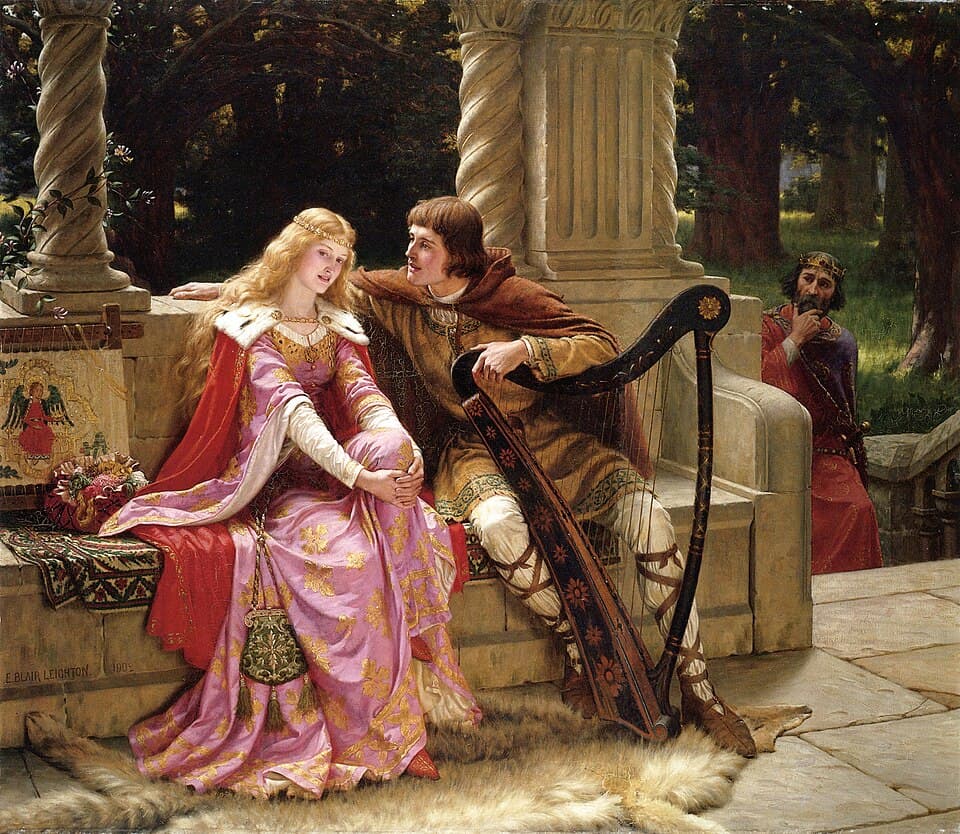
It is at the edge of the Morois forest, where the ferns still bear the imprint of two sleeping bodies, that Marie de France finds the lovers on a spring morning, around 1170. A branch of honeysuckle entwined with a hazel tree hangs above them — the poetess has made a lai of it, and she knows it. Tristan holds his harp against him, Iseult still has on her lips the taste of a wine that never fades. Marie comes with her verses and a question that haunts her: what is the worth of a love one did not choose?
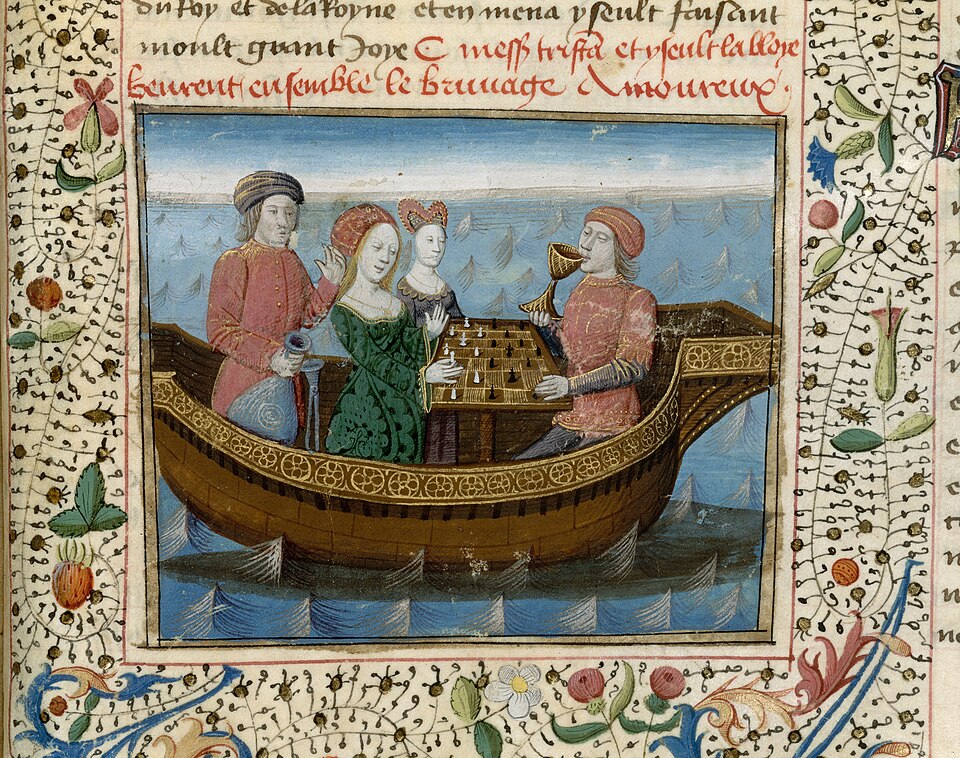
—Tristan, you who brought Iseult back from Ireland to your uncle King Mark, tell me: on that sea, what did you drink from that cup?
Marie, you know better than anyone that it was no ordinary wine. Iseult's mother had entrusted it to Brangien: a herbed wine intended for the wedding, so that the queen and King Mark would love each other with a sure love. But the heat of the crossing parched our throats, a page poured without knowing, and we drank one after the other. When I felt the brew go down, I knew at once that it was the wine of love — and that nothing would ever undo it. Iseult was already looking at me differently. What her mother had promised for Mark, chance had poured for us. One sip, Marie. A single sip decided both our lives.
A single sip decided both our lives, and nothing would ever undo it.
—Iseult, they say a philter takes away all choice. Did you never want to reject that wine, to refuse what was imposed on you?
Refuse it? Marie, how does one refuse the air one breathes? The philter did not plant a foreign love in me: it burned away everything that was not Tristan. I was promised to Mark, queen before being a woman, and suddenly my crown weighed like a stone around my neck. Some nights, yes, I prayed that the spell would release me, that I might become again the daughter of the king of Ireland who did not know this fire. But in the morning, it was enough for him to play three notes on the harp for me to know: there was no going back. One does not blame the flame for burning. The wine bound us; it was we, afterwards, who chose to hold the bond.
The philter did not plant a foreign love: it burned away everything that was not Tristan.
—I knew you were hiding here, in the Morois, fleeing King Mark's court. How does one live on love when one has neither roof nor crown?
You see us well, Marie: no great hall, no feast, a hut of branches and hunting for our only banquet. And yet those months in the forest were the freest of our lives. Far from crowns and glances, we were no longer queen nor king's nephew — only two beings that nothing separated. My sword fed us, the dog Husdent tracked without barking, Iseult wove our beds of leaves. The cold bit, hunger too, but we fell asleep against each other, my naked sword laid between us. The day the hermit Ogrin spoke to us of return, of pardon, I understood that this wild happiness had a price: it could not last. The court would reclaim us.
Those months without roof or crown were the freest of our lives.
—That naked sword you placed between you in the Morois — King Mark found it so. What did you mean to tell him by that?
We meant nothing, Marie — it was Mark who read. He came to surprise us sleeping, and instead of two lovers entwined, he found the sword lying between our bodies, separating our faces. He thought he saw the sign of a chaste love, and his anger fell. He exchanged his glove for the ray of sunlight that struck me, slipped his ring onto Iseult's finger, took back his sword and left mine. When we awoke and I saw those tokens, I knew he had spared us out of doubt, not certainty. That blade, which was meant to speak our honor, only prolonged the misunderstanding. The king wanted to believe; we let him believe.
The king wanted to believe in our innocence; we let him believe.
—Tristan, I have heard you at court, harp in hand. Where does this art come from, to you who are first called a knight?
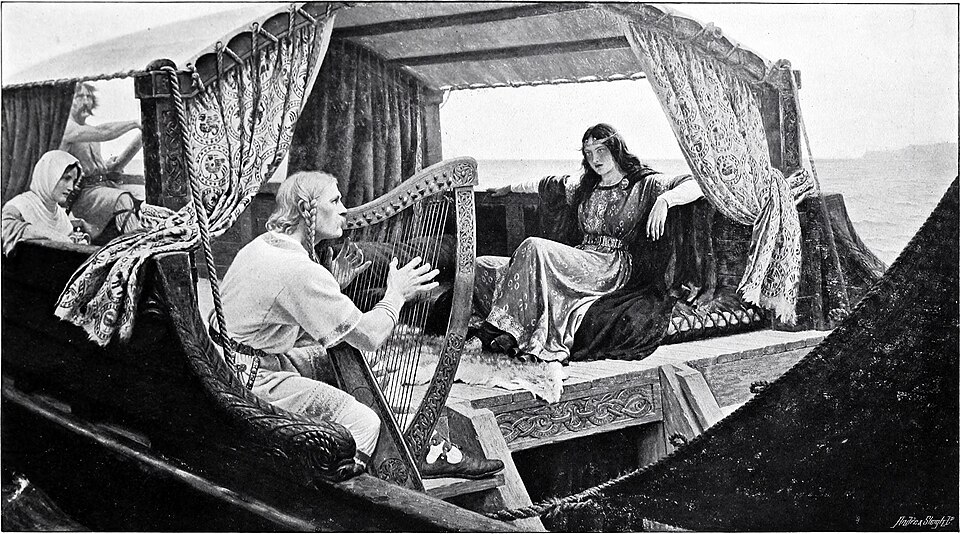
From Brittany, Marie, where I was raised. My tutor Gorvenal taught me the sword and the horse, but also the harp, languages, and the art of speaking well — an accomplished knight should not be only a blade. It was through music that I entered the court of Cornwall: King Mark loved me for my lais before he loved me for my arm. And it was still by the harp that I approached Iseult in Ireland, disguised as a minstrel under the name Tantris. You are a poetess, you know this: a melody opens doors that no army can force. My sword killed the Morholt and the dragon; my harp, on the other hand, won a heart. Of these two weapons, I never knew which served courtly love and which betrayed it.
A melody opens doors that no army can force.
—You both speak of that courtly love that I myself sing. But yours is forbidden, adulterous. Is it still courtliness, or sin?
That is the question the clerics throw in our faces, Marie, and only you can hear it without condemning us. Courtly love demands that one serve one's lady from afar, in desire and renunciation — a fire one stokes without ever being fully burned. The philter deprived us of renunciation. We loved without the proper distance, and yes, against the honor due to the king. Yet I believe we kept the essential: absolute fidelity, to each other, unto death. Iseult was never half mine. If courtliness is loyalty of the heart pushed to its extreme, then none were more courtly than we — even at the cost of sin.
None were more courtly than we — even at the cost of sin.
—I have put your story into verse in my lai of the Honeysuckle, that hazel tree the honeysuckle entwines. Do you recognize yourselves in it, or have I betrayed you?
Betrayed? Marie, you gave us the truest image we have ever heard. The honeysuckle knotted to the hazel: neither can live apart, and if they are torn apart, both die. That is us, word for word. Tristan carved your hazel stick and placed it on my path so that I would recognize him — you made of that secret signal a poem. Other storytellers dress us as they please: one emphasizes the passion of the body, another the sweetness of souls, each according to his country and taste. But you grasped the thing itself, without artifice. The same story changes face according to the mouth that tells it. Yours, at least, understood us.
The honeysuckle and the hazel: if they are torn apart, both die. That is us, word for word.
—Your legend is told in many languages, each in its own way. Does it not worry you to be thus distorted from court to court?
At first, Tristan chafed at it — hearing a Norman minstrel change the order of the trials, another soften our end. But we came to understand, Marie, that this is the fate of any living story. At the court of Cornwall they insist on cunning and passion; elsewhere, they prefer to speak of sin and pardon. Each country lends us its own fears and its own dreams. In the end, it matters little that the details vary: as long as the philter, the love stronger than death, and the fidelity to the end remain, it is still us. You are well placed to know this, you who transform our sorrows into music — a story only survives by accepting to be retold by other voices.
A story only survives by accepting to be retold by other voices.
—Tristan, they say that in Léonois you married another Iseult, of the White Hands. How could you, whom the philter binds?
Do not judge me too quickly, Marie. Far from Iseult the Fair, wounded, exiled, I was like a drowning man. That other Iseult bore her name — her name, do you understand? — and I thought that by marrying her I would deceive my pain, that I would heal. Madness. The philter does not mistake a face: I was never the husband of that woman, and her innocence is my heaviest fault. On the wedding night, I saw the ring of the Fair on my finger and I could go no further. I married a name and betrayed two women at once. That error of Léonois, it is she who will weave my end — for from the jealousy of a neglected wife will come the lie of the sails.
The philter does not mistake a face: I married a name and betrayed two women at once.
—You both know that your love leads you to death. Why not renounce it, while there is still time?
Because one does not renounce what stands in place of blood, Marie. We tried, believe me: we separated, I returned Iseult to the king before the hermit, I fled as far as Léonois. What good? Far from each other, we were but two halves seeking each other and wasting away. Destiny poured us this wine without asking our opinion; we have no choice but to embrace it to the end. We will die, yes — but to die for each other is sweeter to us than to live apart. When the hour comes, let us be buried side by side, and you will see a briar grow from our tombs that will unite them. To love better, that is it: to love unto death, with no regrets.
To die for each other is sweeter to us than to live apart.
Read further
This imaginary interview was generated by artificial intelligence from sources documented in Tristan and Iseult's profile. It dramatises what the figure might have said based on what we know about them, but does not constitute attested historical testimony. For primary sources and factual documentation, refer to the full profile.