Imaginary interview with Tristan and Iseult
by Charactorium · Tristan and Iseult · Mythology · 5 min read
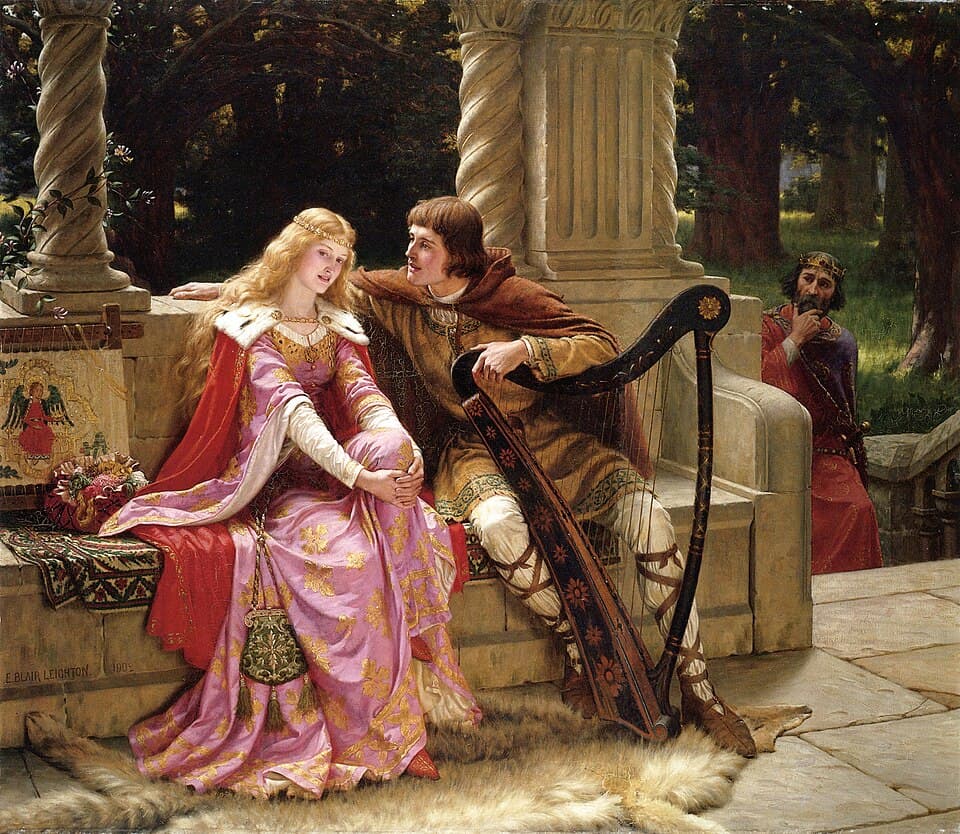
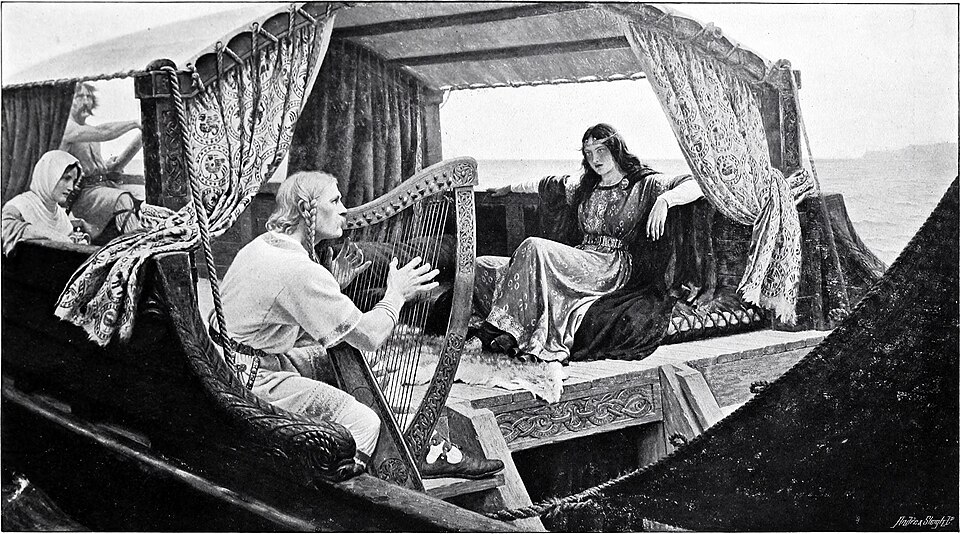
On the deck of a ship gliding from Ireland to Cornwall, the wind still carries the scent of salt and a spilled brew. Tristan holds a harp against his hip; Iseut, a crown set beside her, watches the coast recede. They have agreed, for the duration of a crossing, to answer — not as lovers on trial, but as two voices who know themselves caught in the same fate.
—What exactly happened aboard this ship that was bringing you back to King Marc?
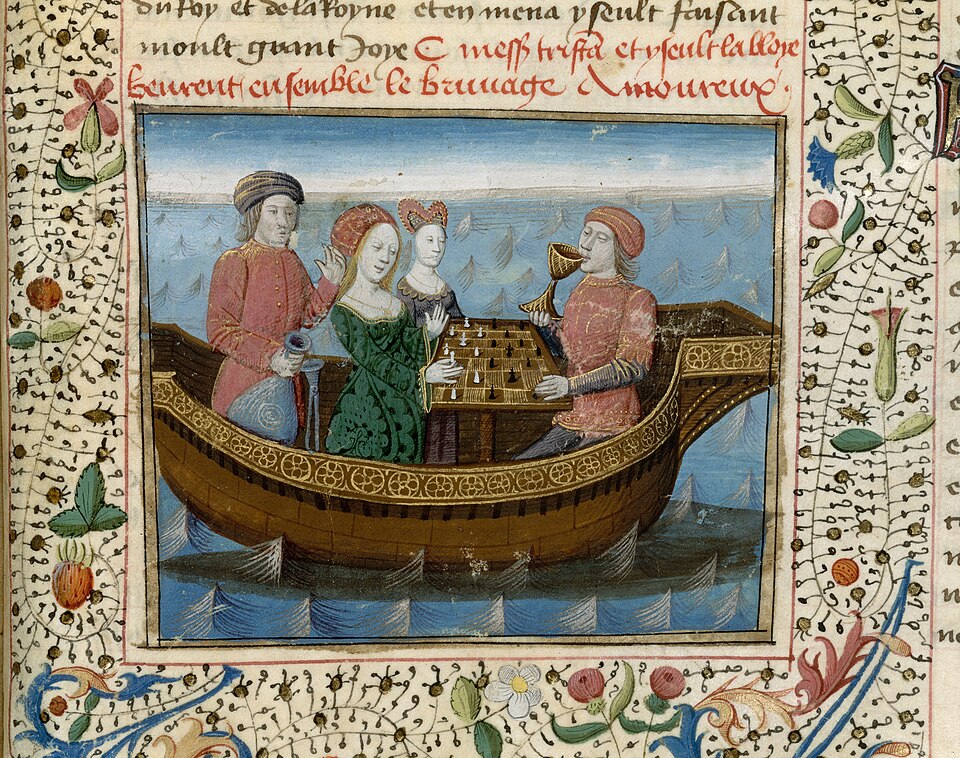
Iseut speaks. The sea heat was heavy, and I was thirsty. A cupbearer came, meaning well, and offered us the herbed wine in a single hanap. My mother had sealed it for the wedding night with Marc, so that conjugal love would bind us; no one was to touch it before the royal bed. We drank, Tristan and I, and at the bottom of the cup I understood that this was not a queen's wine — it was the wine of love. From that moment, my blood no longer belongs to me. One thinks one chooses to love; I drank my destiny without knowing it, on a few planks of wood between two kingdoms.
At the bottom of the cup, it was not a queen's wine, but the wine of love.
—Do you ever wonder if all this could have been avoided?
Tristan speaks. The clerks who write our story say it better than I: it is the potion that took them. I blame neither my hand nor hers. A potion, you see, is not a fault, it is a force — like the tide that takes the ship and leads it where it will. I had crossed the sea to bring back Iseult the Fair to my uncle Marc, loyal of heart, sword at my side, proud of my mission. And then a brew overturned the order of the world in one gulp. Could I erase that hanap? I think I would also erase the only fire that ever made me feel alive. One does not bargain with what surpasses you.
—How did you live once your love was discovered and the court became dangerous?
Iseut speaks. We fled into the Morois forest, far from Tintagel, far from eyes. It was a prison of leaves and a freedom all at once. We had no crown or feast, but ferns for a love bed and the scarce bread Tristan brought back from hunting. There I knew cold, hunger, fear of Marc's huntsmen — and yet, the castle never gave me what this forest offered. When you have lost everything except the other, you discover what the other is truly worth. The great vaulted halls teach rank; the Morois taught me naked love, without precious cloth or maids.
The castle teaches rank; the Morois forest taught me naked love.
—What remains in your memory of those days of exile in the heart of the woods?
Tristan speaks. The noise, above all. At court, I heard bells and audiences; in the Morois, I listened for the crack of a branch, sign that we were being hunted. I slept with the sword between us, ready to spring, without plate armor or coat of royal colors — a knight reduced to the state of a hunted beast. And it was good. In the morning, no mass, no duty: only Iseut and the day breaking. My uncle's lords thought us fallen. They did not know that in this flight I had finally stopped lying. A man who hides to love is more whole than a courtier who smiles beneath his crown.
—You were both bound to a king. How did you bear this conflict between duty and passion?
Iseut speaks. Remember: I was promised to King Marc, princess of Ireland exchanged like a precious veil to seal peace between kingdoms. The crown I wore was not an ornament, it was a chain of obligations to the throne of Cornwall. Tristan, for his part, owed loyalty to his uncle and lord. Our fault was not only to love: it was to betray the feudal oath that holds the world upright. This is what the singers call courtly love — to love in the impossible, in the forbidden, until the heart breaks against duty. Each kiss was a felony, and each felony was sweeter to us than honor.
—King Marc's castle recurs constantly in your story. What did it represent for you?
Tristan speaks. Tintagel perched on its cliff, that was all that separated us. The castle is not just stone: it is the feudal order in person, the walls that say who sleeps with whom, who rules, who obeys. I served my uncle there with joy, ate at his table in the great hall, sang for his court. Then that same castle became the wall between Iseut and me. At night, I saw the crowns gleam in the torchlight, and I knew that power would never forgive love. A king can give his nephew everything — a sword, lands, his trust — except the woman that fate has breathed to him.
A king can give his nephew everything, except the woman that fate has breathed to him.
—Many pens have told your story. Do you recognize yourselves in their versions?
Iseut speaks. Each sings according to his heart. Béroul, the Anglo-Norman, tells our passion raw, carnal, like hunger and fever. Thomas of Britain makes it finer, more painful, all courtliness and tears of the soul. And Marie de France, in her lay of the Honeysuckle, reduced us to a hazel branch entwined with honeysuckle: neither can live apart, or both die. That image, I think, tells the truth better than a thousand battles. The storytellers transform us according to their language and country, but all stumble on the same evidence: we are neither quite two, nor ever truly one.
—What do you think of those who have linked your legend to the world of King Arthur?
Tristan speaks. The clerks of the following century wrote us in prose, the Tristan of Léonois, and made me a knight of the Round Table, launched on a thousand quests alongside Arthur's companions. They loved my adventures more than my sorrow, my sword strokes more than my harp. I do not complain: a knight lives by exploits, and chivalry demands that one seek marvellous adventure through the forests of Brittany. But I sometimes feel that Iseut has been drowned in the crowd of tournaments. My true battle was never against a giant or a dragon — it was against a brew and an oath. That, the prose forgets a little.
—You are said to be as much a musician as a warrior. Where does this art come from?
Tristan speaks. From Brittany, where I grew up and received my training. They taught me to wield the sword in the morning and the harp in the evening — the two hands of the same courtly man. A knight who only knows how to strike is but a brute; one must also know how to charm, like a bard, and speak love through music. It was by my lute that I first pleased in Cornwall, before any potion. In the evening, after training and hunting, when the troubadours fill the great hall, I take my instrument and feel that courtliness is not a learned rule but a song that rises. My weapons made me feared; my harp, it made me loved.
My weapons made me feared; my harp, it made me loved.
—What were your days as a knight like, before everything turned?
Tristan speaks. Regulated like a stone clock. The castle bell roused me from sleep for mass; a little bread, cheese, and wine, then the sword and horse all afternoon — training, the king's hunts, sometimes a tournament. I wore the coat of arms in Marc's colors, proud to serve. Evening brought the lordly meal in the great hall, and courtly entertainments: music, courtly readings, gallant conversation according to custom. It was a full life, honorable, straight as a wall of Tintagel. I never imagined that a single gulp of herbed wine would suffice to overturn this well-built order. One thinks one's life hangs on one's oaths; it hangs on a hanap.
Read further
This imaginary interview was generated by artificial intelligence from sources documented in Tristan and Iseult's profile. It dramatises what the figure might have said based on what we know about them, but does not constitute attested historical testimony. For primary sources and factual documentation, refer to the full profile.