Kids interview Voltaire
by Charactorium · Voltaire (1694 — 1778) · Literature · Philosophy · 5 min read
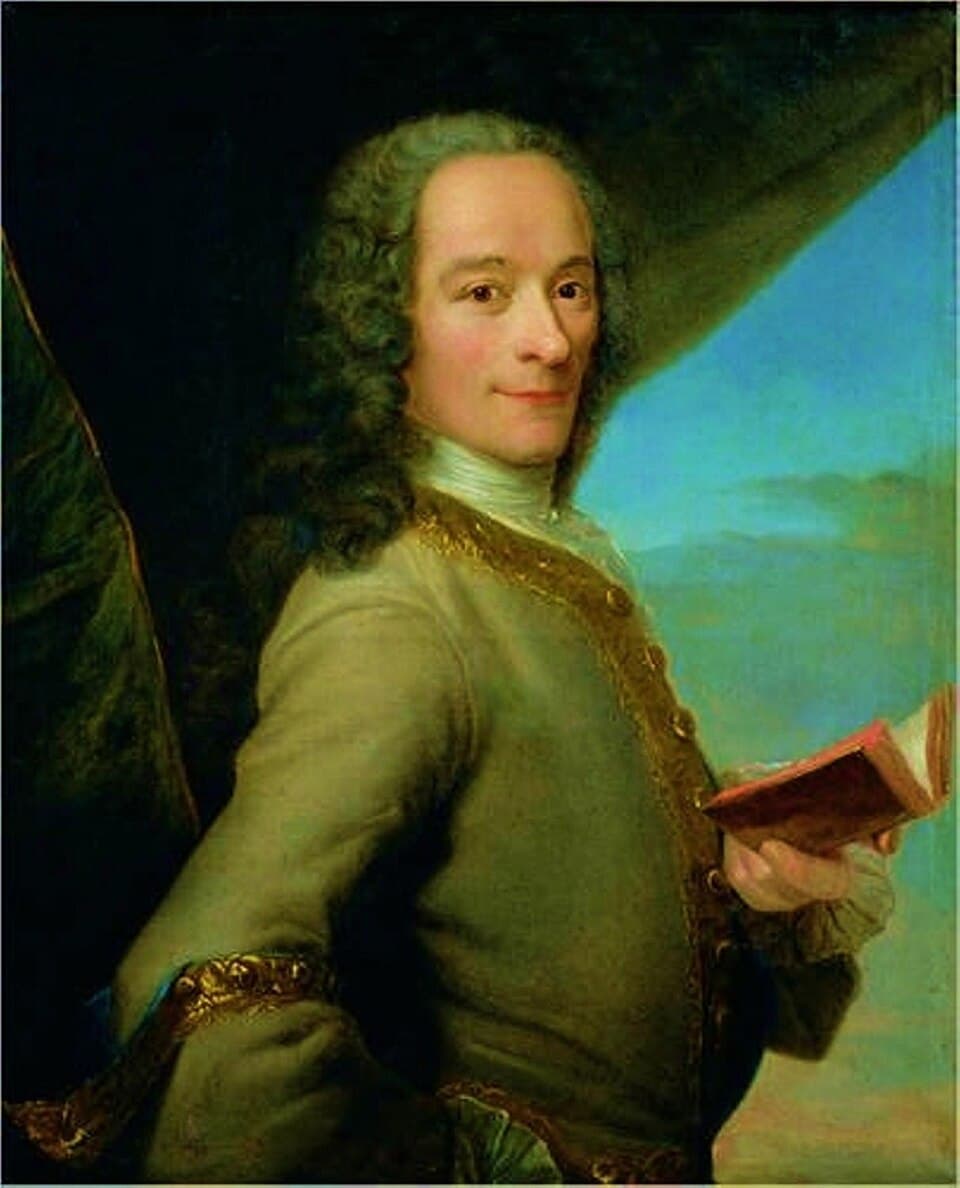
Two young visitors, about twelve years old, come armed with notebooks and a long list of questions. Their class has spent weeks studying the Enlightenment, and today they sit across from the man himself — Voltaire, sharp-eyed and wrapped in a velvet coat, who leans forward as if genuinely curious about what they have come to ask.
—How old were you when a nobleman paid men to beat you up in the street?
I was thirty-two years old. Imagine walking home one evening in Paris, feeling rather pleased with yourself — and suddenly men leap out of the shadows with canes, hired by a noble called the Chevalier de Rohan, whom I had mocked with a few sharp words. That was 1726. I had laughed at a powerful man. That was my mistake — not because laughing is wrong, but because I had no power to protect myself. I ended up first in the Bastille, then exiled to England. And everything changed there. I understood something no beating can undo: an idea written on paper travels further than any fist.
An idea written on paper travels further than any fist.
—What was England like — was it really so different from France?
You would have been astonished, my friend. In England, I watched a man argue publicly with a clergyman about religion — and nothing happened to him. No arrest, no exile. Just a conversation. Back home in France, that kind of talk could mean the Bastille. I went to Parliament, I read everything, I watched how people governed themselves. I wrote it all down in my Lettres philosophiques, published in 1734 when I returned. That book was officially burned in Paris — burned, can you imagine? But it had already spread everywhere. A burned book is not a silenced book. It is an infamous book, and everyone wants to read an infamous book.
—Were you scared of being arrested when you wrote Candide?
Honestly? Yes. When I published Candide in 1759, I put no real name on the cover — I used a mask, a false identity, to stay invisible to the royal censors. I had already been to the Bastille twice; I had no wish to go back. But fear and writing can work together, you know. When you are frightened and you still pick up your pen, the words come out sharper. I was also thinking about something terrible: the earthquake that had destroyed Lisbon in 1755, killing thousands of people in a single morning. How could anyone still claim the world was perfectly arranged? Candide was my answer to that question.
—Why write a funny adventure story to talk about serious ideas?
Because a sermon makes people yawn, my young friend. A good story makes them lean forward. I sent poor Candide across the whole world — through wars, earthquakes, shipwrecks, and prisons — and at the end, all he wants is to tend his own garden. That is the idea. Stop waiting for a perfect world handed down from above. Stop believing easy answers. Work, build, think with your own hands and your own head. I could have written a heavy philosophical treatise instead. But would you read it? Probably not! A tale about a clumsy young man stumbling from one disaster to the next — that you remember. And when you remember the story, the question inside it stays with you.
A sermon makes people yawn. A good story makes them lean forward.
—Why did you defend Jean Calas when he was already dead and couldn't be saved?
You have asked exactly the right question. Jean Calas was a Protestant merchant in Toulouse. In 1762, he was tortured and executed — accused of killing his own son to prevent him from converting. But his son had taken his own life. The judges had been driven by blind religious hatred. When his family came to see me at Ferney, I was old and very tired. But I understood this: if I said nothing, the lie would stand forever, and the next innocent man would face the same fate. So I wrote. I gathered evidence. I published. Three years later, the court overturned the verdict. Jean Calas could not come back — but the truth could.
—Were you ever afraid the judges might come after you too?
Of course I was careful. I was nearly seventy, and I had made many powerful enemies over a long life. But here is what I had learned: fanatisme — that blind, furious certainty that one's own beliefs are the only truth — is the most dangerous thing in the world. Not a sword, not a fire, but a closed and certain mind. When I wrote the Traité sur la tolérance, I wanted to explain something simple: we are all fallible, we can all be mistaken, and so we must leave each other room to think differently. Tolérance is not weakness. It is the most difficult and most human thing to practise — harder than any duel.
—Was the King of Prussia really your friend? What actually happened between you two?
Frédéric II — Frederick the Great — and I had written letters to each other for more than twenty years before I went to live at his court in Potsdam in 1750. He called me the greatest writer in Europe. I called him the king who loved ideas. We both flattered each other, perhaps too much. A king, even a brilliant one, does not enjoy being corrected. When I criticized one of his officials too sharply, he had me detained at a border crossing — my papers seized, my luggage held, a few weeks under guard. My friend the philosopher-king had shown me his other face: the king who owns the room you are sitting in.
—How did it feel to be locked up by someone you had trusted as a friend?
Betrayed, yes. But also — honestly — not entirely surprised. I had long believed in something we called despotisme éclairé — the idea that a wise and reasonable king could build a fairer kingdom without anyone needing to change the laws. Frédéric had seemed like that king. He taught me the limit of that dream. Even the most intelligent monarch still controls the gates. Real liberty cannot live only in a king's goodwill. It must be written into the laws themselves, defended by the courts, not offered as a favour one morning and withdrawn the next. That was 1753, and I never forgot it.
Real liberty cannot live only in a king's goodwill.
—What did your house at Ferney look like — was it huge, like a palace?
Not a palace — a proper country house, comfortable but not showy. It sat near the border with Switzerland, with gardens I had planted myself and, on clear days, a view of the mountains. I chose Ferney in 1760 quite deliberately: close enough to Geneva to escape quickly if things turned dangerous, far enough from Paris to think in peace. I was sixty-six years old when I arrived. Visitors came from all over Europe — writers, nobles, curious travellers who had read my books and wanted to see the old philosopher in person. The house smelled of ink, woodsmoke, and the coffee I drank every morning.
—What did a normal morning at Ferney actually look like for you?
I woke late — around nine or ten — because I had often been writing through the night. My health was always fragile, so I worked from my bed or my armchair with a small writing board across my knees. Mornings were for letters: dozens of them, sometimes hundreds in a week, sent to kings, philosophers, and strangers who had read my books and written to me. After that, I worked on whatever was current — a new article, a scene for a play, an entry for my Dictionnaire philosophique. In the evenings, a small dinner with clever friends, conversation until the candles burned low. For nearly twenty years at Ferney, that was my life: words, ideas, and good conversation.
Read further
This imaginary interview was generated by artificial intelligence from sources documented in Voltaire's profile. It dramatises what the figure might have said based on what we know about them, but does not constitute attested historical testimony. For primary sources and factual documentation, refer to the full profile.