Imaginary dialogue between Frederick II of Prussia and Voltaire
by Charactorium · Voltaire (1694 — 1778) · Literature · Philosophy · 5 min read
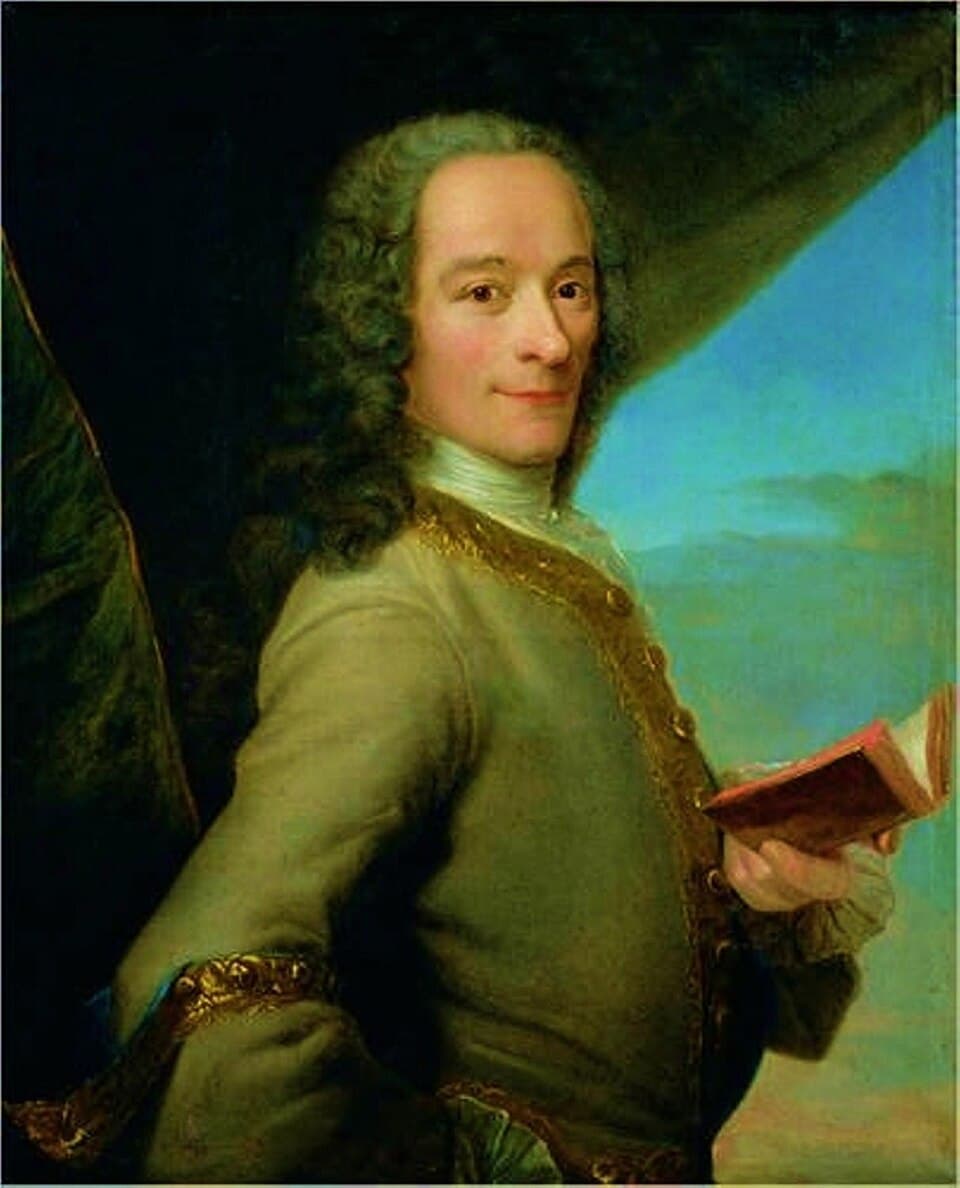
It is at the Château de Ferney, in the grey light of a January afternoon in 1764, that Frederick II of Prussia arrives — or nearly unannounced. A fire burns in the library, ink-stained pages scattered across the writing table, the smell of tallow candles mixing with fresh timber from the new workshops outside. Voltaire receives him wrapped in a wool robe, looking frailer than the king remembers from Potsdam, but no less alert. They have not met face to face since the rupture of 1753; a decade of letters has smoothed the scar, though not entirely erased it.
—Voltaire, when you arrived at Potsdam in 1750, you wrote me that you had found paradise. What did Prussia offer that Paris and Versailles refused you?
You offered something Paris never dared — a sovereign who read the manuscripts before the censors did. My arrival at Potsdam in 1750 was not exile but election, or so I believed. France had burned the Lettres philosophiques and watched me with suspicion for twenty years; you invited me to your table, gave me a chamber in Sans-Souci, and argued philosophy with me until midnight. That, dear Frederick — and I address you as a man, not a king — was the most precious gift any prince can grant a writer: the presumption of his intelligence. Whether paradise proved as durable as the title, we both know the answer to that.
—And yet by 1753 you had left my court — and I confess I did not let you go gracefully. What remained of our friendship after Frankfurt?
What remained? Everything that mattered, I think — and nothing that should have broken it in the first place. I will not rehearse the quarrel over the pamphlet and the arrest at Frankfurt: it was beneath us both. What I carry from that rupture is a lesson I had already written into my work but had not yet fully lived: that even the most enlightened prince is still a prince, and that a philosopher who mistakes a patron for a friend risks both his freedom and his dignity. Our letters resumed, and they were better for the rupture — more honest, less deferential. A friendship purged of flattery is the only kind worth keeping.
A friendship purged of flattery is the only kind worth keeping.
—Long before Potsdam, the Bastille and the Chevalier de Rohan sent you to England in 1726. Did that beating, that exile, truly make you the philosopher you became?
More than any schoolroom. When the Chevalier de Rohan's valets broke my ribs on a Paris street while their master watched from his carriage, I understood in my flesh what no argument had yet fully convinced me of: that privilege and reason are natural enemies. England showed me the alternative — a country where a merchant could contradict a lord in print, where a Quaker sat in Parliament, where Newton was buried among kings. I returned to France with the manuscript that would become the Lettres philosophiques, knowing it would be burned — and burned it was, in 1734. But ideas spread faster when they are forbidden. The Bastille made me a writer; London made me a philosopher.
The Bastille made me a writer; London made me a philosopher.
—The Lettres philosophiques praised English liberty at France's expense. Were the English truly that free, or did you use them as a mirror to shame your own country?
Both, and neither. England had its tyrannies, its religious quarrels, its poor ground beneath their betters — I was not naive. But the mirror you describe was precisely the point of the exercise. A Frenchman who reads that the English tolerate dissent, that their courts offer some protection against arbitrary imprisonment, is not truly reading about England at all: he is reading about the France that does not yet exist. Philosophy proceeds by comparison. One holds a lamp to the darkness not to illuminate another room but to shame the room one is standing in. The censors understood this perfectly — which is why they burned the book before they had finished reading it.
—Candide shook all of Europe when it appeared in 1759. You published it without your name. Was the anonymity necessary, or was the disguise part of the satire itself?
Necessary and delicious — both at once. The censors had been burning my books for thirty years; I had no desire to hand them another occasion. But there is also a deeper reason. Candide is a mask, yes, but masks have their own eloquence. When a named philosopher argues against optimism, men argue back on philosophical grounds. When a young man named Candide stumbles through earthquake, inquisition, and massacre in search of happiness, men laugh — and laughter reaches places that argument never can. The conte philosophique is not evasion but strategy: the Church can imprison a heretic, but it cannot silence a story that everyone has already memorized.
—Why fiction at all? Your Traité sur la tolérance argues directly and with force. Why clothe the same convictions in a tale?
Because the salon laughs, and the treatise persuades — and I need both audiences. The Traité sur la tolérance was written for magistrates, for ministers, for men who weigh arguments and sign orders. Candide was written for everyone else: the young woman who has never read a pamphlet, the merchant who would fall asleep before page ten of Locke. A writer who speaks only to the already-convinced is a preacher, not a philosopher. The conte strips an idea down to its human skeleton and makes it walk. I confess the form also gives me pleasure — there is no sharper knife than irony well handled, and no better shield against censure than having made everyone laugh first.
—The affair of Jean Calas in 1762 — a Protestant condemned by a Toulouse court. What compelled you to take up his cause so loudly?
What compelled me? The evidence — or rather, the absence of it. Here was a man broken on the wheel for murdering a son who, every sober examination suggested, had taken his own life. The judges of Toulouse needed a Protestant killer; the facts were merely inconvenient. I had been writing against fanaticism for decades, but writing abstractions is easy. When the fanaticism arrives with a name, a family, a date, and a specific judicial murder, the philosopher who does not act is simply a coward with elegant prose. I mobilized every connection, every pen, every correspondent in Europe — including, I trust, one or two in Berlin who were not entirely deaf to my letters.
The philosopher who does not act is simply a coward with elegant prose.
—The Traité sur la tolérance followed the rehabilitation of Calas. Do you believe reason alone can turn the tide against fanaticism?
Reason alone, no — reason requires an audience willing to listen, and fanaticism stops its ears by design. What reason can do — what the Traité attempted — is speak to the third man: not the fanatic, not the already-enlightened, but the hesitating magistrate, the bishop who has doubts, the minister who prefers calm to conviction. These are the people who open or close prison doors. The rehabilitation of Jean Calas was not won by converting his persecutors; it was won by persuading enough men of influence that the spectacle of injustice was worse for order than the discomfort of admitting error. Reason wins slowly, case by case. But it does win.
—Diderot and d'Alembert launched the Encyclopédie in 1751 — while you were still here at Potsdam with me. Are you a contributor or a rival to that enterprise?
Neither and both — which is perhaps the honest answer. I have written articles for the Encyclopédie, but I am no disciple of its editorial line, and Diderot knows this. We agree on far more than we disagree, but the Encyclopédie is a monument built by committee, and committees have a genius for filing down the sharp edges that make an idea dangerous. My own Dictionnaire philosophique portatif, finished just this year in 1764, is a different instrument: portable, pungent, and signed by no editorial board. The Encyclopédie illuminates the century; I prefer, when possible, to set fire to it — and then offer a better light.
—Here at Ferney you have built a village, a theatre, a watch factory. Is this your answer to courts and capitals — a republic of your own devising?
It is something I did not entirely plan and would not exchange. Ferney sits sixty steps from the Swiss border — close enough to flee if the authorities arrive, far enough from Paris to think clearly. I have planted trees, built workshops, installed watchmakers, written plays, and received half the thinking minds of Europe at this table. That is not philosophy in the abstract: that is philosophy with mud on its boots. The Encyclopédie tells men what the world contains; Ferney attempts to show, on a small scale, what it might become — a place governed by reason, where a man's creed is his own affair. You, of all people, understand the appeal of building something from the ground up.
Read further
This imaginary interview was generated by artificial intelligence from sources documented in Voltaire's profile. It dramatises what the figure might have said based on what we know about them, but does not constitute attested historical testimony. For primary sources and factual documentation, refer to the full profile.