Imaginary interview with Voltaire
by Charactorium · Voltaire (1694 — 1778) · Literature · Philosophy · 6 min read
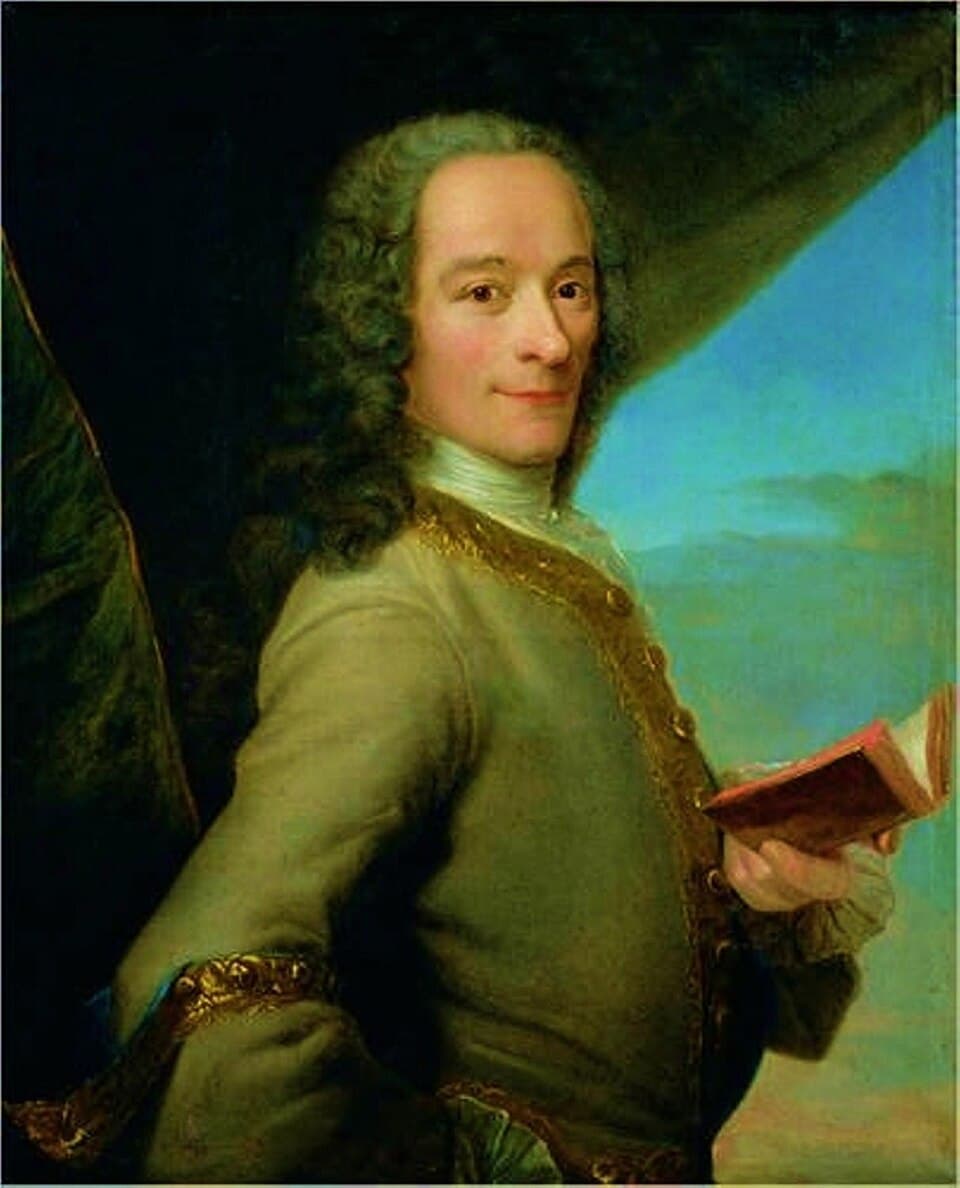
We meet him at his writing table in the Château de Ferney, a few miles from the Swiss border, on a winter afternoon in the early 1770s. The room smells of coffee and ink; a half-finished letter lies beside an inkwell still wet at the rim; outside, snow softens the silence of the estate he has made into a byword for European thought. He does not stand to greet us — only lifts his quill slightly, as if acknowledging that the conversation has already begun.
—You were beaten on the orders of the Chevalier de Rohan — a man whose sole qualification was his birth — and rather than seek vengeance, you left France entirely. How does a man transform that kind of humiliation into a life's philosophy?
Remember it? I carry the bruises in my reasoning, if not in my flesh. 1726 — I had offended the man with a witticism, as one will with people who have nothing else to offer. His hired thugs made their reply in a back street, with fists and sticks. I had two choices: fight back and most likely end my days in the Bastille a third time, or cross the Channel and see what the English had made of liberty. I chose England. What I found there was not paradise — the English have their own varieties of cruelty — but it was a country where one could think aloud without requiring a bishop's countersignature. A Quaker who shook no man's hand and feared no king, a Newton whose natural philosophy circulated freely, a parliament where a merchant might speak. The lesson lodged somewhere between my ribs and never left.
His hired thugs made their reply in a back street — and I chose England.
—What, precisely, did you bring back from England that France lacked?
The evidence — concrete and observable — that men of different faiths can inhabit the same streets without burning each other down. In the Royal Exchange in London I watched Anglicans, Quakers, Catholics, and Presbyterians conduct their business together, and religion was simply not the weapon it became in Paris. I came home with notes that took several years to refine into something fit to publish. Lettres philosophiques appeared in 1734 and was condemned and burned that same year — a book about English tolerance and the freedom of the press, burned by French authorities who grasped the comparison perfectly and did not enjoy it. I fled to Cirey to take shelter with Madame du Châtelet. But you cannot burn an idea that has already been read. The book went on traveling, which is what books that are burned generally do.
—You were already settled at Ferney, already beyond the immediate reach of Paris, when the name Jean Calas reached you. What made you choose to involve yourself in a condemned stranger's cause?
A letter arrived from Donat Calas, the son. His father, Jean — a Protestant cloth merchant of Toulouse — had been broken on the wheel, strangled, and his body burned on the public square: condemned for the supposed murder of his own son, who had in truth hanged himself. I set the letter down on my writing table and asked myself the only question that mattered: was it possible that this father had done such a thing? One hour of inquiry suggested strongly that it was not. And one cannot know a man is innocent and remain still. I had Ferney, I had a correspondence network stretching across Europe, I had the pen — that remarkable instrument which, when aimed correctly, troubles the sleep of magistrates. Le Traité sur la tolérance did not begin as a book; it began as a refusal to look away.
I had the pen — that remarkable instrument which, when aimed correctly, troubles the sleep of magistrates.
—The rehabilitation of Jean Calas came in 1765 — two years after your Treatise on Tolerance. Did you believe, when you first took up the cause, that words could actually reverse a dead man's verdict?
I believed — and still believe — that the most dangerous thing one can give a population is access to a coherent argument. The judges of Toulouse had acted on what I can only call fanatisme: the serene conviction that no inquiry is necessary when doctrine has already spoken. My task was not to argue theology but to introduce doubt — and doubt, as I have written elsewhere, is not a comfortable condition, but it is an honest one. I sent copies of the Traité to every court in Europe that might conceivably care. I kept the story circulating when others wished to bury it with the body. In 1765, the Parlement of Paris reversed the verdict. Jean Calas could not feel the vindication, but his widow and his children could — and that seemed to me the best use to which my quill had ever been put.
—Candide appeared in 1759 under the name of a certain Doctor Ralph — you denied authorship publicly for years, even as all of Paris understood perfectly well who had written it. What is the particular satisfaction of publishing a masterpiece in disguise?
There is something wonderfully clarifying about the censor's stamp. When they forbid a thing, they certify its truth. Candide could not appear under my name without inviting the hospitality of the Bastille once more — so it traveled the world as the work of Doctor Ralph, which somehow made it travel faster. Forbidden things always do. But writing behind that mask produced its own freedom: I could march a young man from Westphalia through an auto-da-fé in Lisbon, could destroy and reassemble an entire cast of nobles, priests, and philosophers, and the whole apparatus held precisely because it announced itself as a fable. The mask is not a deception. It is an invitation to read more closely than you would otherwise dare.
Forbidden things always travel faster.
—Why the tale, the naïve traveler, the philosophical farce — why not simply make the argument directly, as Locke or Montesquieu did?
Because arguments can be refuted and readers can stop reading. A story cannot be refuted — it can only be lived through. When I send young Candide stumbling across the ruins of optimism, the reader is not evaluating a proposition; he is experiencing an absurdity he already half-recognizes from his own life. The satire succeeds where the treatise sometimes stalls because it demands laughter before thought, and laughter lowers every defense. Montesquieu's The Spirit of the Laws — a magnificent architecture — requires patience and a certain prior dedication. Candide requires only the willingness to turn the page. And when the battered survivors finally reach their small garden and discover that they must cultivate it, the reader arrives at a philosophical conclusion having never once felt lectured. That, I think, is the particular cunning of the conte philosophique.
—You corresponded with Frederick of Prussia for decades — a king who styled himself a philosopher and composed verse in French. What drew you to that friendship, and what did you hope to find in it?
Frederick wrote to me first when he was still a crown prince, long before he inherited Prussia and its armies. He wrote with the hunger of a young man who had read everything and wished to dispute it all. For years, our letters were among the most bracing conversation I had — a sovereign who genuinely engaged with Locke, who composed verse with actual earnestness if not always with genius, who believed that a king might govern by reason rather than by the theater of divine right. I went to Potsdam in 1750 with some hope that I had found what so many of us had only theorized: a monarch who meant what the philosophers said. It is, I confess, a seductive idea. A well-read king with absolute power — the temptation to believe it could work is considerable.
—And yet when you tried to leave his court in 1753, Frederick had you detained at Frankfurt for several months, your papers seized. How does a man make sense of being imprisoned by his most celebrated friend?
With difficulty — and then, in time, with a grim satisfaction at the clarity of the lesson. Frederick had lent me his collected verse to edit, then decided he did not wish it to circulate freely. When I attempted to depart, I found myself at Frankfurt under the supervision of his agents, a guest who could neither leave nor be openly called a prisoner. A king of the Enlightenment, detaining a man of letters over a manuscript of indifferent poetry. The lesson wrote itself: le despotisme éclairé is still despotism; an educated sovereign knows precisely which pressure to apply. I bear Frederick no permanent ill will — the correspondence eventually resumed, as these things do — but I never returned to Potsdam. Ferney suited me considerably better, and the Swiss border was nearby for reasons not entirely coincidental.
An educated sovereign knows precisely which pressure to apply.
—Ferney has become something of a pilgrimage destination — thinkers, reformers, young writers arrive from across Europe to find you at the end of a muddy road near Geneva. What does a day in that house actually consist of?
Late mornings, I confess. I am not a man of the early dawn — I keep the hours of my vocation, which is to say I write through the night by candlelight and receive visitors when the world has properly assembled itself. They find me in my study, usually still in a dressing gown, amid a productive disorder of manuscripts and half-finished letters. The afternoons are given to correspondence — thirty, forty letters in a busy week, to Paris, to Berlin, to Stockholm, to Saint Petersburg, to friends and enemies in equal measure. Evenings, when health allows: a dinner, good wine, conversation in which a question posed at the soup course is still being answered over the dessert. Ferney has become, I am told, a kind of republic of letters made physical — which pleases me more than any title a king ever offered.
—Looking back across your decades of work — the tragedies, the tales, the treatises, the tens of thousands of letters — which form do you believe has carried ideas farthest?
The theater brings the largest crowd in an evening but leaves the smallest trace. Candide has traveled under a dozen names to places I shall never visit, which pleases me. The Traité sur la tolérance has been cited in courtrooms, which pleases me considerably more. But if I am honest with myself, it is the private letter — the correspondance manuscrite, written to one person and designed to be copied and passed from hand to hand — that has done the most persistent and least detectable work. A letter cannot be condemned as a book can. It circulates beneath the censor's attention. It reaches a mind directly, without the apparatus of publication or the performance of authorship. When I wrote to a young man in Geneva or an aging magistrate in Toulouse, I was not addressing one person. I was addressing everyone who would one day read over his shoulder.
Read further
This imaginary interview was generated by artificial intelligence from sources documented in Voltaire's profile. It dramatises what the figure might have said based on what we know about them, but does not constitute attested historical testimony. For primary sources and factual documentation, refer to the full profile.