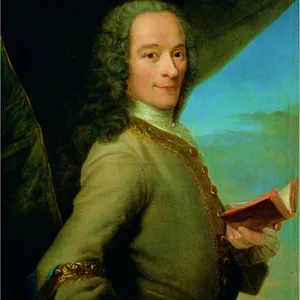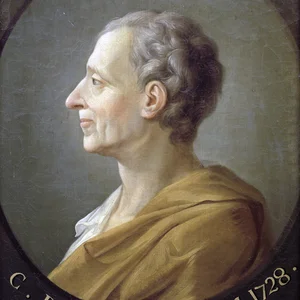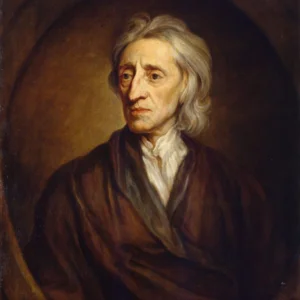

A 17th-century English philosopher, John Locke is the founder of modern empiricism and a major thinker of political liberalism. He developed the theory of natural rights (life, liberty, property) and justified the right to revolt against tyrannical power, profoundly influencing democratic revolutions.
John Locke(1632 — 1704)
John Locke
royaume d'Angleterre
7 min read
Frequently asked questions
Famous Quotes
« No man can transfer to another more power than he has in himself, for this would rest on free consent.»
« Reading furnishes the mind only with materials of knowledge; it is thinking that makes what we read ours.»
Key Facts
- 1689: Publication of 'A Letter Concerning Toleration', defending religious freedom
- 1689: Writing of 'Two Treatises of Government', justifying the Glorious Revolution of 1688 and laying out the theory of the social contract
- 1690: Publication of 'An Essay Concerning Human Understanding', foundation of empiricism (tabula rasa, knowledge through experience)
- 1693: Publication of 'Some Thoughts Concerning Education', influencing modern pedagogy
- 1704: His death at High Laver (Essex) marks the end of his productive philosophical life
Works & Achievements
A major philosophical work that founds modern empiricism by asserting that all knowledge comes from sensory experience. It breaks with Cartesian rationalism and would influence the entire Enlightenment century.
A foundational text of political liberalism, in which Locke theorizes the social contract, natural rights (life, liberty, property) and the right of the people to resist tyranny. This text directly inspired the American Declaration of Independence of 1776.
A plea for the separation of Church and State and for freedom of religious conscience. This courageous text, published under the cover of anonymity, is one of the first great modern texts on toleration.
A pedagogical treatise derived from letters to a friend, in which Locke advocates an education founded on experience, reason, and virtue rather than memorization. It profoundly influenced Rousseau and the educators of the Enlightenment.
Locke proposes a rational and tolerant reading of the Christian faith, seeking to reconcile reason and religion, which earned him accusations of heresy from conservative theologians.
Anecdotes
During the Glorious Revolution of 1688, John Locke returned to England aboard the same ship as the future Queen Mary II. He had spent five years in exile in the Netherlands for allegedly plotting, according to King Charles II, against the monarchy. This triumphant return marked the beginning of his most productive period.
Locke was trained as a physician and saved the life of his patron Anthony Ashley Cooper, the Earl of Shaftesbury, by supervising a risky operation to drain a liver cyst. This surgical procedure, considered daring for the time, cemented their friendship and gave Locke access to the most influential political circles in England.
Although he is famous today for his political theories, Locke published his two major works — the Two Treatises of Government and An Essay Concerning Human Understanding — in the same year, 1689–1690, when he was already 57 years old. He had been working on these texts in secret for many years.
Locke was one of the founding shareholders of the Royal African Company, which was involved in the slave trade, and in 1669 drafted the Fundamental Constitutions of Carolina, which recognised slavery. This troubling contradiction between his theories on liberty and his actions is today at the heart of many historical debates.
Primary Sources
The great and chief end, therefore, of men's uniting into commonwealths, and putting themselves under government, is the preservation of their property.
I esteem toleration to be the chief characteristical mark of the true church, insomuch that whosoever claims to belong to it, yet persecutes and torments other men under pretence of religion, does thereby in effect depart from the true religion.
Let us then suppose the mind to be, as we say, white paper, void of all characters, without any ideas: how comes it to be furnished? [...] Whence has it all the materials of reason and knowledge? [...] To this I answer, in one word, from experience.
I think I may say, that of all the men we meet with, nine parts of ten are what they are, good or evil, useful or not, by their education.
Key Places
John Locke's birthplace in 1632, born into a modest Puritan family. This rural village in southwest England shaped his early years and religious upbringing.
Locke studied medicine, philosophy, and natural sciences here from 1652. It was there that he met Robert Boyle and developed his taste for empirical experimentation.
Locke lived in exile in Amsterdam and Utrecht from 1683 to 1689, taking advantage of the Dutch climate of tolerance to write his major works and frequent European philosophical circles.
The Masham family home where Locke spent his final years; he died there in 1704 surrounded by friends and philosophers, having revised and completed his works.
At the heart of English power, Locke mingled with ministers and parliamentarians under the protection of Shaftesbury, closely observing the workings of a nascent constitutional monarchy.
Typical Objects

Locke was a tireless letter-writer and thinker, producing thousands of pages of notes, letters, and manuscripts. His quill was the instrument of intellectual revolutions that crossed oceans.

The blank writing tablet is the central metaphor of Locke's philosophy: the human mind is born without innate ideas, like a blank page that experience comes to fill.

Locke was a qualified physician from Oxford; he practised medicine throughout his life, and it was his surgical skill that earned him the unwavering trust of his patron Shaftesbury.

Locke, a deeply Christian man of Puritan tradition, drew on the Scriptures to ground his arguments on tolerance and the natural rights granted by God to all men.

As Secretary of the Board of Trade and Plantations, Locke handled official documents on a daily basis, giving him a concrete understanding of how the state functioned.

Locke suffered from fragile health and visual difficulties in the later years of his life; he nonetheless continued to read and correspond with the greatest minds of his time until his death.
School Curriculum
Vocabulary & Tags
Key Vocabulary
Tags
Époque
Concept
Mouvement
Daily Life
Morning
Locke rose early, despite fragile health worsened by asthma. He began his day with a reading of the Scriptures, then devoted himself from dawn to correspondence with philosophers, physicians, and politicians from across Europe.
Afternoon
The afternoon was reserved for writing his philosophical essays and treatises, often in the library of his patrons. He sometimes received learned visitors for scholarly discussions, and recorded his reflections in highly organized notebooks.
Evening
In the evenings, Locke took part in drawing-room conversations at his hosts' homes, or read works on natural science. At Oates, he particularly enjoyed evenings in the company of Damaris Masham, a philosopher herself, with whom he maintained a deep intellectual correspondence.
Food
His delicate health required a frugal diet; he often followed his own medical prescriptions, avoiding excess fatty meat and strong alcohol. He enjoyed tea, a beverage that was then new and fashionable in 17th-century England.
Clothing
Locke wore the sober, functional attire of a learned Protestant gentleman: dark coat, breeches, woolen stockings, and a white shirt with a lace collar. He avoided extravagant wigs and the sartorial ostentation of the court.
Housing
Locke lived in comfortable bourgeois houses rather than palaces. At Oates, he had a bedroom and a study at the Masham estate, surrounded by books and scientific instruments, in the verdant countryside of Essex.
Historical Timeline
Period Vocabulary
Visual Style
Un style sobre et savant, inspiré du portrait baroque anglais tardif : lumière dorée de bougie sur des livres et parchemins, intérieurs en chêne sombre, élégance puritaine sans ostentation.
Sound Ambience
L'univers sonore de Locke mêle le calme studieux d'un cabinet de travail à la vie animée des villes marchandes d'Angleterre et des Pays-Bas du XVIIe siècle.
Liens externes & ressources
Références
Œuvres
Essai sur l'entendement humain
1690
Deux Traités du gouvernement civil
1689
Lettre sur la tolérance
1689
Quelques pensées sur l'éducation
1693
La Raisonnabilité du christianisme
1695