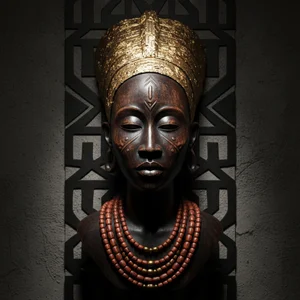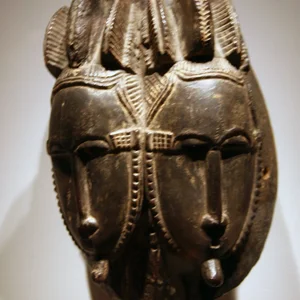

Founding queen of the Baoulé people (Côte d'Ivoire) in the 18th century, according to Akan oral tradition. To allow her people to cross the Comoé River during a forced exile, she is said to have sacrificed her only son. Her name means "the child who does not return."
Frequently asked questions
Key Facts
- Around the mid-18th century, Aura Pokou left the Ashanti kingdom (present-day Ghana) with part of her people following a succession conflict.
- According to Baoulé oral tradition, diviners demanded the sacrifice of what she held most dear in order to allow her people to cross the flooded Comoé River.
- She sacrificed her only son; hippopotamuses are said to have then formed a natural bridge, allowing the crossing.
- After crossing, her people spoke the words "Ba ouli" ("the child is dead"), giving rise to the name "Baoulé."
- These events are transmitted exclusively through oral tradition; no contemporary written source attests to them directly.
Works & Achievements
Aura Pokou's greatest achievement: the establishment of an autonomous Akan state in what is now central Côte d'Ivoire, with its own political, judicial, and spiritual structures, which endured until French colonization.
Aura Pokou maintained the cohesion of tens of thousands of Akan refugees during a migration of several hundred kilometers — an act of leadership that established the legitimacy of her future reign.
By adapting Akan matrilineal traditions to their new territorial context, Aura Pokou shaped the social codes, inheritance rules, and ritual ceremonies that continue to structure Baoulé society today.
The story of Aura Pokou is itself a collective work — a founding narrative passed from generation to generation by Baoulé griots, comparable to great epics such as that of Sundiata Keita.
A novel by Ivorian writer Véronique Tadjo that reinterprets the Baoulé founding myth, questioning sacrifice as a political act and the nature of African collective memory. Part of the secondary school curriculum in several French-speaking countries.
Anecdotes
According to Akan oral tradition, Aura Pokou was an Asante princess who was forced to flee the kingdom with part of her people during a succession war within the royal family. She led thousands of people through dense forests and treacherous rivers, asserting her authority under extreme circumstances.
Upon reaching the flooded banks of the Comoé River, Aura Pokou consulted diviners who told her she must offer what she held most precious for the waters to part. She cast her only son into the raging current. According to the account, hippopotamuses then rose from the water and formed a living bridge, allowing the entire people to cross.
After the crossing, the survivors expressed their grief by repeating "Ba oulé" — "the child is dead" in the Akan language. It is from this collective cry of mourning that the name Baoulé was born — the people Aura Pokou had just founded through her sacrifice. Her name is thus etched into the very identity of an entire people.
Aura Pokou settled in the central region of present-day Côte d'Ivoire and established her court at Sakassou, which became the political and spiritual heart of the new Baoulé kingdom. She ruled there as sovereign queen, organizing society according to the matrilineal structures inherited from the Akan tradition.
Aura Pokou is today venerated as a near-divine founding ancestor by the Baoulé people. Ritual ceremonies perpetuate her memory, and her story is passed down by specialized griots on important occasions. The Alassane Ouattara University in Bouaké, Côte d'Ivoire, also bears the name "Université Aura Pokou" in her honor.
Primary Sources
The elders tell: when the waters would not part, the queen wept and said 'He is all I have.' Then she lifted her child toward the sky and entrusted him to the river. The hippopotamuses came, and the people crossed.
The Akan migration led by Princess Pokou is one of the best-attested settlement events in the collective memory of West African forest peoples. The sacrifice of the only son is the narrative pivot around which Baoulé identity is organized.
O Pokou, mother of the waters, you gave life twice: once in bearing a child, once in offering him. The people who walk are the people of your blood.
The Baoulé preserve a precise oral genealogy tracing the lineage of Aura Pokou back to Osei Tutu, founder of the Asante empire. Baoulé dynastic memory presents Pokou as the niece of the Asante king Opoku Ware I.
There are stories that cannot be told without trembling. Pokou's is one of them. It forces us to look squarely at what we are capable of doing in the name of collective survival.
Key Places
Capital of the Ashanti Empire and the birthplace of Aura Pokou. It was from this royal city that she was forced to flee with her followers during the succession crisis that tore apart the Akan court.
A West African river where Aura Pokou's legendary sacrifice is said to have taken place. This crossing site is the founding moment of Baoulé identity — the place where a wandering people became a rooted one.
The royal Baoulé city founded by Aura Pokou, serving as the political and spiritual heart of the new kingdom. It remains to this day the symbolic seat of Baoulé chieftaincy and a living site of collective memory.
The geographic heartland of Baoulé country, this central region of Côte d'Ivoire is the territory that Aura Pokou's people settled and developed following the great migration of the 18th century.
A dense forest zone crossed by the Baoulé migrants during their long exodus. These thick forests represented both an obstacle and a shield against enemies who might have pursued the fleeing group.
Typical Objects

The supreme symbol of Akan political power, the carved stool is the most sacred object of the monarchy. It is said that the soul of the ruler resides within it: Aura Pokou is believed to have taken hers into exile as a mark of dynastic legitimacy.

Akan queens wore heavy cast-gold ornaments depicting proverbs or totemic animals. These jewels proclaimed royal rank and the wealth of the lineage during official ceremonies.

These large royal drums were used to summon the people and relay messages over long distances. During the migration, they set the rhythm of the march and kept the group together as it moved.

High-ranking Akan women wore cotton wraps with symbolic geometric patterns, ancestors of kente cloth. The colors and motifs indicated the wearer's social rank and lineage affiliations.

Akan rulers carried ceremonial staffs topped with gold pommels depicting fables or political maxims. The staff was an emblem of power passed down from reign to reign.

Both an everyday object and a ritual vessel, the engraved calabash was used for libations offered to ancestors and river deities. It was into just such a calabash that diviners cast their cowrie shells to reveal to Aura Pokou the sacrifice she must make.
School Curriculum
Vocabulary & Tags
Key Vocabulary
Tags
Daily Life
Morning
Aura Pokou began her day with libations to the ancestors and the protective deities of the royal lineage. Akan priests recited propitiatory formulas while the queen donned her ceremonial adornments. The council of elders gathered early to address the political and judicial affairs of the nascent kingdom.
Afternoon
The afternoon was devoted to political organization: receiving allied village chiefs, settling land disputes between newly settled clans, and overseeing agriculture on the freshly cleared land. In a kingdom still taking shape, every decision regarding the allocation of land and resources was crucial to the group's cohesion.
Evening
In the evenings, the court gathered around fires to hear griots recite royal genealogies and the great deeds of the migration. These storytelling gatherings served an essential political function: reminding everyone of their common origin and of Aura Pokou's dynastic legitimacy. High-ranking women would weave or braid while listening to the ancestral tales.
Food
The Akan diet was built around yam, cassava, and plantains, prepared as fufu or spiced stews with forest vegetables. Game meat — antelope, monkey, porcupine — was a prestige food reserved for royal feasts. Fish from the Comoé River rounded out the daily diet of communities settled near waterways.
Clothing
The Akan queen wore woven cotton wraps with geometric patterns, draped toga-style around the body with one shoulder bare in keeping with royal tradition. Heavy gold ornaments — bracelets, necklaces, rings — announced her rank with every movement. At ceremonies, she wore an elaborate hairstyle and decorated leather sandals.
Housing
The Baoulé royal court at Sakassou consisted of a cluster of mud-walled, thatched-roof huts arranged around a central courtyard where public audiences were held. The royal dwelling, larger than the rest, was decorated with geometric patterns painted in white and red clay. An adjoining sacred grove housed the ancestral altars and ritual objects of the kingship.
Historical Timeline
Period Vocabulary
Visual Style
Un style visuel mêlant la somptuosité de la cour akan — or, textiles géométriques, insignes royaux sculptés — à la dramaturgie sombre de la forêt équatoriale et du fleuve légendaire.
Sound Ambience
L'univers sonore d'Aura Pokou mêle les percussions royales akan, le murmure des fleuves d'Afrique de l'Ouest et les chants de deuil qui donnèrent leur nom au peuple baoulé.
Liens externes & ressources
Références
Œuvres
Fondation du royaume baoulé
vers 1745-1750
Traversée du Comoé et unification du peuple en exil
vers 1740-1745
Instauration des lois et coutumes baoulé
vers 1750-1760
Récit épique oral de la traversée (tradition vivante)
XVIIIe siècle — transmis jusqu'à aujourd'hui
Reine Pokou : Concerto pour un sacrifice — Véronique Tadjo
2004