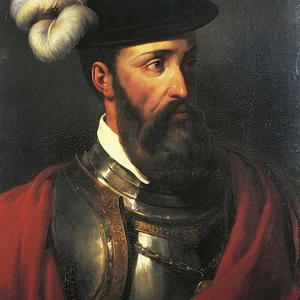

Spanish conquistador (c. 1478–1541), he led the conquest of the Inca Empire in Peru between 1532 and 1533, captured the emperor Atahualpa, and founded Lima in 1535. His expedition transformed the New World and opened South America to Spanish colonization.
Francisco Pizarro(1478 — 1541)
Francisco Pizarro
Espagne, couronne de Castille
9 min read
Frequently asked questions
Key Facts
- Around 1478: born in Trujillo, in Extremadura (Spain)
- 1513: takes part in Vasco Núñez de Balboa's expedition that discovers the Pacific Ocean
- 1532: captures the Inca emperor Atahualpa at Cajamarca following an ambush
- 1533: execution of Atahualpa and collapse of the Inca Empire
- 1535: founding of Lima (Ciudad de los Reyes), future capital of Peru
- 1541: assassinated in Lima by supporters of Diego de Almagro
Works & Achievements
In less than two years, Pizarro overthrew one of the most extensive empires in the pre-Columbian world. The capture of Atahualpa at Cajamarca and the fall of Cuzco brought five centuries of Inca civilization to an end and opened South America to European colonization.
Choosing a coastal site at the mouth of the Rímac rather than the Andean highlands of Cuzco, Pizarro founded what would become the capital of the Viceroyalty of Peru. Lima served as the political, economic, and religious center of all Spanish South America for three centuries.
In tribute to his Spanish hometown, Pizarro founded Trujillo on the northern coast of Peru. This strategic port city served as a relay point between Lima and the mines of the northern viceroyalty.
Pizarro traveled to Spain in person to obtain from Charles V the powers he needed for his conquest. This founding document granted him the title of governor, awarded him privileges over the territories to be conquered, and defined how the spoils would be shared with the Crown.
Beyond the military conquest, Pizarro worked to structure the new territory: distributing encomiendas, appointing local officials, and drafting the first municipal ordinances. These fragile administrative foundations were quickly undermined, however, by the civil wars among the conquistadors.
Anecdotes
Born illegitimate around 1478 in Trujillo, Extremadura, Francisco Pizarro grew up in poverty and never learned to read or write. This uneducated soldier's son nonetheless went on to conquer one of the most powerful empires in the world, proving that determination could substitute for education in Renaissance Spain.
In 1527, during his second voyage of exploration, his exhausted and starving men wanted to turn back. Pizarro drew a line in the sand with his sword and declared: “On one side, ease and poverty; on the other, wealth and glory.” Only thirteen men crossed the line — this group, known as the “Thirteen of Gallo Island,” continued southward and discovered the Inca coastline.
In November 1532, at Cajamarca, Pizarro captured the Inca emperor Atahualpa in a lightning ambush. As the price for his freedom, Atahualpa offered to fill an entire room with gold (approximately 6 tons) and two rooms with silver. The ransom was delivered, but Pizarro had the emperor executed anyway in August 1533, triggering the final collapse of the Inca Empire.
On June 26, 1541, around twenty supporters of Diego de Almagro the Younger burst into Pizarro's palace in Lima. Despite being 63 years old, Pizarro defended himself with a sword, killing two attackers before being overwhelmed. According to witnesses, as he lay dying, he drew a cross in the blood spilled on the floor and died kissing it — a tragic end for the man who had conquered an empire.
Primary Sources
We arrived at the town of Cajamarca… and the governor sent Father Friar Vicente to speak with the chieftain Atahuallpa… who replied that he did not wish to come in peace, but in war.
Francisco Pizarro was a man of medium height, lean of body, of good bearing, and knew well how to command and govern men of war.
The governor ordered the artillery to be unleashed, and charged with the horsemen across the square, while the foot soldiers entered with their blades… Atahuallpa was taken prisoner in this battle.
That you, the said Don Francisco Pizarro, may conquer and settle the provinces and lands of Peru… with the title of Governor and Captain General.
Pizarro was a man of great spirit and industry, enduring of hardships, a lover of honor, though he lacked learning — which is a grave failing in one who must govern.
Key Places
Francisco Pizarro's hometown and the birthplace of many Spanish conquistadors. An equestrian statue of Pizarro still stands today in the main square, a symbol of local pride for this native son who became the conqueror of an empire.
The site of Atahualpa's capture on November 16, 1532 — the pivotal moment of the conquest of Peru. In this Andean city, 168 Spaniards ambushed thousands of Inca warriors, forever changing the course of history for the American continent.
The sacred and political capital of the Inca Empire, seized by Pizarro in November 1533. The conquistadors looted the Coricancha Sun Temple and built a cathedral over its foundations, symbolically erasing the Inca religion and replacing it with Christianity.
Founded by Pizarro on January 18, 1535, in the Rímac Valley, Lima became the administrative capital of the Viceroyalty of Peru and the main port through which Andean gold and silver were shipped to Spain.
The launching point for all three of Pizarro's expeditions southward. From this first Spanish city on the Pacific coast, he assembled his crews, secured funding for his voyages, and recruited his men before sailing into the unknown.
Typical Objects

Pizarro wore Toledan steel armor — breastplate, bracers, and morion — which provided protection against Inca weapons but weighed heavily under the Andean sun. This armor symbolized Spanish military superiority over warriors equipped with bronze and wooden weapons.

Forged in Toledo, the capital of Spanish steel, the double-edged sword was Pizarro's personal weapon. Its tempered steel blade proved lethal during the capture of Atahualpa and at his own assassination, where he fought back to the very end.

A primitive firearm whose thunderous noise and smoke terrified Inca soldiers who had never encountered anything like it. The discharge of a few arquebuses during the ambush at Cajamarca helped sow panic throughout Atahualpa's ranks.

Unknown to Andean peoples before the arrival of the Spanish, the horse was perceived by some Incas as a mythical and fearsome creature. Pizarro's cavalry played a decisive role at Cajamarca, enabling a charge that scattered an army many thousands of times larger.

The gold and silver collected for Atahualpa's ransom consisted of Inca ritual and royal objects: vessels, figurines, and temple ornaments. Melted down into ingots, these treasures constituted one of the greatest acts of plunder in history, redistributed among the soldiers according to a strict formula.

Pizarro had a large wooden cross planted at each city founding or taking of possession of territory in the name of the Spanish Crown and the Catholic Church. The Christianization of indigenous peoples was officially one of the stated justifications for the conquest.

During his coastal expeditions, Pizarro relied on the portolan charts and navigation instruments available at the time. These rudimentary tools guided his three voyages along the Pacific coast before he turned inland.
School Curriculum
Vocabulary & Tags
Key Vocabulary
Tags
Daily Life
Morning
Pizarro rose early, attending the daily Mass celebrated by the expedition's chaplain — the Catholic religion structured the daily routine of the conquistadors. He would then gather his captains to plan troop movements, inspect the horses, and check provisions, as logistics in unknown territory were a constant concern.
Afternoon
The afternoon was devoted to travel, negotiations with local indigenous chiefs, or overseeing construction work in newly founded towns. Pizarro, who was illiterate, dictated his correspondence to a secretary: letters to the King of Spain, reports on the progress of the conquest, and requests for reinforcements were drafted with care, as his future appointments depended on their quality.
Evening
In the evenings, the conquistadors gathered around a fire to share a meal, discuss the spoils, settle disputes over precedence, and plan the next stages. Pizarro, a man of few words according to the chroniclers, resolved disagreements with authority; the tensions among his men — particularly with Almagro — consumed much of his political energy.
Food
On the Andean roads, the conquistadors lived partly off local supplies: maize (sara), potatoes, dried llama meat (charqui), and chicha — the Inca fermented maize beer. The Spaniards supplemented these with their own provisions: hardtack, salt pork, and wine when any remained. In the towns they founded, pigs and chickens brought from Spain provided more familiar fare.
Clothing
Pizarro wore full armor in hostile territory: a steel breastplate, leg guards, a morion (a crested helmet with a curved brim), and a wool cape for the freezing Andean nights. In towns and during official audiences, he donned dark velvet garments in the Spanish fashion — doublet, hose, and cloak — to assert his authority as governor.
Housing
During expeditions, Pizarro slept in tents or requisitioned indigenous buildings. Once Lima was founded, he took up residence in a palace built on the ruins of an Inca administrative complex, at the heart of the new city. This palace, serving as both private residence and seat of government, was the epicenter of colonial power until his assassination in 1541.
Historical Timeline
Period Vocabulary
Visual Style
Un style Renaissance espagnol rencontrant l'esthétique inca : contrastes dramatiques entre l'acier gris des conquistadors et l'or des ornements incas, sur fond de paysages andins grandioses aux ciels profondément bleus.
Sound Ambience
Une atmosphère sonore de choc des civilisations : les vents andins, les flûtes incas et les chants en quechua s'entremêlent au cliquetis des armures espagnoles, aux hennissements des chevaux et aux premières cloches catholiques résonnant sur les ruines d'un empire.
Liens externes & ressources
Références
Œuvres
Conquête de l'Empire inca
1532-1533
Fondation de Lima (Ciudad de los Reyes)
18 janvier 1535
Fondation de Trujillo del Perú
1535
Capitulación de Toledo — négociation avec la Couronne
1529
Organisation administrative du Pérou
1534-1541