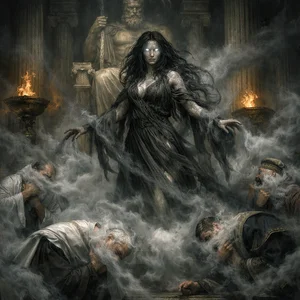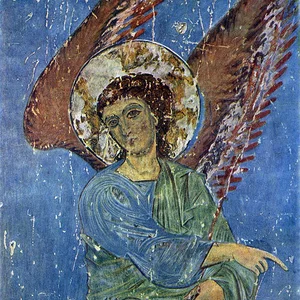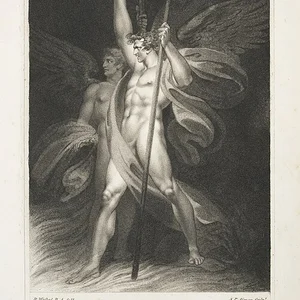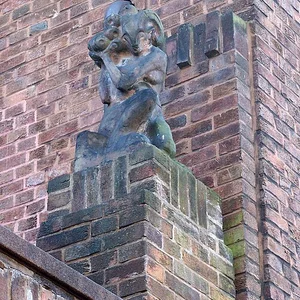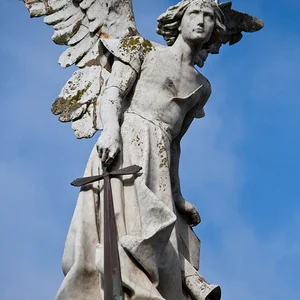

A biblical figure from the Book of Revelation, Abaddon is the angel-king of the bottomless pit, whose Hebrew name means 'destruction.' He commands the devastating locusts during the fifth seal and embodies the ambiguous boundary between destroying angel and demonic power.
Abaddon
Abaddon
8 min read
Frequently asked questions
Key Facts
- Mentioned in the Book of Revelation (Rev 9:11) as king of the devastating locusts
- His Hebrew name 'Abaddon' (אֲבַדּוֹן) means 'destruction' or 'ruin'
- Called in Greek 'Apollyon', meaning 'the Destroyer'
- Also appears in the books of Job and Proverbs as a place of perdition
- Reinterpreted throughout the Middle Ages as a prince of hell in Christian demonology
Works & Achievements
Canonical Christian text in which Abaddon is named and personified for the first time as the angel-king of the Abyss. It is the primary — and almost sole — source for the figure of Abaddon as retained by Christian tradition.
A Hebrew wisdom text that mentions Abaddon as a cosmic place of destruction and death, the direct ancestor of the apocalyptic personification. Here Abaddon is a toponym of the afterlife, synonymous with Sheol.
A collection of Essene texts discovered in 1947 in caves near the Dead Sea, which use the term Abaddon in a liturgical and eschatological context, attesting to its presence in intertestamental Jewish theology.
A Jewish apocryphal text describing the world of angels, demons, and cosmic punishments. Although it does not name Abaddon directly, it belongs to the same current of thought that prepared his figure and influenced the Book of Revelation.
The earliest known Latin commentary on Revelation, written by a bishop of Pannonia (present-day Slovenia). It offers an interpretation of the figure of Abaddon/Apollyon that would shape all of Western medieval exegesis.
Anecdotes
The name 'Abaddon' appears seven times in the Hebrew Bible, notably in the Book of Job, where it refers not to a being but to a place: the realm of the dead, an underground region of destruction. It is only in the Book of Revelation that Abaddon becomes a personified figure — an angel given both a name and a specific role.
In Revelation (chapter 9), when the fifth angel sounds his trumpet, a bottomless pit opens and smoke pours out, darkening the sun. From this smoke emerge locusts resembling warhorses, crowned with gold, with human faces and lions' teeth. Their king is Abaddon — an image of extraordinary symbolic power for first-century readers.
Abaddon has a double name: 'Abaddon' in Hebrew and 'Apollyon' in Greek, both meaning 'destroyer.' This deliberate bilingualism in the text of Revelation reveals that John was addressing both Jewish and Greek communities simultaneously, seeking to reach the widest possible audience amid the persecutions of the late first century.
Some ancient biblical scholars drew a connection between Apollyon (the Greek name for Abaddon) and the Greek god Apollo, whose attributes included the locust and epidemic plague. This phonetic similarity may have been intentional — a subtle way of critiquing the Roman imperial cult, which identified emperors such as Nero or Domitian with Apollo.
In the Dead Sea Scrolls (Qumran manuscripts, 2nd–1st century BCE), the word 'Abaddon' appears as a synonym for 'Sheol,' the kingdom of the dead. These texts show that the figure existed in the Jewish imagination long before the Book of Revelation, attesting to a long tradition of representing ultimate destruction.
Primary Sources
The fifth angel sounded his trumpet [...] They had as king over them the angel of the Abyss, whose name in Hebrew is Abaddon and in Greek is Apollyon.
Death is naked before God; Destruction (Abaddon) lies uncovered.
Death and Destruction (Abaddon) lie open before the Lord — how much more do human hearts!
The cords of death have encompassed me and Sheol is upon my bed; I groan on my couch until morning [...] like those who go down into Abaddon.
Is your love declared in the grave, your faithfulness in Destruction (Abaddon)?
Key Places
Aegean island where John of Patmos received his visions and wrote the Book of Revelation, the foundational text in which Abaddon appears. John's exile to this rocky island under Emperor Domitian gave rise to the most visionary text of the New Testament.
Holy city whose destruction by Rome in 70 AD haunts all apocalyptic literature of the 1st century. The imagery of destruction associated with Abaddon echoes the trauma of the fall of the Temple, the religious center of Judaism.
Site where the Essene community produced the Dead Sea Scrolls (2nd–1st centuries BC), in which Abaddon is mentioned as a place of cosmic destruction — evidence of a tradition predating the Book of Revelation.
A major metropolis of Asia Minor and the first of the seven recipients of the Book of Revelation. A cosmopolitan city where imperial cults, Greek mystery religions, and early Christian communities coexisted, Ephesus embodies the religious syncretism that forms the backdrop for Abaddon.
Capital of the Roman Empire, implicitly referred to as 'Babylon the Great' in the Book of Revelation. The imperial persecutions launched from Rome form the direct political context in which the text featuring Abaddon/Apollyon was written.
Typical Objects

In the Book of Revelation, an angel receives the key to the bottomless pit to open it and release Abaddon. This object symbolizes divine power over the forces of chaos: even destructive powers cannot act without heavenly authorization.

The fifth angel sounds the trumpet to trigger the release of Abaddon. A Hebrew ritual instrument made from a ram's horn, the shofar signals moments of cosmic rupture in Jewish tradition — the New Year, the Day of Atonement, and the announcement of war.

Hybrid creatures commanded by Abaddon: the body of a horse, a human face, hair like a woman, teeth like a lion, and a scorpion's tail. They torment men without killing them for five months — a symbol of divine punishment that is controlled and limited in time.

The scroll on which John records his vision, as dictated by an angel. This type of document — rolls of papyrus or animal skin — was the standard writing medium in the first-century Mediterranean world, used for official letters and sacred texts alike.

Abaddon's locusts wear crowns that look like gold, a sign of their infernal royalty. In the Greco-Roman world, the golden crown was reserved for gods and emperors — a symbolic transgression highlighting the usurping nature of the powers of evil.

The locusts are described as wearing iron breastplates, a reference to Roman legionary soldiers. This image grounded the vision in the contemporary military reality of its readers, suggesting that behind Roman power lurked a demonic force.
School Curriculum
Vocabulary & Tags
Key Vocabulary
Daily Life
Morning
In apocalyptic cosmology, Abaddon has no daily routine in the human sense: he is chained in the Abyss, suspended in a timeless waiting beyond ordinary time. His 'awakening' begins when the fifth heavenly trumpet sounds, signaling a cosmic upheaval.
Afternoon
Once released, Abaddon commands his legions of devastating locusts and sends them to torment those 'who do not have the seal of God on their foreheads' for exactly five months — a precise duration reflecting the natural cycle of locust swarms in the eastern Mediterranean.
Evening
In ancient Jewish and Christian eschatology, the powers of the Abyss are returned to the depths once their mission is fulfilled. Abaddon's activity is strictly bounded by divine will, which underscores the rigorously ordered structure of apocalyptic chaos.
Food
A non-human, non-incarnate figure in the texts, Abaddon does not feed in any material sense. Symbolically, his 'sustenance' is destruction itself: he 'consumes' the world by fulfilling his function as an instrument of divine punishment, in direct continuity with the destroying angels of the Hebrew tradition.
Clothing
In medieval iconographic depictions inspired by the Book of Revelation, Abaddon is portrayed either as a dark angel with black wings or as a hybrid creature wearing a crown. His 'garment' is cosmic armor — a breastplate of darkness, infernal royal regalia.
Housing
The Abyss (Greek: Abyssos) is Abaddon's dwelling: a bottomless pit sealed by a heavenly lock, located beneath the earth according to ancient cosmology. This place is not the medieval Christian hell but a pre-existing cosmic region — a reservoir of primordial chaotic forces.
Historical Timeline
Period Vocabulary
Visual Style
Un style alliant enluminure byzantine et horreur cosmique : contrastes saisissants entre or céleste et ténèbres abyssales, figures hybrides monumentales surgissant d'une fumée soufrée, sur fond de parchemin fissuré et de ciel sans étoiles.
Sound Ambience
L'univers sonore d'Abaddon mêle la déflagration de la trompette apocalyptique, le bourdonnement ravageur d'un essaim de sauterelles et les gémissements souterrains de l'Abîme, dans une atmosphère de catastrophe cosmique lente et inexorable.
Liens externes & ressources
Références
Œuvres
Apocalypse de Jean (Nouveau Testament)
vers 95 apr. J.-C.
Livre de Job (Bible hébraïque)
entre le Ve et le IIe siècle av. J.-C.
Manuscrits de la mer Morte (Qumrân)
vers 200-68 av. J.-C.
Livre d'Hénoch (1 Hénoch)
IIIe-Ier siècle av. J.-C.
Commentaire sur l'Apocalypse, Victorin de Poetovio
vers 260-304 apr. J.-C.