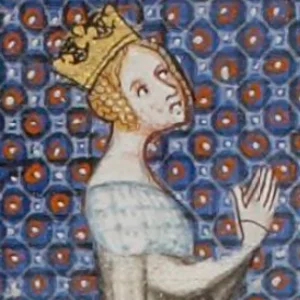

Queen of France through her marriage to Louis VII in 1160, Adela of Champagne is best known as the mother of Philip II Augustus. She served as regent of the kingdom during her son's crusade in 1190–1191.
Adela of Champagne(1140 — 1206)
Adela of Champagne
France
8 min read
Frequently asked questions
Key Facts
- Born around 1140, daughter of Count Thibaut II of Champagne
- Married Louis VII of France in 1160, becoming his third wife
- Gave birth in 1165 to the future Philip II Augustus, the long-awaited male heir
- Served as regent of the Kingdom of France during Philip Augustus's crusade (1190–1191)
- Died in 1206, having outlived her husband and seen her son become one of France's greatest kings
Works & Achievements
During Philip II's absence on crusade, Adele and her brother William of Reims managed the governance of the kingdom: justice, finances, and administration of the royal lands. This regency passed without major incident, attesting to her genuine political abilities.
Through her marriage to Louis VII, Adele united the two great powers of the northern kingdom. This alliance lastingly strengthened the Capetian monarchy against the Plantagenet threat by drawing Champagne into the royal orbit.
Her most significant historical legacy remains having given birth to and raised Philip Augustus — the king who doubled the royal territory, reformed French administration, and turned Paris into a true capital. Adele watched over his princely upbringing until his accession to the throne.
Like all Capetian queens, Adele granted donations to abbeys and pious foundations. Her final retreat to the Cistercian abbey of Pont-aux-Dames illustrates this constant religious commitment throughout her life.
Anecdotes
After two marriages that had failed to produce a male heir, Louis VII had waited for decades for a son to secure the Capetian succession. When Adèle gave birth to Philippe on 21 August 1165, joy overflowed throughout the kingdom: bells rang out in Paris, the king distributed alms to the poor, and chroniclers spoke of a true dynastic miracle. This son, the future Philip II Augustus, would go on to double the royal territory.
When Philip II set out on the Third Crusade in July 1190 alongside Richard the Lionheart, he entrusted the regency of the kingdom to his mother Adèle and his uncle Guillaume, Archbishop of Reims — Adèle's own brother. For more than a year, the queen mother administered the royal domain, dispensed justice, and oversaw the finances without any revolt disturbing the kingdom.
Adèle belonged to one of the most powerful houses in France: the counts of Champagne. Her father, Thibaut II, known as the Great, ruled over a prosperous county where the famous Champagne Fairs were held — a commercial crossroads for all of Europe. By marrying Adèle, Louis VII sealed an essential political alliance with this powerful vassal who had long resisted him.
Adèle's marriage to Louis VII was celebrated in November 1160, less than a month after the death of his second wife Constance of Castile. This haste shocked some clergymen, including Pope Alexander III, who threatened to impose an interdict, but dynastic urgency prevailed: Louis VII, approaching forty, could not afford to wait.
After the death of Louis VII in 1180, Adèle gradually withdrew from political life. She ended her days at the Cistercian abbey of Pont-aux-Dames, in Seine-et-Marne, where she died on 4 June 1206 at around 66 years of age, having outlived her royal husband by twenty-six years.
Primary Sources
Anno Domini MCLXV natus est Philippus rex Francorum, filius Ludovici regis et Adelaidis reginae, in villa Goncesse... magna laetitia in toto regno exorta est, et rex Ludovicus, prae nimio gaudio, lacrimis perfusus est.
Adelaidis regina, mater nostra, et Willelmus Remensis archiepiscopus, avunculus noster, regni nostri curam gerant donec revertamur, et sine eorum consilio nichil fiat.
Regina Adelaidis cum Guillelmo Remensi archiepiscopo, fratre suo, regnum prudenter gubernavit; nec aliquid turbationis accidisse fertur in Francia per illud tempus.
Philippus rex, antequam mare transiret, matri sue regine Adelaidi et avunculo suo archiepiscopo Guillelmo curam regni commisit, ut eis obedirent barones et officiales regni.
Key Places
The probable birthplace of Adèle, and capital of the powerful County of Champagne ruled by her father Thibaut II. Troyes was a major political and commercial hub, renowned for its international trade fairs.
The main residence of the Capetian court, where Adèle lived first as queen and later as regent. The royal palace on the Île de la Cité was the heart of government in the Kingdom of France.
The episcopal see of her brother Guillaume de Champagne, archbishop and co-regent. Reims was also the city where French kings were crowned, making it central to Capetian royal legitimacy.
The royal necropolis of the Capetians, where Louis VII was buried in 1180. Adèle fulfilled her duty as queen by overseeing the solemn funeral rites for her husband in accordance with royal protocol.
The Cistercian monastery where Adèle retired after her years at court, and where she died on 4 June 1206. She is buried there, in this place of contemplation located in Seine-et-Marne.
Typical Objects

As regent, Adèle affixed her pendant seal to the kingdom's official acts. This instrument of power, engraved with her likeness, guaranteed the authenticity of the charters and ordinances issued in her name during Philip II's absence.

Twelfth-century queens owned manuscript prayer books adorned with illuminations in gold and vivid colors, used for their daily devotions. These precious objects structured Adèle's day according to the liturgical offices.

Worn at major ceremonies, Adèle's crown was made of gold set with precious stones in the Romanesque goldsmith tradition of the twelfth century. It symbolized royal dignity and was displayed prominently during solemn audiences.

Official acts — treaties, royal letters, donations — were kept in sealed chests entrusted to the regent's keeping. During Philip II's crusade, Adèle was the guardian of these archives, essential to the running of the kingdom.

Capetian queens wore prestigious garments of silk imported from the East, embroidered with gold thread and trimmed with ermine or vair. These fabrics arrived via the fairs of Champagne — Adèle's homeland and a major commercial crossroads of Europe.

Like all medieval sovereigns, Adèle owned goldsmith reliquaries containing the relics of saints, objects of personal devotion and dynastic prestige. Such pieces were also given to monasteries to secure the prayers of their communities.
School Curriculum
Vocabulary & Tags
Key Vocabulary
Daily Life
Morning
Adèle's day began before dawn with the matins prayer in the palatine chapel, accompanied by her chaplain and her ladies-in-waiting. She then attended morning Mass, an obligatory act of devotion for any Capetian sovereign, before receiving the first news of the kingdom brought by the palace servants.
Afternoon
Afternoons were devoted to court affairs: audiences, the reading and signing of charters, and consultations with the royal advisors. During the regency period (1190–1191), Adèle presided over the king's council, settled disputes, supervised the bailiffs, and received messengers from the great lords of the realm who came to report.
Evening
The evenings brought the court together for a lavish meal in the great hall of the palace. Trouvères sometimes enlivened these gatherings, for the French court was a flourishing center of poetry in the *langue d'oïl*. Adèle then withdrew with her ladies for the compline prayer before retiring, thus ending a day measured out by the liturgical hours.
Food
The royal table offered roasted meats (venison, poultry), abundant fish on fast days (Fridays and Lent), vegetables from the palatial garden, and fine white wheat bread. Wines from the Île-de-France accompanied the meals, and oriental spices (pepper, cinnamon, ginger) — imported via the Champagne fairs — announced the luxury of the court.
Clothing
Adèle wore long robes of silk or fine wool cloth in vivid colors (purple, royal blue, scarlet), edged with ermine or vair depending on the season. Her head was covered with a white veil and a golden circlet, the royal crown being reserved for official ceremonies and solemn feast days.
Housing
Adèle resided chiefly at the royal palace on the Île de la Cité in Paris, a vast complex of halls and towers overlooking the Seine. The itinerant court also moved between the royal residences of the Île-de-France (Compiègne, Poissy). In her final years, she settled into the austere yet comfortable surroundings of the Cistercian abbey of Pont-aux-Dames.
Historical Timeline
Period Vocabulary
Liens externes & ressources
Références
Œuvres
Régence du royaume de France
1190-1191
Alliance dynastique Champagne-Capétiens
1160
Éducation de Philippe II Auguste
1165-1180
Soutien aux établissements religieux
vers 1176-1206