 flip
flipChildhood Sweet Mint Tea
Childhood Sweet Mint Tea
Why this dish? Sweet mint tea was Zewail's childhood drink, one he enjoyed throughout his life. In Egypt, tea is not a simple beverage: it is the gesture of welcome, served piping hot and very sweet in small glasses, at any hour.
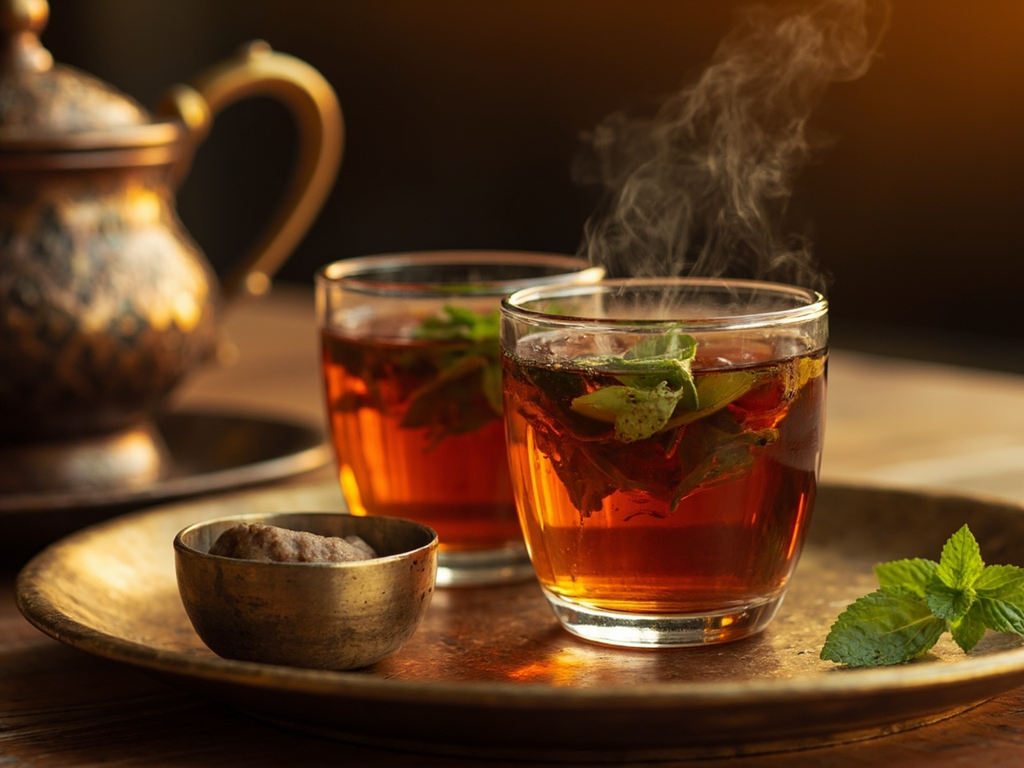
Strongly brewed black tea, generously sweetened, scented with crushed fresh mint leaves, served boiling in small clear glasses showing the amber color. The quintessential Egyptian hospitality ritual.
If there is one thing I have never stopped asking for, wherever the world's laboratories have taken me, it is a small glass of shay bil-na'na', the mint tea of my childhood. It must be black and strong, very sweet — do not be timid with the sugar, that would offend the host! — and you crush a handful of fresh mint into it at the last moment. Look, observe the steam rising from the glass: here is a movement much slower than those I spent my life filming, but just as beautiful. In our culture, offering this glass is saying "welcome."
- •Loose black tea — a generous spoonful per glass (strong infusion)
- •Fresh mint (na'na') — a handful of leaves (aroma)
- •Sugar — abundant, to Egyptian taste (sweetness)
- •Water — freshly boiled (infusion)
Childhood Sweet Mint Tea
Strongly brewed black tea, generously sweetened, scented with crushed fresh mint leaves, served boiling in small clear glasses showing the amber color. The quintessential Egyptian hospitality ritual.
Why this dish? Sweet mint tea was Zewail's childhood drink, one he enjoyed throughout his life. In Egypt, tea is not a simple beverage: it is the gesture of welcome, served piping hot and very sweet in small glasses, at any hour.
If there is one thing I have never stopped asking for, wherever the world's laboratories have taken me, it is a small glass of shay bil-na'na', the mint tea of my childhood. It must be black and strong, very sweet — do not be timid with the sugar, that would offend the host! — and you crush a handful of fresh mint into it at the last moment. Look, observe the steam rising from the glass: here is a movement much slower than those I spent my life filming, but just as beautiful. In our culture, offering this glass is saying "welcome."
Ingredients (period version)
- Loose black tea — a generous spoonful per glass (strong infusion)
- Fresh mint (na'na') — a handful of leaves (aroma)
- Sugar — abundant, to Egyptian taste (sweetness)
- Water — freshly boiled (infusion)
Ingredients
- Black tea (loose or strong bags) — 2 tsp per 500 ml (infusion)
- Fresh mint — 1 good handful (aroma)
- Sugar — 2 to 4 tsp (to taste) (sweetness)
- Water — 500 ml (infusion)
Method
- Bring water to a full boil.
- Put the tea in a teapot (or directly in the saucepan, popular style) and pour the boiling water over.
- Steep for 3 to 5 minutes to obtain a strong, dark amber brew.
- Crush the mint leaves between your fingers to release their aroma and add them at the end of steeping.
- Sweeten generously, stir, and pour piping hot into small clear glasses.
- Serve immediately, as a sign of welcome.
How it was made : In Egypt, tea (shay) became the national drink during the 19th-20th centuries. It is prepared in two ways: shay kushari (steeped) and shay saiidi from Upper Egypt (boiled long and very strong). Mint (na'na') is added in summer for freshness. The abundant sugar and the small clear glass are inseparable from the hospitality ritual: refusing offered tea would be improper.
The contemporary twist : Serve with a sugar cube on a string that you dip into the glass and watch dissolve — a "dissolution kinetics" to observe, a playful homage to the ultrafast chemist... here, very slow.
Sources : Claudia Roden, A Book of Middle Eastern Food · Ahmed Zewail, Voyage Through Time: Walks in Life and the Science (autobiography, 2002)
Ahmed Zewail · Charactorium