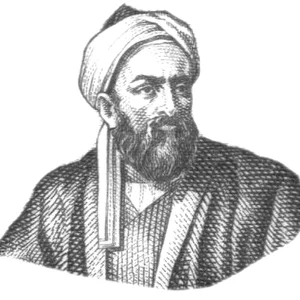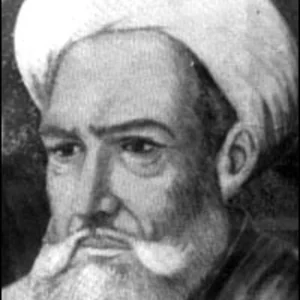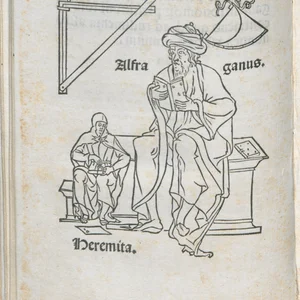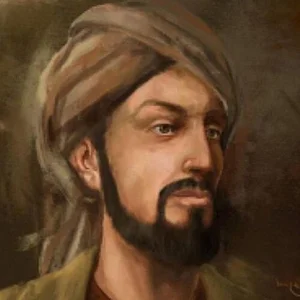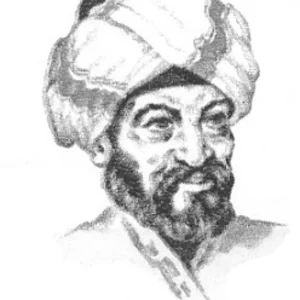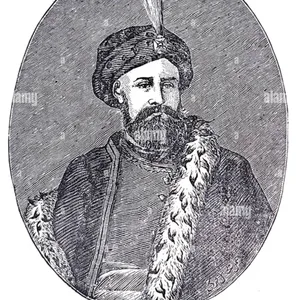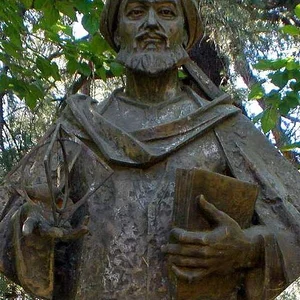

A Persian mathematician, geographer, and astronomer of the 9th century, Al-Khwârizmî revolutionized mathematics by formalizing algebra and popularizing the Indo-Arabic decimal numeral system. His name gave rise to the word "algorithm", a concept fundamental to modern mathematics.
Frequently asked questions
Key Facts
- Around 820: composition of his treatise 'Kitab al-Mukhtasar fi Hisab al-Jabr wa al-Muqabala' ('The Compendious Book on Calculation by Completion and Balancing'), the founding work of modern algebra
- 9th century: introduction and systematization of the Indo-Arabic numeral system in Islamic mathematics, including the concept of zero
- Around 820–830: work at the House of Wisdom (Bayt al-Hikma) in Baghdad, a major center of Islamic scholarship
- Composition of astronomical tables and geographical works, notably on cartography
- His Latinized name 'Algoritmi' in medieval Europe gave rise to the modern term 'algorithm'
Works & Achievements
A foundational work of modern algebra that systematizes methods for solving equations. This treatise establishes the basic principles of algebra as an autonomous mathematical discipline.
A treatise describing the Indo-Arabic decimal numeration system and the use of zero. This work was crucial in spreading the modern numeral system to the West.
Trigonometric tables developed for astronomical and geographical calculations. They represent a major advancement in the development of trigonometry.
A cartographic work depicting the extent of lands known under the Abbasid Caliphate. This map reflects the importance given to geography in the medieval Islamic world.
A geographical treatise describing the regions of the known world with geographical coordinates. This work combines practical geography and mathematical calculations.
Formalization of step-by-step calculation procedures, whose name derives from the Latinized form of his name (Algoritmi). This method is the origin of the modern concept of the algorithm.
Anecdotes
Al-Khwārizmī worked at the House of Wisdom in Baghdad, the greatest scientific center of the medieval world, where he collaborated with the leading scholars of his era. It was there that he developed his groundbreaking research in mathematics and geography, drawing on access to Greek, Indian, and Persian knowledge.
His treatise titled "Kitab al-Muhtasar fi Hisab al-Jabr wal-Muqabala" (The Compendious Book on Calculation by Restoration and Comparison) established algebra as an independent mathematical discipline. The word "algebra" derives directly from the Arabic term "al-jabr" used in this foundational title.
Al-Khwārizmī wrote a treatise on Indo-Arabic numeration that introduced the revolutionary concept of zero and the decimal system into Arabic mathematics and, by extension, Western mathematics. Without his work of popularization, the numerals we use today would probably never have replaced Roman numerals in Europe.
His name "Al-Khwārizmī", which literally means "the one from Khwarezm" (a region of Central Asia), was latinized to "Algoritmi" by medieval scholars, giving rise to the word "algorithm" — one of the most fundamental terms in computer science and modern mathematics.
Al-Khwārizmī also compiled precise astronomical tables and contributed to the mapping of the known world under Caliph al-Ma'mun, demonstrating that his genius extended well beyond pure mathematics alone.
Primary Sources
This work sets out methods for solving first- and second-degree equations, thereby establishing algebra as an autonomous mathematical discipline. Al-Khwarizmi demonstrates how to restore (al-jabr) and balance (al-muqabala) terms in order to solve mathematical problems.
This treatise presents the Indo-Arabic decimal numeral system and its arithmetic operations, enabling the spread of this revolutionary system throughout the Islamic world and subsequently into Europe.
A geographical work listing the coordinates and positions of cities, seas, and mountains of the known world, reflecting the geographical knowledge of the 9th century and the scientific rigour of al-Khwarizmi.
Al-Khwarizmi contributed to mathematical astronomy by developing tables and methods for computing the positions of celestial bodies, which were integrated into later Islamic astronomical traditions.
Key Places
Historical region of Central Asia (present-day Uzbekistan) from which al-Khwārizmī takes his name. It is his place of origin and the center of his intellectual formation.
Capital of the Abbasid Empire where al-Khwārizmī spent most of his career, working at the House of Wisdom. It is there that he wrote his major works.
Prestigious institution in Baghdad founded by Caliph al-Maʾmūn where al-Khwārizmī worked as a mathematician and astronomer. It is the birthplace of his revolutionary discoveries in algebra.
Major cultural center of Central Asia where al-Khwārizmī's works spread. The city was a key crossroads of scientific and commercial exchange.
Region of medieval Spain where translations and adaptations of al-Khwārizmī's works circulated during the Middle Ages, contributing to the transmission of mathematical knowledge to Europe.
Major center of learning in the Arab world where al-Khwārizmī's texts were studied and copied. His ideas circulated widely within Egyptian institutions.
Liens externes & ressources
Références
Œuvres
Kitab al-Jabr wa-al-Muqabala (Livre de la restauration et de la confrontation)
820
Kitab al-Adad al-Hind (Livre du calcul indien)
825
Tables de sinus et de tangente
830
Carte du monde connu
830
Kitab Surat al-Ard (Description de la Terre)
840
Développement de la méthode algorithmique
820-850