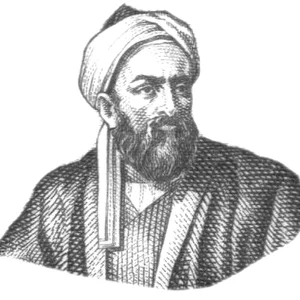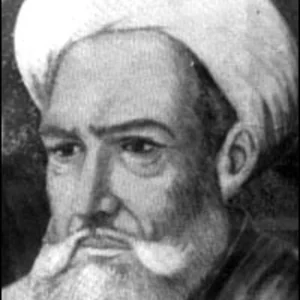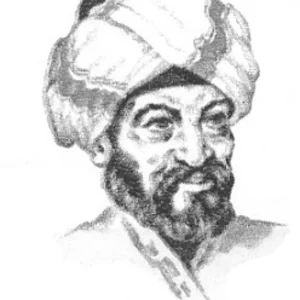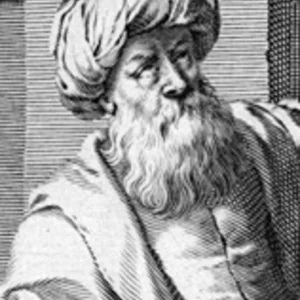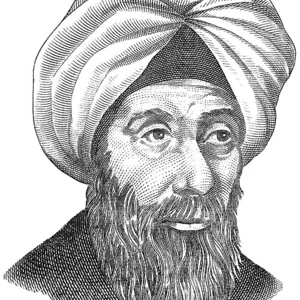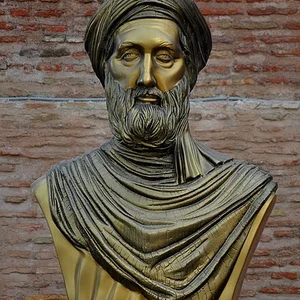

Muslim philosopher, sociologist, historiographer and historian
Frequently asked questions
Key Facts
- Ibn Khaldoun naît à Tunis en 1332 dans une famille d'origine andalouse et reçoit une formation approfondie en sciences islamiques, mathématiques et philosophie.
- Entre 1375 et 1379, il se retire dans le château d'Ibn Salama (actuelle Algérie) et rédige la Muqaddima (les Prolégomènes), œuvre fondatrice de la sociologie et de la philosophie de l'histoire.
- Il développe le concept d'« asabiyya » (cohésion sociale ou esprit de corps) pour expliquer la naissance, l'apogée et le déclin des civilisations et des dynasties.
- Nommé grand cadi (juge suprême) malékite au Caire en 1384, il exerce des fonctions politiques et judiciaires en Égypte jusqu'à sa mort en 1406.
- En 1401, il rencontre à Damas le conquérant Tamerlan et négocie avec lui, épisode qu'il relate dans son autobiographie, le Tarif.
Works & Achievements
Ibn Khaldoun's absolute masterpiece, this theoretical introduction to his universal history lays the foundations of a science of human society. It contains his theory of asabiyya (group solidarity) and the cycle of dynasties.
A major universal history in seven volumes, covering the history of the Arabs, Berbers, and Islamic dynasties. The Muqaddima forms its first volume and theoretical keystone.
An autobiographical text written at the end of his life, in which Ibn Khaldoun recounts his political adventures, his exiles, and his meeting with Tamerlane. A valuable source for the history of the Maghreb and the medieval Near East.
An early work, an abridged commentary on a theological treatise by the philosopher Fakhr al-Din al-Razi. It attests to Ibn Khaldoun's solid theological training.
Pedagogical texts intended for the teaching of mathematics and Aristotelian logic. They illustrate the encyclopedic breadth of Ibn Khaldoun's knowledge, which was not limited to the human sciences.
Anecdotes
In 1375, Ibn Khaldoun withdrew to the isolated castle of Qal'at Ibn Salama, in Algeria, to devote himself entirely to writing. In less than five months, he composed the Muqaddima, one of the most ambitious works in all of medieval thought. He himself would say that ideas came to him like divine inspiration, without his having needed to consult many sources.
In 1401, Ibn Khaldoun was sent on a diplomatic mission to Tamerlane, the fearsome Mongol conqueror who was besieging Damascus. Lowered by ropes from the city ramparts, he met the ruler in his encampment. For several weeks, he conversed with Tamerlane, who, fascinated by his learning, asked him many questions about North Africa. Ibn Khaldoun managed to obtain a safe-conduct to leave the city.
Ibn Khaldoun is often considered the father of sociology, long before Auguste Comte in the 19th century. In the Muqaddima, he develops the concept of asabiyya (group solidarity) to explain the rise and fall of dynasties. This theory allowed him to analyze history not as a series of chance events, but as a process governed by social laws.
His life was marked by numerous disgraces and exiles. Born in Tunis, he served at the courts of several sultans in the Maghreb and Andalusia, was imprisoned, released, then recalled. He lost his wife and children in a shipwreck as they were joining him in Egypt in 1384. Despite these hardships, he continued to write and teach until the end of his life.
Primary Sources
"Men who live in fertile lands are generally less courageous than those who live in arid regions, for the ease of life softens character and weakens group solidarity."
"History is a science whose subject is human society, that is to say universal civilization, and whose aim is to make known to us social phenomena such as savage life, the domestication of customs, clan solidarities, and the manner in which one group seizes power over another."
"I withdrew to the fortress of Ibn Salama, far from the world, and there, in solitude, I committed to writing what I had long meditated upon concerning the nature of dynasties and human civilizations."
"Civilization is founded on human cooperation, and this cooperation cannot exist without an authority that compels men to honor their mutual commitments."
Key Places
Ibn Khaldoun's birthplace, where he was born in 1332 and received his early intellectual education. Tunis was then a major Hafsid capital, a crossroads of knowledge between the Islamic East and West.
An isolated Berber fortress in the Tiaret mountains where Ibn Khaldoun withdrew in 1375. It was there that he wrote the Muqaddimah in a matter of months, far from political intrigue.
Ibn Khaldoun settled there permanently in 1382, teaching law and serving as chief qadi. The Mamluk city was then the intellectual capital of the Arab world.
Ibn Khaldoun stayed at the court of the Nasrid sultan Mohamed V in the 1360s, mingling with the great Andalusian scholars. He discovered a refined Arab civilization on the verge of disappearing.
In 1401, Ibn Khaldoun was sent to negotiate with Timur, who was besieging the city. He conducted celebrated conversations with the Mongol conqueror, which he recorded in his autobiography.
Typical Objects

The essential writing instrument of the medieval scholar, the calamus was used by Ibn Khaldun to set his analyses down on paper. He wrote the entirety of the Muqaddimah with this tool, in the solitude of his Algerian retreat.

Paper, introduced into the Muslim West from the East, replaced parchment in Arab scriptoria of the 14th century. Ibn Khaldun wrote and revised several versions of his work on these materials.

A everyday object of the Arab man of letters, often finely engraved. The inkwell was the indispensable companion of every scholar and symbolized the function of the erudite.

A deeply devout man, Ibn Khaldun punctuated his working days with the five daily prayers. The prayer rug was a central object of his spiritual life and structured his daily schedule.

An emblematic scientific instrument of the medieval Arab scholarly world, used to measure time and the position of celestial bodies. Ibn Khaldun, in the intellectual tradition of his era, took an interest in mathematical and astronomical sciences.

As a senior Maliki-rite qadi in Egypt, Ibn Khaldun constantly referred to the founding legal texts of this school. The Muwatta was the reference work of his legal tradition.
School Curriculum
Vocabulary & Tags
Key Vocabulary
Daily Life
Morning
Ibn Khaldun rose before dawn for the fajr prayer, recited in congregation at the mosque. He then devoted the first hours of the day to reading and annotating manuscripts, a period he considered the most conducive to reflection. During his years in Cairo, he went to the madrasa to teach Maliki law to his students.
Afternoon
The afternoon was often dedicated to public affairs: hearings at the tribunal when he served as qadi, meetings with dignitaries or envoys. During his periods of retreat, he continued drafting his historical work, endlessly rereading and correcting his texts. He sometimes received learned visitors with whom he debated philosophy, history, or jurisprudence.
Evening
After the maghrib prayer, Ibn Khaldun took his main meal, often shared with colleagues or disciples. Evenings were devoted to writing, correcting copies, or scholarly discussion by candlelight. He recorded the day's reflections in his notes, continually feeding the great undertaking of his universal history.
Food
Ibn Khaldun's diet was that of a North African scholar of the 14th century: flatbreads, dried legumes (lentils, chickpeas), dates and figs, mutton on festive occasions. In Cairo, he enjoyed a more varied diet thanks to the agricultural wealth of the Nile. He scrupulously observed Islamic dietary prescriptions.
Clothing
Ibn Khaldun wore the typical garment of a Maghrebi Maliki scholar: a djellaba or jallabiyya of white or beige wool, covered with a burnous when traveling. His head was adorned with a white turban, a mark of his status as a religious scholar. During his official duties in Cairo, he wore the ceremonial robes befitting the rank of grand qadi.
Housing
In Tunis and during his early years, Ibn Khaldun lived in family residences in the Arab-Andalusian style, organized around an interior courtyard with a fountain. During his retreat at Qal'at Ibn Salama, he occupied quarters in an austere Berber fortress. In Cairo, he lodged in multi-story Mamluk houses featuring mashrabiyya (wooden lattice screens) and terraces.
Historical Timeline
Period Vocabulary
Visual Style
Enluminure islamique médiévale nord-africaine et andalouse : arabesques dorées, calligraphies, architecture à arcs en fer à cheval, palette ocre, terre et lapis-lazuli.
Sound Ambience
Sons du monde islamique médiéval : appel à la prière, agitation du souk nord-africain, murmures des élèves dans la madrasa, vent sur les hauts plateaux algériens.
Liens externes & ressources
Références
Œuvres
Muqaddima (Prolégomènes à l'histoire universelle)
1377
Kitab al-Ibar (Livre des exemples et recueil des origines)
1377-1382
Al-Ta'rif bi-Ibn Khaldun (Autobiographie)
vers 1405
Lubab al-Muhassal (Résumé de la théologie scolastique)
vers 1350
Traité sur l'arithmétique et la logique
vers 1360