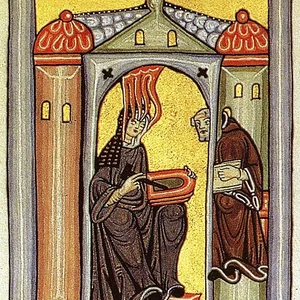

A twelfth-century German Benedictine nun, Hildegard of Bingen was at once a mystic, composer, naturalist, and theologian. She founded her own monastery and corresponded with the most powerful figures of her time, including popes and emperors.
Hildegard of Bingen(1098 — 1179)
Hildegard of Bingen
Saint-Empire romain germanique
7 min read
Frequently asked questions
Famous Quotes
« I am a feather on the breath of God.»
« Music is the path to God.»
Key Facts
- Born in 1098 at Bermersheim vor der Höhe in the Rhineland (Holy Roman Empire)
- Founded the Rupertsberg monastery near Bingen in 1150
- Composed the Symphonia armonie celestium revelationum around 1150, a collection of 77 liturgical chants
- Wrote the Physica and Causae et Curae, encyclopedias of medicine and natural science
- Canonized and declared a Doctor of the Church by Pope Benedict XVI in 2012
Works & Achievements
Hildegard's masterwork, this treatise describes twenty-six cosmological and theological visions illustrated with magnificent miniatures. It earned her the official recognition of the Church at the Synod of Trier.
A collection of 77 musical compositions (hymns, sequences, antiphons) for the monastic liturgy. It is one of the most significant medieval musical corpora preserved from a single composer, including the dramatic work Ordo Virtutum.
A natural encyclopedia describing the properties of 213 plants, 63 trees, minerals, animals, and metals. It establishes a system of medicine based on the balance of humors and the virtues of natural elements.
A medical treatise on the causes and cures of diseases, combining clinical observation, Galenic humors, and a Christian vision of the human body. It notably addresses sexuality and gynecology.
A theological and cosmological summa describing a vision of the world as harmony between God, humanity, and nature. Considered her most mature and ambitious intellectual work.
Exchanges with popes, emperors, abbots, kings, and ordinary believers, attesting to her exceptional political and spiritual influence. These letters constitute a major historical source on the 12th century.
A constructed language with its own alphabet (Litterae Ignotae) and a vocabulary of nearly 900 words, one of the earliest known artificial languages in Western history. Its precise purpose remains debated among scholars.
Anecdotes
At the age of five, Hildegard is said to have experienced her first luminous vision, which she called the 'living light.' Long kept secret, this mystical experience became the foundation of her entire spiritual and intellectual work.
In 1148, at the Synod of Trier, Pope Eugene III publicly read excerpts from Hildegard's Scivias and officially authorized its circulation. This was an extraordinary recognition for a woman at a time when public speech was virtually forbidden to them.
Hildegard composed a secret language called the Lingua Ignota, complete with its own alphabet and a vocabulary of around 900 words. Possibly intended for liturgical use within her monastery, it remains one of the earliest known constructed languages in history.
At over sixty years of age, Hildegard undertook four preaching tours across the Germanic Empire, speaking publicly in cathedrals before crowds of clergy and laypeople — a practice entirely unprecedented for a woman of her time.
Near the end of her life, Hildegard clashed with the Archbishop of Mainz, who had ordered the exhumation of an excommunicated man buried in her monastery. She refused to comply, risking an interdict on her convent. She ultimately prevailed, just a few months before her death.
Primary Sources
And behold, in the year 1141 of the Incarnation of the Son of God... a blazing light of extraordinary brightness came from the open heaven, poured through my whole brain and kindled my whole heart.
Peony is warm and slightly dry. It is useful against gout if worn on one's person, for its warmth and subtlety resist gout.
I beseech you, by the love of God, counsel me, you who are full of goodness: I, a poor little figure of a woman, have not lived a single hour in security since my childhood.
The man whose bile is pure and whose blood is temperate is cheerful, kind, compassionate, and well-disposed toward all those around him.
Listen, king, if you wish to live; otherwise my sword will strike you.
Key Places
Hildegard's birthplace in 1098, located in the Duchy of Franconia. Her noble family resided there, and it was in this Rhenish setting that she was offered to the Church as an oblate.
A mixed Benedictine monastery where Hildegard spent the first forty years of her monastic life, first as an oblate and later as magistra of the women's community.
Founded by Hildegard around 1150 on a promontory overlooking the confluence of the Rhine and Nahe rivers. It served as the center of her intellectual, artistic, and spiritual activity for nearly thirty years.
A second monastery founded by Hildegard in 1165 on the right bank of the Rhine, still active today. Hildegard's relics have been kept there since the 13th century.
The episcopal city where the synod of 1147–1148 was held, officially approving Hildegard's visions in the presence of Pope Eugene III, granting her legitimacy throughout the Christian world.
Typical Objects

The everyday tool of monastic work, the trimmed goose-quill pen was what Hildegard used to record her visions, medical treatises, and hundreds of letters. She often dictated to her secretaries, most notably the monk Volmar.

The black woolen robe worn by the nuns according to the Rule of Saint Benedict, a symbol of belonging to the order and of the contemplative life. Hildegard is said, however, to have allowed her sisters to wear floral crowns during the great liturgical feasts.

A plucked stringed instrument common in medieval monasteries, used to accompany liturgical chanting. Hildegard composed her 77 musical pieces for voice and instruments of this type.

Hildegard catalogued the properties of 213 plants in her Physica. The monastery's medicinal garden was a space for healing and experimentation where she developed remedies and herbal infusions.

The Scivias was illustrated with high-quality miniatures produced under Hildegard's supervision. These visionary images, with their vivid colors and symbolic forms, rank among the most original works of Romanesque art.

Light played a central role in Hildegard's spiritual life — she constantly invoked the divine 'living light.' Bronze or wrought-iron candlesticks illuminated the Liturgy of the Hours, which the nuns celebrated seven times a day.
School Curriculum
Vocabulary & Tags
Key Vocabulary
Daily Life
Morning
Hildegard's day began before dawn with the Office of Vigils, around 2 a.m., followed by Lauds at sunrise. After Prime and an early morning Mass, she oversaw the activities of the scriptorium, where her secretaries copied and illuminated her texts.
Afternoon
The afternoon was devoted to musical composition, writing her treatises, or consulting with the sick who came to the monastery seeking remedies and counsel. Terce, Sext, and None punctuated the work with breaks for prayer.
Evening
Vespers and Compline closed the liturgical day. Hildegard took part by leading the chant of her nuns, sometimes performing her own compositions. She slept little, noting in her writings the insomnia that accompanied her visions.
Food
Following the Rule of Saint Benedict, the main meal was taken at None (mid-afternoon), consisting of vegetables, legumes, bread, cheese, and fish. Rhenish wine, heavily diluted, was consumed in moderation. In her Physica, Hildegard advised against red meat for those of a sensitive temperament.
Clothing
The Benedictine monastic habit consisted of a black wool robe (cuculla) worn over a white linen tunic, with a black veil on the head. Hildegard did, however, allow her nuns to wear a crown of flowers on major feast days — a practice that drew criticism from her contemporaries.
Housing
The Rupertsberg monastery, founded around 1150 on a promontory overlooking the Rhine, included a Romanesque abbey church, a cloister, a common dormitory, a refectory, and a scriptorium. Hildegard's cell was modest, with a writing table, a chest, and a straw mattress, opening onto the herb garden.
Historical Timeline
Period Vocabulary
Visual Style
Le style visuel s'inspire des enluminures romanes du Scivias : couleurs saturées, symbolisme cosmique, or et lapis-lazuli, figures hiératiques baignées d'une lumière divine rayonnante.
Sound Ambience
L'atmosphère sonore du Rupertsberg mêle chants liturgiques bénédictins, sons naturels de la vallée du Rhin et le silence contemplatif des heures canoniales rythmant chaque journée monastique.