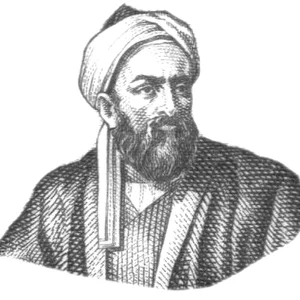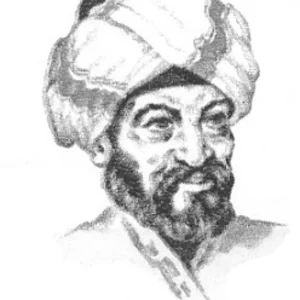

A 7th-century Indian mathematician and astronomer, Brahmagupta was the first to formulate arithmetic rules for zero and negative numbers. His major work, the Brahmasphutasiddhanta (628), influenced both Arabic and European mathematics.
Brahmagupta(598 — 670)
Brahmagupta
7 min read
Frequently asked questions
Key Facts
- Born around 598 AD in Bhinmal (present-day Rajasthan, India)
- In 628, wrote the Brahmasphutasiddhanta, a treatise on mathematics and astronomy composed in Sanskrit verse
- First to define zero as a number and to establish rules for calculating with negative numbers
- Directed the astronomical observatory at Ujjain, a major scientific center of India
- His works were translated into Arabic in the 8th century and passed on to medieval Europe
Works & Achievements
Brahmagupta's masterwork in 25 chapters, it lays down the first arithmetic rules for zero and negative numbers, develops algebra, and presents advanced mathematical astronomy. Translated into Arabic in the 8th century, it directly influenced Al-Khwarizmi and Islamic mathematics.
A practical astronomical treatise in eight chapters, designed as an accessible companion to the Brahmasphutasiddhanta. It provides simplified tables for calculating planetary positions and eclipses, and was widely used by Indian and Arab astronomers.
A general rule for calculating the area of any cyclic quadrilateral (a four-sided figure inscribed in a circle) from the lengths of its four sides. This geometric discovery, presented in the Brahmasphutasiddhanta, goes beyond the work of Euclid and would not be rediscovered in Europe until the 17th century.
An algebraic formula showing that the product of two sums of two squares is itself a sum of two squares. Independently rediscovered by Fibonacci in the 13th century, it illustrates the remarkable lead that Indian mathematics held over the rest of the world at the time.
A geometry theorem about cyclic quadrilaterals stating that if the diagonals are perpendicular to each other, then the midpoint of one diagonal is the foot of the perpendicular drawn from that point to the other side. It stands as one of Brahmagupta's original contributions to plane geometry.
Anecdotes
Brahmagupta was the first mathematician in history to establish precise rules for calculating with zero: he explained that a number added to zero remains itself, and that zero multiplied by any number gives zero. However, he made a famous error by claiming that zero divided by zero was equal to zero — a mistake mathematicians would correct centuries later.
At just 30 years old, Brahmagupta wrote the *Brahmasphutasiddhanta*, a monumental treatise from 628 CE comprising 25 chapters. This text was translated into Arabic in Baghdad in the 8th century on the orders of Caliph al-Mansur, making it one of the first bridges between Indian mathematics and the Islamic world.
Brahmagupta worked at the observatory of Ujjain, one of the great scientific centers of medieval India. There he calculated, with remarkable precision, the length of the tropical year as 365 days, 6 hours, 5 minutes, and 19 seconds — an error of less than two minutes compared to modern values.
In his treatise, Brahmagupta described negative numbers for the first time as "debts" and positive numbers as "fortunes." This economic metaphor was ingenious: it made the abstract notion of a negative number concrete and understandable for his students.
Brahmagupta formulated a general rule for finding the area of a cyclic quadrilateral (inscribed in a circle), known today as "Brahmagupta's formula." This discovery went beyond the Greek geometry of Euclid and was not rediscovered in Europe until roughly a thousand years later.
Primary Sources
The sum of a positive and a negative number is their difference; if their absolute values are equal, the sum is zero. The sum of two negative numbers is negative, the sum of two positive numbers is positive.
This practical astronomical treatise, written in 665, provides simplified tables for calculating planetary positions and eclipses, intended for astronomers and astrologers at court.
Zero added to a positive or negative number is that number. Zero subtracted from a positive number is positive; subtracted from a negative number is negative. Zero multiplied by any number is zero.
It presents methods for solving quadratic equations and formulates theorems on arithmetic progressions, laying the groundwork for algebra as it would later be developed by Arab mathematicians.
Key Places
Brahmagupta's birthplace, then the capital of the Gurjara kingdom. It was in this cultural and commercial hub of northwestern India that he received his early intellectual training.
A major intellectual and astronomical center of medieval India, where Brahmagupta directed the observatory and composed his two landmark works. Ujjain also served as the reference meridian for Indian astronomers.
A Buddhist monastic university, one of the greatest of the medieval world and a contemporary of Brahmagupta. It embodies the remarkable intellectual flourishing of 7th-century India, of which Brahmagupta was one of the foremost representatives.
Capital of the Abbasid Caliphate, where the *Brahmasphutasiddhanta* was translated into Arabic in the 8th century. This marked the starting point for the spread of Indian mathematics — and the concept of zero — into Europe.
Liens externes & ressources
Références
Œuvres
Brahmasphutasiddhanta (La doctrine correcte de Brahma)
628
Khandakhadyaka
665
Formule de Brahmagupta
628
Identité de Brahmagupta–Fibonacci
628
Théorème de Brahmagupta
628