 flip
flipSweet Quandong
Sweet Quandong
Why this dish? The quandong (desert peach) is a native fruit of Central Australia, harvested by the Arrernte in the areas Namatjira painted. During festive gatherings at Hermannsburg — Christmas at the mission, return from a successful painting sale in Melbourne — women prepared sweets by combining bush fruits with ration sugar.
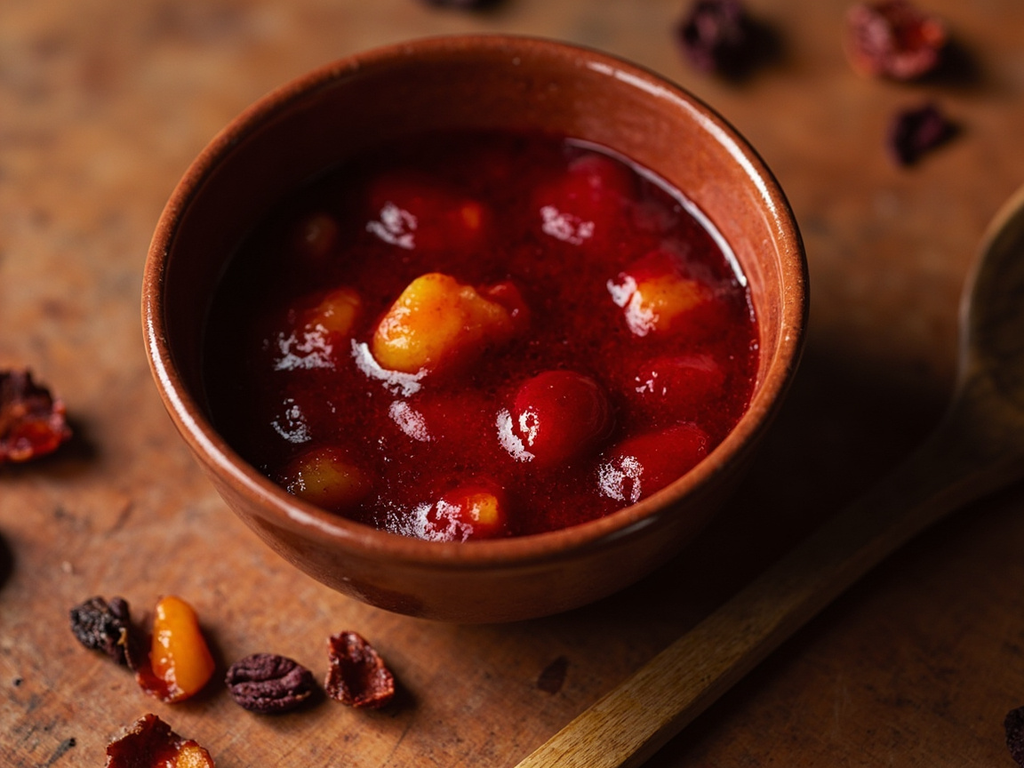
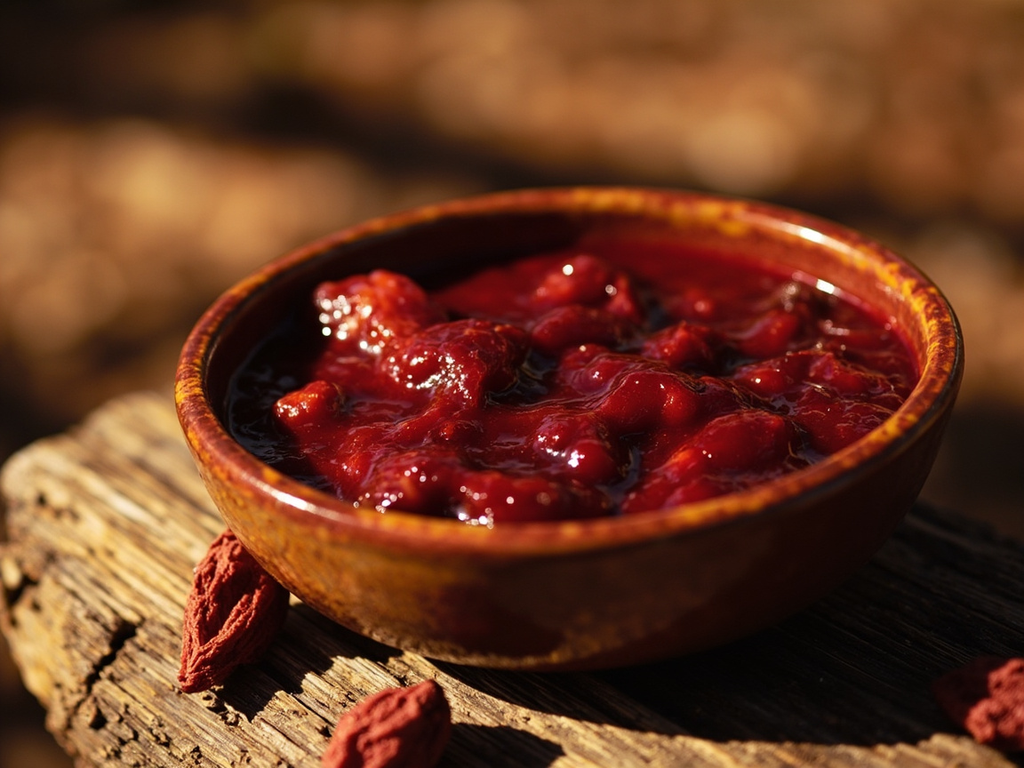
A thick compote of quandong (Santalum acuminatum), the bright red fruit of the Australian desert, slowly cooked with sugar. Quandong has a unique flavor, somewhere between sour apricot and rhubarb, with a melting texture. This festive sweet symbolizes the meeting of worlds: the ancestral bush fruit and the sugar of colonial rations.
The quandong is the red fruit you find in the bush after the rains, the trees are loaded with them. The women collect them in their coolamons, there are so many that the ground is red beneath. At the mission for Christmas, they cook the quandongs with ration sugar, it makes a thick jam, red like the earth of our MacDonnells. When I came back from Melbourne after my first exhibition, my wife Rubina had made some, and the whole camp came to eat with us. That's the taste of celebration for us.
- •Fresh quandongs — a full coolamon (wooden bowl) (main fruit)
- •White sugar (rations) — several handfuls (sweetener)
- •Water — a little (cooking)
Sweet Quandong
A thick compote of quandong (Santalum acuminatum), the bright red fruit of the Australian desert, slowly cooked with sugar. Quandong has a unique flavor, somewhere between sour apricot and rhubarb, with a melting texture. This festive sweet symbolizes the meeting of worlds: the ancestral bush fruit and the sugar of colonial rations.
Why this dish? The quandong (desert peach) is a native fruit of Central Australia, harvested by the Arrernte in the areas Namatjira painted. During festive gatherings at Hermannsburg — Christmas at the mission, return from a successful painting sale in Melbourne — women prepared sweets by combining bush fruits with ration sugar.
The quandong is the red fruit you find in the bush after the rains, the trees are loaded with them. The women collect them in their coolamons, there are so many that the ground is red beneath. At the mission for Christmas, they cook the quandongs with ration sugar, it makes a thick jam, red like the earth of our MacDonnells. When I came back from Melbourne after my first exhibition, my wife Rubina had made some, and the whole camp came to eat with us. That's the taste of celebration for us.
Ingredients (period version)
- Fresh quandongs — a full coolamon (wooden bowl) (main fruit)
- White sugar (rations) — several handfuls (sweetener)
- Water — a little (cooking)
Ingredients
- Dried quandongs (or tart dried apricots as substitute) — 200 g (main fruit)
- Sugar — 100 g (sweetener)
- Water — 300 ml (rehydration and cooking)
- Lemon juice — 1 tbsp (complementary acidity)
Method
- If using dried quandongs, soak them in water for 2 hours (or overnight) until plump.
- Place rehydrated quandongs with their soaking water in a saucepan.
- Add sugar and lemon juice, bring to a gentle boil.
- Reduce heat and simmer for 20–25 minutes, stirring regularly, until a thick, glossy compote forms.
- Mash lightly with a fork for a smoother texture, or leave chunky.
- Serve warm or cold, with damper or on its own as a sweet treat.
How it was made : The quandong (Santalum acuminatum) has been harvested by Aboriginal peoples of Central Australia for millennia. The fruit can be eaten fresh, dried for long-term storage, or processed into a paste. The extremely hard pits were used in traditional games and as tools. In Namatjira's time, Arrernte women at Hermannsburg combined traditional fruits with ration sugar to create new sweet preparations, adapting their culinary skills to available ingredients.
The contemporary twist : Serve in verrines with a layer of Greek yogurt and a wattle seed crumble for an elegant Australian fusion dessert.
Sources : Latz, Peter. 'Bushfires and Bushtucker: Aboriginal Plant Use in Central Australia'. IAD Press, 1995. · Isaacs, Jennifer. 'Bush Food: Aboriginal Food and Herbal Medicine'. Weldons, 1987. · Mountford, Charles P. 'Brown Men and Red Sand'. Robertson & Mullens, 1950.
Albert Namatjira · Charactorium