 flip
flipTeurgoule, Norman Cinnamon Rice Pudding
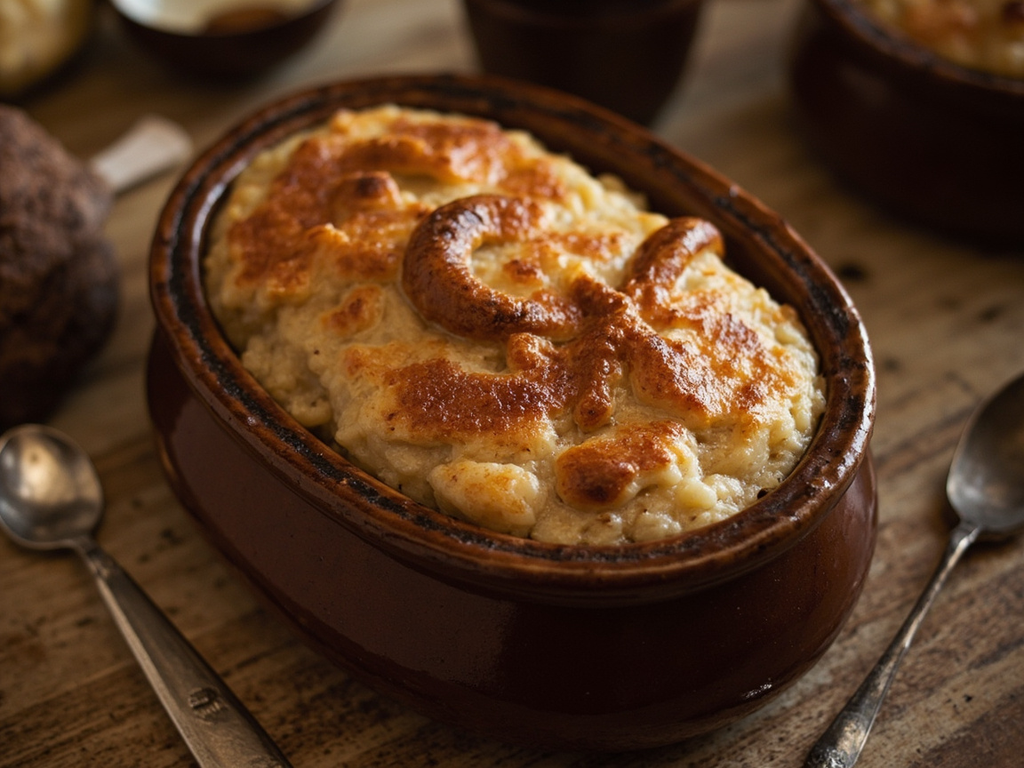
Teurgoule, Norman Cinnamon Rice Pudding
Why this dish? Teurgoule is the emblematic dessert of Tocqueville's Normandy: rice cooked for hours in the baker's oven, after the bread batch, in every house of the Cotentin and Pays d'Auge. At the Château de Tocqueville, this humble, fragrant dish connected the master's table to the peasant kitchen of his lands.
Rice slowly confit in sweetened milk and perfumed with cinnamon, baked slowly in the oven until a golden, caramelized skin forms. The slow, comforting Sunday dessert of Normandy.
Do not disdain this very simple dish, for it is the very soul of my Normandy. One mixes rice with the milk of our cows, perfumes it with cinnamon, and leaves it to cook for hours in the baker's still-warm oven, after the bread has come out. It produces a brown, perfumed crust that must be awaited, for teurgoule rewards patience and burns the tongue of the impatient — hence its name, they say. It is the Sunday dish, the one that gathers the household and reminds me that the greatness of a people also lies in its humble sweetnesses.
- •Rice — a handful per person (base)
- •Raw whole milk — plenty (cooking liquid)
- •Sugar — to taste (sweetness)
- •Ground cinnamon — a good pinch (signature flavor)
- •Pinch of salt — one (balance)
Teurgoule, Norman Cinnamon Rice Pudding
Rice slowly confit in sweetened milk and perfumed with cinnamon, baked slowly in the oven until a golden, caramelized skin forms. The slow, comforting Sunday dessert of Normandy.
Why this dish? Teurgoule is the emblematic dessert of Tocqueville's Normandy: rice cooked for hours in the baker's oven, after the bread batch, in every house of the Cotentin and Pays d'Auge. At the Château de Tocqueville, this humble, fragrant dish connected the master's table to the peasant kitchen of his lands.
Do not disdain this very simple dish, for it is the very soul of my Normandy. One mixes rice with the milk of our cows, perfumes it with cinnamon, and leaves it to cook for hours in the baker's still-warm oven, after the bread has come out. It produces a brown, perfumed crust that must be awaited, for teurgoule rewards patience and burns the tongue of the impatient — hence its name, they say. It is the Sunday dish, the one that gathers the household and reminds me that the greatness of a people also lies in its humble sweetnesses.
Ingredients (period version)
- Rice — a handful per person (base)
- Raw whole milk — plenty (cooking liquid)
- Sugar — to taste (sweetness)
- Ground cinnamon — a good pinch (signature flavor)
- Pinch of salt — one (balance)
Ingredients
- Short-grain rice — 120 g (base)
- Whole milk — 2 litres (cooking liquid)
- Sugar — 150 g (sweetness)
- Ground cinnamon — 1 to 2 teaspoons (signature flavor)
- Salt — 1 pinch (balance)
Method
- In an earthenware dish, mix rice, sugar, cinnamon, and salt.
- Pour in cold milk and stir.
- Bake in a low oven (150°C) for 5 to 6 hours, without stirring.
- Let a thick, golden, almost caramelized skin form on the surface.
- Serve warm or cold, directly from the dish, breaking the crust.
How it was made : Teurgoule was traditionally cooked in a glazed Cotentin earthenware dish, slipped into the communal bread oven after the bread was baked and left for hours in the declining heat. The long cooking gives it its amber color and characteristic skin. Cinnamon and sugar arrived via the port of Honfleur.
The contemporary twist : Served in individual pots with a shard of caramelized crust placed on top like a tile, and a few diced Cotentin apples pan-fried in butter.
Alexis de Tocqueville · Charactorium