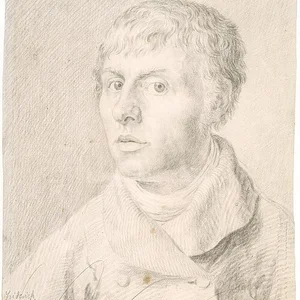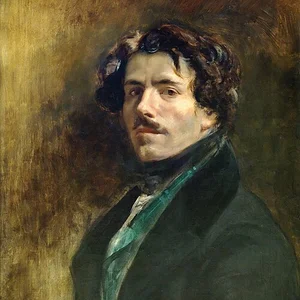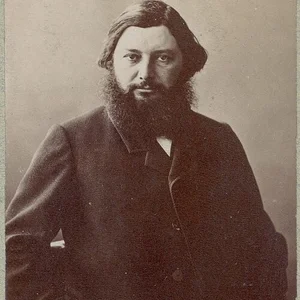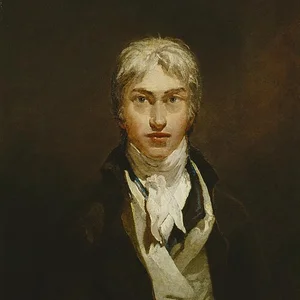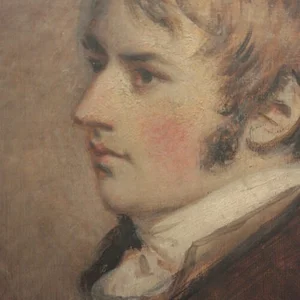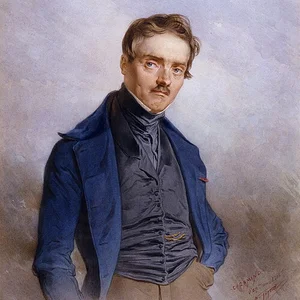

French sculptor (1795–1875) and pioneer of Romantic animalism. His bronzes depicting wild animals in combat combine naturalistic precision with dramatic tension. He is considered the undisputed master of animal sculpture in the 19th century.
Antoine-Louis Barye(1795 — 1875)
Antoine-Louis Barye
France
9 min read
Frequently asked questions
Key Facts
- Born 24 September 1795 in Paris, died 25 June 1875
- Student at the École des Beaux-Arts in Paris, trained notably under the sculptor Bosio
- Presented his celebrated group "Lion and Serpent" at the 1831 Salon, where it caused a sensation
- Professor of animal drawing at the Muséum national d'Histoire naturelle from 1854
- His works adorn the Flore and Richelieu pavilions of the Louvre palace
Works & Achievements
The first major work presented at the Salon, it revealed to the Parisian public a sculptor capable of capturing animal ferocity with unprecedented anatomical precision. It is now held in the Louvre.
A masterpiece of Romantic sculpture, immediately acquired at the Salon by the Duke of Orléans, it combines expressive power and naturalistic truth; the monumental version adorns the gardens of the Louvre.
An official commission for the Tuileries Gardens, this work is one of the first monumental animal sculptures in French art and an artistic symbol of the reign of Louis-Philippe.
A bronze group inspired by Ariosto's Orlando Furioso, demonstrating that Barye could handle mythological and literary subjects with the same dramatic power as his animal combat scenes.
One of his most admired works, it captures the fleeting moment of predation with exceptional dramatic tension; widely reproduced in editions, it featured in many bourgeois collections of the Second Empire.
Commissioned by Napoleon III for the façades of the new Louvre, these four monumental groups demonstrate Barye's ability to handle both large-scale architectural sculpture and intimate cabinet bronzes.
Depicting a mythological battle between a centaur and a Lapith warrior, this work reflects the dual influence of Greek antiquity and the Romantic taste for violence and physical energy.
Anecdotes
Barye visited the menagerie at the Jardin des Plantes almost daily to observe and sketch wild animals. He also attended the autopsies of animals that died at the Muséum national d'Histoire naturelle, dissecting the carcasses himself to study their musculature with surgical precision. This scientific rigor explains why his sculptures convey the impression of being animated by an inner life.
In 1837, the Salon jury rejected nearly all of his works without explanation, provoking widespread indignation among artists and critics. Wounded by this ostracism, Barye stopped submitting his work to the Salon for ten years, preferring to sell his bronzes directly to collectors from his own studio.
The economic crisis of 1848 ruined Barye: drowning in debt, he was forced to surrender his original plaster models to his creditors, along with the right to cast them. For several years, other foundries sold his works without him receiving a penny of the profits. He eventually bought back his rights and reopened his own foundry.
Before devoting himself to animal sculpture, Barye worked as a goldsmith for Martin-Guillaume Biennais, the official goldsmith of Napoleon I. This training gave him an exceptional mastery of metalworking and ornamental detail — a quality evident in the refined surface finish of his bronzes.
His 'Lion Devouring a Serpent', shown at the 1833 Salon, was immediately acquired by the Duke of Orléans. This resounding success made Barye the most celebrated animal sculptor in Paris, and a monumental version of the work was commissioned to adorn the Tuileries gardens as early as 1836.
Primary Sources
No. 3006 — BARYE: Tiger Devouring a Gavial from India. Bronze.
BARYE: Lion Devouring a Serpent. Bronze. Acquired by H.R.H. the Duke of Orléans.
M. Barye is unquestionably the foremost animal sculptor of his age; no one has better captured the life, movement, and power of wild beasts. His bronzes breathe and roar.
An entire room is devoted to the works of M. Barye, sculptor: animal combats, mythological groups, and equestrian figures bear witness to a career of remarkable consistency and power.
Barye spent his mornings at the Jardin des Plantes, sketchbook in hand, capturing the postures of wild animals; in the evenings he would model from memory in wax, striving to restore the power and momentum he had observed that same day.
Key Places
Barye was born on September 24, 1795 in Paris and spent his entire life there. His successive studios, notably on the Île Saint-Louis, were cluttered with plaster casts, animal skulls, and sketches pinned to the walls.
A true permanent school for Barye, the Jardin des Plantes menagerie allowed him to observe lions, tigers, bears, and live snakes on a daily basis, giving his sculptures a naturalistic truthfulness unprecedented in the history of sculpture.
Barye received his formal training there, studying sculpture under Antoine-Louis Bosio and painting under Baron Gros, acquiring the academic foundations he would go on to transcend and renew through his direct observation of nature.
The monumental *Lion au serpent* (1836) was installed in the Tuileries Gardens, visible to all Parisians. The allegorical groups Barye sculpted for the façades of the new Louvre (1854–1856) still adorn the palace today.
Appointed professor of zoological drawing in 1854, Barye taught there until his death. He had access to collections of skeletons and taxidermied specimens that deepened his comparative anatomical knowledge of animals.
Barye frequented the village of Barbizon and painted en plein air in the Forest of Fontainebleau alongside Millet, Corot, and Théodore Rousseau, exploring landscape painting and thus rounding out his sculptural practice.
Typical Objects

Wood and metal tools that Barye used to model clay and wax with precision. They allowed him to render the bulging muscles, claws, and scales of his animals with astonishing anatomical realism.

Barye filled countless sketchbooks with animal drawings made at the Jardin des Plantes. These preparatory studies — resting poses, leaps, fights — were the indispensable foundation for all his sculptures.

The original plasters served as matrices for bronze casting. The forced loss of these models during his 1848 bankruptcy was a disaster: foundrymen used them to produce editions without his consent or supervision.

Barye mastered the art of chemical patination, which gave his bronzes shades ranging from golden brown to deep black. This technique visually reinforced the impression of power and animal muscular tension.

He kept skulls, bones, and taxidermied skins in his studio as permanent anatomical references — true working tools that turned his workshop into a cabinet of scientific curiosities.

Barye himself practiced lost-wax casting in his own small foundry workshop. Personally overseeing the casting process guaranteed the flawless surface quality he demanded of every piece.
School Curriculum
Vocabulary & Tags
Key Vocabulary
Daily Life
Morning
Barye began his day early, walking or taking a cab to the menagerie at the Jardin des Plantes, where he spent two to three hours sketchbook in hand, capturing the postures of big cats at rest or in motion. When the opportunity arose, he also attended the autopsies of animals that had died, in order to study their internal anatomy.
Afternoon
In the afternoons, he worked in his studio modeling clay or wax, drawing on the morning's sketches. He checked his proportions using skeletons and preserved hides kept on the premises, endlessly reworking his models until he achieved the precise muscular tension he was seeking to convey.
Evening
In the evenings, Barye drew pen-and-ink or watercolor studies, sometimes landscapes of the Forest of Fontainebleau. During successful periods, he received collectors and fellow artists; in the lean years — particularly after 1848 — he took on goldsmithing commissions to secure an income.
Food
Like many artists of his generation with irregular earnings, Barye led a frugal life. His diet was simple and unpretentious: soup, bread, seasonal vegetables, and modest portions of meat. The years of financial hardship following the crisis of 1848 forced him into extreme austerity.
Clothing
At work, Barye wore a smock or a coarse canvas jacket stained with clay and plaster, along with sturdy trousers. For Salon openings or receptions at patrons' homes, he dressed in a plain dark bourgeois coat with no particular flair, in keeping with the serious, hardworking image he projected.
Housing
Barye lived and worked in several Parisian studios, including one on the Île Saint-Louis. His living and working space was cluttered with plaster models, animal skulls, sketches pinned to the walls, and a small kiln for casting. During difficult years, he sometimes slept in his studio itself.
Historical Timeline
Period Vocabulary
Liens externes & ressources
Références
Œuvres
Tigre dévorant un gavial de l'Inde
1831
Roger enlevant Angélique sur l'hippogryphe
1840
Jaguar dévorant un lièvre
vers 1850
Centaure et Lapithe
1850