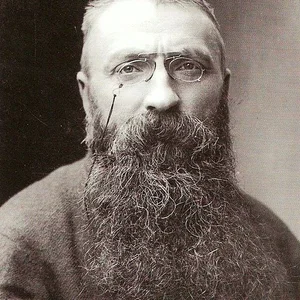

French sculptor (1840–1917) considered the father of modern sculpture. He revolutionized sculptural art by abandoning academicism to explore expressiveness, emotion, and movement. His masterwork, The Thinker, has become one of the most iconic sculptures in Western art.
Frequently asked questions
Famous Quotes
« Art is love given form»
Key Facts
- 1840: Born in Paris
- 1880: Creation of The Gates of Hell, a monumental commission that includes The Thinker
- 1904: Established his own museum in Meudon
- 1917: Died in Meudon, his worldwide renown firmly established
- Development of a revolutionary technique combining realism and expressionism
Works & Achievements
Rodin's first major sculpture, of such striking realism that he was accused of casting from a live model. The controversy launched his reputation.
An unfinished monumental work inspired by Dante's Inferno, which served as the matrix for many famous sculptures including The Thinker and The Kiss.
Originally conceived to crown The Gates of Hell, it became one of the most recognizable sculptures in the world, a universal symbol of contemplation.
A monument commemorating six notables of Calais who surrendered to the English in 1347. Rodin innovated by placing the figures at ground level, without a heroizing pedestal.
A marble sculpture depicting an embracing couple, inspired by Paolo and Francesca in the Divine Comedy. It became a universal symbol of passionate love.
A bold portrayal of the writer in his dressing gown, rejected at the time but now regarded as a precursor of modern sculpture.
A marble sculpture showing a giant hand shaping two human bodies, a metaphor for the creative gesture of the artist and the divine.
Anecdotes
Rodin failed the entrance exam to the École des Beaux-Arts in Paris three times. Rejected at each attempt between 1857 and 1859, he had to train as a self-taught artist and in private studios, notably that of Antoine-Louis Barye at the Muséum d'Histoire Naturelle.
In 1877, his sculpture The Age of Bronze was so realistic that critics accused him of having cast it directly from the body of his living model, a Belgian soldier named Auguste Neyt. Rodin had to call several artists as witnesses and show his preparatory studies to prove that he had indeed sculpted the work with his own hands.
Rodin worked for nearly 37 years on The Gates of Hell, begun in 1880 and never completed in his lifetime. This monumental project, inspired by Dante's Divine Comedy, gave rise to some of his most celebrated works, including The Thinker and The Kiss, originally conceived as elements of this gate.
Camille Claudel, a brilliant sculptor, was at once Rodin's student, collaborator, and companion for about fifteen years beginning in 1884. Their passionate and turbulent relationship left a deep mark on the work of both artists, and the question of their mutual influence is still debated among art historians.
In 1898, the monument to Balzac commissioned by the Société des Gens de Lettres caused a resounding scandal. Rodin depicted the writer wrapped in his dressing gown — a massive, visionary silhouette that the committee rejected as shapeless and unworthy. Today, the work is regarded as a major milestone in modern sculpture.
Primary Sources
The artist worthy of the name must express all the truth of nature, not only the outward truth, but also and above all the inner truth.
I strongly protest against this accusation of casting from life. I modelled this figure entirely from my studies and with the sole assistance of my living model.
The cathedral is the synthesis of the land. Rocks, forests, gardens, the northern sun — all of this is merged into this gigantic work into a body as dense as nature itself.
I give to the State my entire body of work — my sculptures, drawings, and the collection of antiquities I have assembled — on the condition that it dedicates the Hôtel Biron to a Rodin museum.
Key Places
An 18th-century mansion where Rodin set up his studio from 1908. Converted into the Musée Rodin in 1919, it houses the largest collection of his works.
Rodin's main residence and studio from 1895, where he lived and worked until his death. His tomb, topped by The Thinker, is located in the garden.
A former State warehouse at 182 rue de l'Université where Rodin was given an official studio from 1880 to work on The Gates of Hell.
Rodin stayed there from 1871 to 1877, working as an ornamentalist and decorative sculptor. It was there that he created The Age of Bronze, the work that launched his career.
Rodin held a deep admiration for French Gothic cathedrals. Chartres inspired him particularly for his book The Cathedrals of France published in 1914.
Typical Objects

The sculptor's primary tool, this wooden or metal spatula was used by Rodin to model clay and shape his figures.

A rotating platform on a tripod allowing a sculpture to be worked from every angle. Rodin had several in his spacious studios.

Rodin's preferred material for his initial studies. He would first model in clay before having plaster casts made and then bronze castings.

A measuring instrument used to transfer the proportions of a live model onto the sculpture, essential to Rodin's realist method.

Rodin drew constantly, often without looking at his page, capturing the movement of his models in thousands of rapid pencil and watercolor sketches.

Rodin kept hundreds of casts of fragments — hands, torsos, feet — which he assembled and recombined to create new compositions.
School Curriculum
Vocabulary & Tags
Key Vocabulary
Daily Life
Morning
Rodin rose early, often at dawn, and quickly made his way to his studio. He would begin by observing and sketching his live models, who posed freely, capturing the natural movement of the body in rapid pencil drawings.
Afternoon
The afternoon was devoted to modeling clay and supervising his praticiens — assistants tasked with transposing his models into plaster or marble. He also received visitors: collectors, art critics, or students seeking his advice.
Evening
In the evenings, Rodin would often dine simply at his home in Meudon with Rose Beuret, his lifelong companion. He read extensively, particularly Dante, Baudelaire, and the ancient poets, and would sometimes continue drawing by lamplight.
Food
Rodin had simple, hearty tastes, favoring traditional French bourgeois cooking: soups, roasted meats, and vegetables from the Meudon garden. He drank wine in moderation and had coffee in the morning before starting work.
Clothing
In his studio, Rodin wore a work smock stained with clay and plaster over his clothes. In society, he adopted the classic dress of the Parisian bourgeoisie: a dark frock coat, waistcoat, bowler hat, and his characteristic well-groomed beard.
Housing
Rodin spent his final decades between two places: the Hôtel Biron in Paris — a grand private mansion in the Faubourg Saint-Germain that served as his studio and reception space — and the Villa des Brillants in Meudon, a more modest house surrounded by a garden where he stored his works.
Historical Timeline
Period Vocabulary
Visual Style
Un style visuel sculptural et dramatique, jouant sur les contrastes de lumière et d'ombre, avec les textures brutes de la terre, du plâtre et du bronze propres à l'univers de Rodin.
Sound Ambience
L'atmosphère sonore d'un grand atelier de sculpteur parisien de la fin du XIXe siècle, entre le travail de la matière et la vie urbaine qui filtre par les fenêtres.
Liens externes & ressources
Références
Œuvres
Les Bourgeois de Calais
1884-1895