
Catalan architect
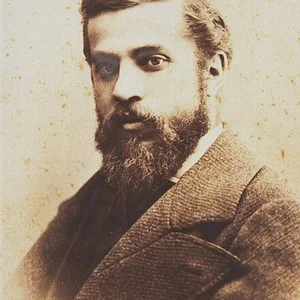
Antoni Gaudí(1852 — 1926)
Antoni Gaudí
Espagne
8 min read
Frequently asked questions
Famous Quotes
« L'originalité consiste à revenir aux origines.»
« Tout vient du grand livre de la nature.»
Key Facts
- Né le 25 juin 1852 à Reus (Catalogne), il montre très tôt un intérêt pour la nature et les formes organiques.
- En 1883, il prend en charge la construction de la Sagrada Família, projet auquel il consacre les 40 dernières années de sa vie.
- Il réalise plusieurs chefs-d'œuvre classés au patrimoine mondial de l'UNESCO : Park Güell, Casa Milà, Casa Batlló.
- Profondément catholique, il mène une vie de plus en plus ascétique et est renversé par un tramway à Barcelone le 7 juin 1926.
- Sa Sagrada Família est toujours en construction au XXIe siècle, plus de 140 ans après le début des travaux.
Works & Achievements
Gaudí's first major work in Barcelona, commissioned by tile manufacturer Manuel Vicens. It already reveals his Orientalist style and inventive use of polychrome ceramics.
A private mansion built for Eusebi Güell in the heart of Barcelona's Raval district, listed as a UNESCO World Heritage Site. Gaudí experimented here with the parabolic dome and rooftop terraces featuring sculpted chimneys.
A public park conceived as a garden city, featuring viaducts in rough stone, a grand terrace with mosaic benches, and a hypostyle hall with Doric columns. Listed as a UNESCO World Heritage Site in 1984.
A spectacular renovation of a bourgeois building on the Passeig de Gràcia, nicknamed 'the house of bones'. Its undulating façade, organic balconies, and dragon-evoking roof make it a masterpiece of Catalan Modernisme.
A residential building with an entirely curved floor plan and not a single straight load-bearing wall, whose stone façade and rooftop populated with warrior-chimneys are recognised worldwide. UNESCO World Heritage Site.
An underground chapel for Güell's workers' village, and a decisive structural laboratory. Gaudí experimented here with inclined brick columns and catenary vaults that directly foreshadow the nave of the Sagrada Família.
Gaudí's total work and spiritual testament, whose construction he directed for forty-three years. His plans and models, partially destroyed in 1936, still guide the architects continuing his dream today.
Anecdotes
Gaudí was so absorbed in his work that he completely neglected his appearance. Toward the end of his life, he wore clothes so worn and dirty that in June 1926, after being knocked down by a tram in Barcelona, passersby mistook him for a beggar. Taken to the Hospital de la Santa Creu, no one recognized him for several hours.
To design the forms of the Sagrada Família, Gaudí invented an ingenious method: he hung weighted strings with small lead bags from the ceiling of his workshop, creating natural catenaries. By photographing this model upside down, he obtained the perfectly calculated arches and vaults of his building, letting physics do the work of mathematics.
Gaudí was a devout Catholic and refused any salary for his work on the Sagrada Família. He devoted the last fifteen years of his life exclusively to this cathedral, living in complete austerity and sometimes sleeping on site in his workshop at the construction yard. He once confessed: 'My client is in no hurry', referring to God.
In 1878, Gaudí designed a display case for glove manufacturer Esteve Comella at the Paris Universal Exhibition. This creation caught the attention of Eusebi Güell, a wealthy Catalan industrialist, who became his main patron and lifelong friend. Without this fateful Parisian encounter, neither Park Güell nor Palau Güell would ever have existed.
Primary Sources
Gaudí declared to his friend and biographer: 'Originality consists in returning to the origin. Thus, the original is that which returns to the roots of nature.'
In his project notes, Gaudí states his aim to imitate nature in load-bearing structures, arguing that the inclined column is more efficient than the straight column because it naturally absorbs lateral thrust.
'Great architecture is the expression of human feeling. That is why it must have a soul. Pure geometric forms are cold; it is nature that brings warmth.'
The display case for the Comella house, designed by architect Antonio Gaudí, drew attention for its decorative originality and the quality of its craftsmanship.
Key Places
Expiatory cathedral begun in 1882, to which Gaudí devoted the last forty years of his life. It is now a UNESCO World Heritage Site and still under construction.
Public park designed between 1900 and 1914 for patron Eusebi Güell, featuring its trencadís terraces, Doric columns, and the house where Gaudí lived from 1906 to 1925.
Building renovated by Gaudí between 1904 and 1906 on the Passeig de Gràcia, with its undulating facade evoking a dragon and its balconies shaped like carnival masks.
Gaudí's last civic building (1906–1912), whose undulating limestone facade and rooftop populated with sculpted chimneys have become symbols of Modernista architecture.
Gaudí's birthplace (1852), in the province of Tarragona. His childhood in this industrious city and his observation of coppersmith craftsmen profoundly shaped his sensitivity to forms in metal and stone.
Chapel commissioned by Eusebi Güell for his model workers' village, of which only the crypt was built (1908–1914). This site served as the experimental laboratory where Gaudí tested all the structural techniques later used in the Sagrada Família.
Typical Objects

Fundamental tools of the draughtsman, which Gaudí used before developing his three-dimensional models. He eventually set them aside in favour of suspended models to calculate his organic forms.

Gaudí's invention for designing the Sagrada Família: strings weighted with small bags of lead shot, hung from the ceiling, formed catenary curves. Turned upside down, the model yielded the perfect arches of the cathedral.

Gaudí constantly observed nature and sketched its forms: bones, plants, shells, insect wings. These sketchbooks were the source of his ornamental and structural vocabulary.

A technique that Gaudí brought to its artistic peak, notably on the rooftops of Casa Batlló and the benches of Parc Güell. He would collect broken ceramic tiles to compose mosaics of vivid, brilliant colours.

Gaudí was a deeply devout Catholic, reciting the rosary daily and attending Mass every morning. His faith was inseparable from his architectural creation.

A local material favoured by Gaudí for his Barcelona constructions, most notably the Sagrada Família. He personally selected the blocks and supervised the work of the stonemasons.
School Curriculum
Vocabulary & Tags
Key Vocabulary
Daily Life
Morning
Gaudí rose at dawn and attended Mass every morning at the church of Sant Felip Neri in Barcelona. He would then observe the sunlight on his construction sites, mentally noting how the shadows revealed the forms of his facades.
Afternoon
He spent his afternoons on the construction sites, particularly at the Sagrada Família, personally overseeing every stone cut and mosaic placement. He spoke directly with the craftsmen, explaining through gestures what the plans could not express.
Evening
In the evenings, Gaudí retreated to his workshop at the foot of the Sagrada Família to work on his scale models, read treatises on botany and geology, or meditate in silence. He led a very reclusive life, declining most social invitations.
Food
Gaudí followed a near-ascetic vegetarian diet, especially in his later years. He fasted frequently out of religious devotion, sometimes subsisting solely on lettuce dressed with olive oil. This strict regimen weakened his health.
Clothing
In his old age, Gaudí wore simple, dark, and often very worn clothing, indifferent to his appearance. He had renounced all outward signs of wealth or social status, which is why he was mistaken for a vagrant after his accident in 1926.
Housing
From 1906, Gaudí lived in the house-museum at Park Güell, which he had furnished simply. From 1925, he moved into his own workshop at the Sagrada Família, sleeping on a camp bed, so as not to waste a single minute away from his construction site.
Historical Timeline
Period Vocabulary
Visual Style
Un style visuel organique et coloré mêlant la pierre ocre de Barcelone, les mosaïques de trencadís polychromes et les formes inspirées de la nature, dans une lumière méditerranéenne chaude et contrastée.
Sound Ambience
L'atmosphère sonore de Gaudí mêle le bruit des chantiers barcelonais du début du XXe siècle — marteaux sur la pierre, poulie grincante, chants des ouvriers catalans — aux cloches d'église et au brouhaha de la ville moderniste.
Liens externes & ressources
Références
Œuvres
Casa Vicens
1883-1885
Palau Güell
1886-1890
Parc Güell
1900-1914
Casa Batlló
1904-1906
Casa Milà, dite La Pedrera
1906-1912
Crypte de la Colònia Güell
1908-1914
Basilique de la Sagrada Família
1883-1926 (et toujours en construction)