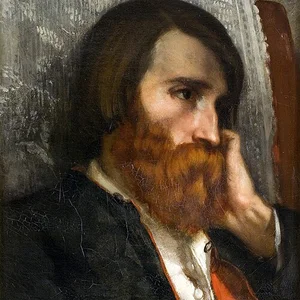

Alfred Bruyas (1821-1877) was a French collector, patron of the arts, and amateur painter from Montpellier. Heir to a family fortune, he devoted his life to building a major art collection, most notably by supporting Gustave Courbet. His collection forms the core holdings of the Musée Fabre in Montpellier.
Alfred Bruyas(1821 — 1877)
Alfred Bruyas
France
7 min read
Frequently asked questions
Key Facts
- Born in 1821 in Montpellier into a banking family, he inherited a fortune that allowed him to dedicate himself to art
- He commissioned several portraits of himself from Gustave Courbet, including the celebrated *The Meeting* (1854)
- His collection includes works by Delacroix, Courbet, Cabanel, and many painters of his era
- In 1868 he bequeathed the bulk of his collection to the Musée Fabre in Montpellier, forming its core holdings
- He died in 1877, leaving behind a collection of nearly 800 paintings and drawings
Works & Achievements
Bruyas donated his entire collection — more than 200 works — to the Musée Fabre during his lifetime. This unprecedented gesture endowed Montpellier with an exceptional holding representative of French Realism and Romanticism.
Bruyas published a detailed catalogue of his collection, with notes and commentary. This document is an essential primary source for the history of collecting and patronage in the 19th century.
Bruyas commissioned this iconic painting during Courbet's stay in Montpellier. The work, known as *Bonjour Monsieur Courbet*, is today one of the most celebrated masterpieces in the Musée Fabre.
During the Universal Exhibition, Bruyas lent his moral support to Courbet, who opened his own exhibition space outside the official framework. This act of patronage — as much intellectual as financial — went far beyond the simple acquisition of artworks.
Bruyas produced canvases himself as an amateur painter, reflecting his direct involvement in artistic practice and his desire to understand art from the inside.
Anecdotes
Alfred Bruyas had a singular fascination with his own portrait: he commissioned more than twenty likenesses of himself from the artists he supported, including Gustave Courbet, Alexandre Cabanel and Octave Tassaert. This self-centered collection reflects both his romantic personality and an original way of compensating painters while securing his own place in art history.
In 1854, Gustave Courbet painted “The Meeting” (also known as “Bonjour Monsieur Courbet”), depicting Bruyas welcoming the painter at the outskirts of Montpellier, hat in hand. The painting subverts the usual social codes: it is the bourgeois who bows before the artist, suggesting that Courbet — not Bruyas — holds the true nobility. Courbet himself embraced this reading.
Bruyas was known for seeing himself as a perpetual invalid, a self-image reflected in several of his commissioned portraits: some show him pale, melancholic, languid in a romantic pose. Courbet referred to this hypochondria with affection in his letters, never mocking it, finding in it the mark of an exceptionally sensitive soul.
Unlike most great collectors who bequeathed their holdings after death, Bruyas donated his entire collection to the Musée Fabre in Montpellier in 1868 — during his own lifetime. He was thus able to witness the public installation of his works and see his hometown enriched by this exceptional bequest, which included masterpieces of Realism.
During Courbet’s stay in Montpellier in 1854, the two men spent long hours working and debating art and society. Courbet wrote to those close to him that Bruyas was, for him, “the solution” — a term he used to describe this ideal patron, one capable of understanding and funding his revolutionary vision without betraying it.
Primary Sources
In his letters to Bruyas, Courbet refers to him as 'the solution' and confides his ambitions to revolutionize art outside academic circles. He describes their friendship as an alliance between a free artist and a visionary patron.
Bruyas presents the assembled works with detailed notes, championing a vision of sincere art rooted in reality and opposed to academic artifice. He sets out the reasons that led him to support innovative painters such as Courbet.
Bruyas expresses to Courbet his admiration for his artistic honesty and his desire to see art reach everyone, not just the Parisian elite. He assures him of his lasting support, both moral and financial.
Key Places
Alfred Bruyas's birthplace and lifelong home, where he built his collection and welcomed Courbet in 1854. He died there in 1877, having bequeathed to his city an exceptional artistic heritage.
The institution that today holds the Bruyas collection, donated by the patron as early as 1868. The bequest includes masterworks by Courbet and Delacroix and forms the artistic heart of the museum.
The official annual fine arts exhibition in Paris, where Bruyas discovered Courbet in 1853 and made his most important acquisitions, forging relationships with the most innovative artists of his time.
The bourgeois residence where Bruyas hosted Courbet in 1854, which served as an informal studio. Its walls covered in paintings made it as much a private gallery as a home.
Typical Objects

Bruyas was himself an amateur painter and owned a complete set of artist's tools. These objects symbolize his direct involvement in the practice of art, beyond the simple role of financial patron.

Hundreds of letters exchanged with Courbet, Cabanel, and other painters stand as a living record of his relationships with the art world and constitute a major historical source.

Bruyas personally wrote and published *catalogues raisonnés* of his collection — a cultivated practice that reflects both his rigour as a collector and his desire to share his choices with the public.

An essential accessory of the cultivated bourgeois in the 19th century, the walking cane appears in several of the portraits Bruyas commissioned, signalling his social standing and his romantic silhouette.

Displaying works in carefully chosen frames was an aesthetic concern for Bruyas, who gave considerable thought to the hanging and presentation of his paintings within his home.

Bruyas recorded his impressions during visits to painters' studios in Paris and Montpellier, allowing him to spot emerging talents worth supporting and to refine his collecting choices.
School Curriculum
Vocabulary & Tags
Key Vocabulary
Daily Life
Morning
Alfred Bruyas began his mornings at his Montpellier home by reading through his voluminous correspondence with painters and Parisian art lovers. He would then spend time in his study examining recent acquisitions, rereading auction catalogues, or annotating his collection records.
Afternoon
Afternoons were often devoted to visiting local studios or, during his stays in Paris, to the Salons and galleries. Bruyas enjoyed meeting artists directly, discussing their ongoing projects, and offering his financial support in exchange for works.
Evening
In the evenings, Bruyas received friends, intellectuals, and artists passing through Montpellier in his drawing room. These informal gatherings were conducive to exchanges on art and society; he also practiced painting as a dilettante during these leisure moments.
Food
Like any prosperous bourgeois from the South of France in the 19th century, Bruyas enjoyed a generous table: local produce from the Hérault, regional wines, game, and Mediterranean fish. His fragile health — whether genuine or exaggerated — sometimes led him to follow diets prescribed by doctors.
Clothing
Bruyas dressed according to the codes of the French upper bourgeoisie: dark frock coat, waistcoat, and carefully knotted cravat, with a top hat for outings. His many portraits show him elegantly attired, sometimes wearing a cape or coat with a Romantic flair.
Housing
Bruyas lived in the family property in Montpellier, a spacious bourgeois residence adapted to his ever-growing collection. The walls of his reception rooms were covered with carefully hung paintings, turning his home into a private gallery as much as a family dwelling.
Historical Timeline
Period Vocabulary
Liens externes & ressources
Références
Œuvres
Don de la collection Bruyas au musée Fabre de Montpellier
1868
La Galerie Bruyas — Catalogue raisonné
1876
Soutien au Pavillon du Réalisme de Courbet
1855
Peintures personnelles (œuvres d'amateur)
vers 1840-1870