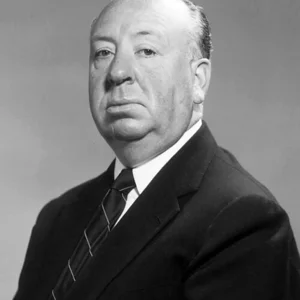

A British filmmaker and naturalized American citizen, Alfred Hitchcock was nicknamed the “master of suspense.” A pioneer of a cinema built on psychological tension and dread, he profoundly reinvented the conventions of the thriller with works such as *Psycho*, *The Birds*, and *Vertigo*.
Alfred Hitchcock(1899 — 1980)
Alfred Hitchcock
États-Unis, Royaume-Uni, Royaume-Uni de Grande-Bretagne et d'Irlande
6 min read
Frequently asked questions
Famous Quotes
« Drama is life with the dull bits cut out.»
« There is no terror in the bang, only in the anticipation of it.»
Key Facts
- Born in 1899 in Leytonstone (London) and died in 1980 in Los Angeles
- Directed *The 39 Steps* (1935), a model of the British spy film
- Moved to Hollywood in 1939; *Rebecca* (1940) won the Academy Award for Best Picture
- Made *Vertigo* (1958) and *North by Northwest* (1959), peaks of his formal mastery
- Directed *Psycho* (1960) and *The Birds* (1963), which left a lasting mark on the cinema of dread
Works & Achievements
A silent film often regarded as the first true “Hitchcock,” centered on a suspect and a serial killer. Several of the themes that would later make him famous already appear in it.
Considered the first fully talking British feature film. In it, Hitchcock experiments with the use of sound to heighten suspense.
A breathless chase involving a man wrongly accused. The film establishes the template of the “innocent man on the run,” a recurring figure in Hitchcock's work.
Hitchcock's first American film, which won the Academy Award for Best Picture. An atmospheric work, haunted by a character we never see.
An immobilized photographer watches his neighbors and believes he is witnessing a crime. The entire film unfolds from a single window, a feat of staging.
A dizzying tale of love and obsession, famous for its “vertigo effect” created in the camera. Often cited among the greatest films of all time.
A low-budget horror film that revolutionized the genre. Its shower scene remains one of the most studied in the history of cinema.
Birds begin attacking the residents of a coastal town, without explanation. The film impresses with its special effects and its pervasive sense of dread.
Anecdotes
Alfred Hitchcock loved to appear for a few seconds in almost all of his films: you can spot him boarding a bus, walking two dogs, or missing a train. These appearances, known as “cameos,” became a game for audiences, who watched for the moment the director would cross the screen.
For the famous shower scene in *Psycho* (1960), Hitchcock filmed for a week and used nearly 70 camera positions for barely 45 seconds of film. Since the film was in black and white, the “blood” running down the bathtub was actually chocolate syrup.
Hitchcock often told a story from his childhood: his father supposedly sent him to the police station with a note, and an officer locked him in a cell for a few minutes to “teach” him what happens to disobedient children. True or exaggerated, this story is said to explain his fascination with fear and guilt.
For *The Birds* (1963), the crew combined mechanical birds, animation, and real trained fowl. During one scene, actress Tippi Hedren was attacked for several days in a row by real birds tied to her clothes, an ordeal she spoke about long afterward.
Despite his immense fame, Hitchcock never won the Oscar for Best Director, although he was nominated five times. He did receive an honorary award in 1968, and was then knighted by the Queen of England a few months before his death, becoming “Sir” Alfred Hitchcock.
Primary Sources
There is a very clear difference between surprise and suspense. The audience is aware that the bomb is there while the characters know nothing about it: in this way the audience takes part in the scene.
For me, the film is finished the moment I have done writing it and breaking it down into shots. The actual shooting bores me a little.
Drama is life with the dull bits cut out.
Key Places
A district in east London where Hitchcock was born in 1899, the son of a greengrocer. A mural there celebrates the area's famous native today.
A Jesuit school where Hitchcock spent part of his education. He often spoke of the strict discipline that prevailed there.
It was in the British studios that Hitchcock learned his craft and made his first silent and then sound films, such as *Blackmail*.
The heart of American cinema where Hitchcock settled in 1939 and shot his masterpieces. He lived there and died there in 1980.
A small coastal town north of San Francisco chosen as the setting for *The Birds*. The location still draws fans of the film today.
Typical Objects

The director's central tool, the camera captures the images. Hitchcock used it with genius to create tension, by precisely choosing what the viewer did or did not see.
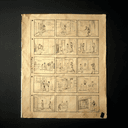
A series of drawings depicting each shot of a scene before filming. Hitchcock mapped out his films in the smallest detail, so much so that he claimed to know the result before even turning on the camera.

A text that describes the action, the dialogue, and the breakdown of a film into shots. For Hitchcock, a successful film rested above all on a solid and meticulously prepared script.

The knife from the shower scene became a symbol of horror cinema. Hitchcock almost never shows the blade touching the body: it is the rapid editing that gives rise to the terror.

A self-portrait sketched in a few strokes that Hitchcock drew himself and that opened his television series. This round, instantly recognizable profile became his visual signature.

A folding seat bearing the name of the director, a symbol of his authority on set. From it Hitchcock directed his crew with legendary calm and precision.
School Curriculum
Vocabulary & Tags
Key Vocabulary
Tags
Daily Life
Morning
Hitchcock began his day with discipline and punctuality, true to his love of order. On set, he arrived prepared down to the smallest detail, having already sketched out everything in advance.
Afternoon
The afternoon was devoted to the meticulous work of directing or to preparing his films, which he broke down shot by shot. He liked to repeat that the real film was made on paper, long before shooting began.
Evening
In the evening, a renowned gourmet, he enjoyed fine dinners accompanied by good wines, often in the company of his wife and collaborator Alma Reville. These refined meals were among his greatest pleasures.
Food
Hitchcock was a discerning gourmet, fond of refined cuisine, meats, cheeses, and great wines. His imposing waistline was in fact part of his public image, which he played up with humor.
Clothing
He was almost always seen wearing a dark suit, white shirt, and tie, whatever the circumstances. This strict and unvarying attire reinforced his serious and recognizable demeanor.
Housing
After settling in the United States, Hitchcock lived comfortably in the Los Angeles area, near Hollywood. He also owned a property in California where he liked to retreat.
Historical Timeline
Period Vocabulary
Liens externes & ressources
Références
Œuvres
Chantage (Blackmail)
1929